The big picture
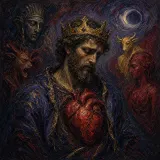
The chapter turns Solomon’s greatest strength, his heart, into the site of his decisive failure. His many marriages lead him after other gods, and the king who built the temple also builds high places for rival worship near Jerusalem. Because the LORD had appeared to Solomon twice and explicitly warned him, the resulting judgment is presented as conscious covenant disobedience rather than ignorance. Most of the kingdom will be torn away after his death, though David’s line and Jerusalem remain protected by earlier promises. The rest of the chapter shows that fracture entering history from several directions. Hadad and Rezon carry unresolved consequences from David’s wars into Solomon’s later years, while Jeroboam rises from within Solomon’s own labor administration. Ahijah’s torn garment gives the coming division a visible sign and offers Jeroboam a conditional promise of an enduring house if he obeys. Solomon instead seeks Jeroboam’s death, driving him into Egyptian refuge. The forty-year reign closes without repairing the announced breach, leaving Rehoboam to inherit a kingdom whose splendor remains intact on the surface and whose unity has already been sentenced.
In this chapter
- The Builder Provides Places for Other Gods 1 Kings 11:1-8
The Book of 1 Kings returns to the verb “loved,” and the change in its object tells the tragedy.
- Judgment Remembers Both Warning and Promise 1 Kings 11:9-13
Solomon’s apostasy is judged as disobedience committed with unusually clear knowledge.
- Hadad Carries an Earlier War Into Solomon’s Peace 1 Kings 11:14-22
Hadad’s opposition reaches backward into David’s wars before it reaches Solomon’s throne.
- Pressure from Damascus and from the Workforce 1 Kings 11:23-28
Pressure gathers both outside Solomon’s borders and inside his administration.
- A New Garment, Twelve Pieces, a Conditional Future 1 Kings 11:29-39
Ahijah turns a new garment into a kingdom that cannot stay whole.
- Egypt Shelters the Man Solomon Would Kill 1 Kings 11:40-43
Solomon ends the episode by trying to kill Jeroboam.

Scripture beside the summary
1 Kings · King James Version · 431 Kings 11:1-8
The Builder Provides Places for Other Gods
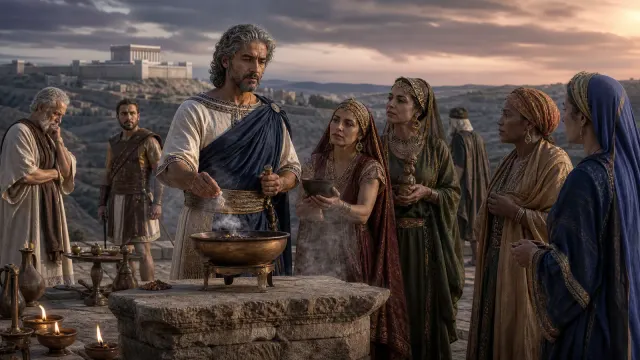
The Book of 1 Kings returns to the verb “loved,” and the change in its object tells the tragedy. Solomon once loved the LORD; now he loves many foreign women and clings to them despite a warning that such unions would turn his heart after other gods. The issue is not foreign birth in isolation. Chapter 8 already welcomed the foreigner who came seeking the LORD. Here the stated consequence is religious allegiance. Solomon’s wives turn his heart, and the king who prayed for undivided hearts no longer has one. The scale of his marriages is enormous, but the book’s decisive evaluation is not arithmetic. It is that he goes after other gods and no longer follows the LORD fully. Then the inward turning becomes architecture. Solomon builds high places for Chemosh and Molech and provides for the worship of his wives. The great builder has not lost his ability to create sacred space. He has lost the exclusivity of the allegiance that was supposed to govern what he built.
Deep dive
The opening deliberately returns to love. Chapter 3 said Solomon loved the LORD; this chapter says he loved many foreign women and clung to them in love. The issue is then stated as the turning of his heart after their gods. The women’s foreignness matters within that named religious consequence, not as a free-standing claim that every foreign person is unfaithful. The prayer for the stranger in chapter 8 has already prevented that simplification.
The numbers are immense, but the decisive evaluation concerns allegiance. Solomon’s heart is no longer whole toward the LORD as David’s had been. This comparison does not erase David’s grave sins, which 15:5 will explicitly qualify by naming Uriah. Here the contrast concerns following other gods. The account directly says Solomon did evil; no additional denunciation is needed to sharpen its judgment.
Construction now gives the inward turning an outward form. The king who built the LORD’s house builds high places for Chemosh and Molech and provides for the worship of his wives. His skill at completing religious buildings has not changed; the object of his support has. The hill before Jerusalem places these new sites within the setting of the capital whose temple dedication insisted on wholehearted allegiance.
Words to trace: Solomon, heart, LORD, wives, abomination, gods
Verse-by-verse path
- 1 Kings 11:1
“Strange” means foreign, nokriyyot, the feminine of the nokri whose prayers Solomon welcomed in 8:41. The nations named are neighbours David had fought, so the marriages sealed treaties. Rehoboam’s mother was Naamah, an Ammonite (14:21), and he was forty one at his accession, so that match was made before Solomon was king.
- 1 Kings 11:2
The prohibition quotes Deuteronomy 7:3–4 and Exodus 34:16. “Clave” is dabaq, the verb of a man cleaving to his wife in Genesis 2:24 and of Israel cleaving to the LORD in Deuteronomy 10:20. Solomon clings with the very verb his loyalty belonged to.
- 1 Kings 11:3
“Princesses” means women of royal birth, diplomatic brides from foreign courts. Song of Songs 6:8 speaks of sixty queens and eighty concubines, a smaller court than this one. The line ends bluntly: the wives turned his heart.
- 1 Kings 11:4
“When Solomon was old” echoes the opening of the book, where David in old age is managed by others (1:1). The turning came late in a forty year reign, after the temple and the prayer, not in a young king’s ignorance.
- 1 Kings 11:5
Ashtoreth is Astarte, the Canaanite goddess, her name probably given the vowels of boshet, “shame”, by Hebrew scribes. Milcom, “their king”, was the national god of Ammon. “Abomination” is shiqquts, a detestable thing, a deliberately contemptuous term.
- 1 Kings 11:6
“Went not fully after” is literally “did not fill after”, the idiom used of Caleb, who “followed the LORD fully” (Numbers 14:24, Joshua 14:8). Caleb is the model of wholehearted following; Solomon falls short of it.
- 1 Kings 11:7
The hill before Jerusalem is the Mount of Olives, east of the city across the Kidron. Chemosh is the god named on the Moabite Stone of King Mesha. These shrines stood for three centuries until Josiah defiled them, on what 2 Kings 23:13 calls the mount of corruption.
- 1 Kings 11:8
The Hebrew participles describe a continuing practice: the wives kept on burning incense and sacrificing, and Solomon kept providing the places. Each foreign bride brought her gods, and each god got a shrine.
1 Kings 11:1-8
King James Version1But king Solomon loved many strange women, together with the daughter of Pharaoh, women of the Moabites, Ammonites, Edomites, Zidonians, and Hittites;
2Of the nations concerning which the LORD said unto the children of Israel, Ye shall not go in to them, neither shall they come in unto you: for surely they will turn away your heart after their gods: Solomon clave unto these in love.
3And he had seven hundred wives, princesses, and three hundred concubines: and his wives turned away his heart.
4For it came to pass, when Solomon was old, that his wives turned away his heart after other gods: and his heart was not perfect with the LORD his God, as was the heart of David his father.
5For Solomon went after Ashtoreth the goddess of the Zidonians, and after Milcom the abomination of the Ammonites.
6And Solomon did evil in the sight of the LORD, and went not fully after the LORD, as did David his father.
7Then did Solomon build an high place for Chemosh, the abomination of Moab, in the hill that is before Jerusalem, and for Molech, the abomination of the children of Ammon.
8And likewise did he for all his strange wives, which burnt incense and sacrificed unto their gods.
1 Kings 11:9-13
Judgment Remembers Both Warning and Promise
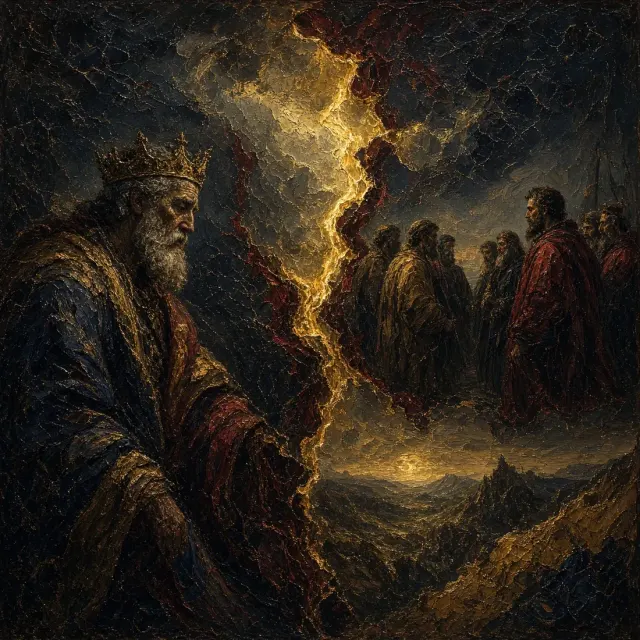
Solomon’s apostasy is judged as disobedience committed with unusually clear knowledge. The LORD had appeared to him twice and had specifically warned him against following other gods. The Book of 1 Kings therefore leaves little room for explaining the failure as confusion about an obscure requirement. Solomon knew the covenantal boundary and crossed it. The announced consequence is the tearing of the kingdom and the transfer of most of it to a servant. Yet even this judgment is limited by earlier promises. It will not happen during Solomon’s lifetime, and it will not remove everything from his son. David and Jerusalem are named as reasons a remnant remains. The restraint does not excuse Solomon. It shows that divine judgment and divine promise are operating at the same time. The king’s disobedience has real political consequences, but those consequences do not erase what God had already pledged concerning David and the chosen city. The kingdom will break, though not into total abandonment.
Deep dive
Solomon’s failure is measured against knowledge already given. The LORD had appeared twice and had specifically commanded him not to follow other gods. The account therefore does not explain the apostasy as an innocent misunderstanding of an obscure requirement. The turned heart follows a clearly stated warning, and the judgment names the covenant and statutes Solomon has not kept.
The sentence has limits as well as force. It will not be carried out during Solomon’s life, and it will not remove the whole kingdom from his son. David and the chosen Jerusalem are named as reasons for that restraint. These qualifications do not amount to approval of Solomon’s conduct. They show the earlier promise continuing to shape what judgment will and will not do. The kingdom will be given to a servant, reversing the expected movement of authority within the royal house. The rest of the chapter begins identifying the people through whom that announced fracture enters history.
Words to trace: LORD, commanded, rend, sake, David, kept
Verse-by-verse path
- 1 Kings 11:9
This is the first time in the Book of 1 Kings that the LORD is said to be angry with anyone. Ten chapters of favour, building and blessing pass before the word appears, and it is aimed at the king who built the temple.
- 1 Kings 11:10
“Kept not” is shamar, the verb of David’s deathbed charge: “keep the charge of the LORD thy God” (2:3). The indictment reads like a court record: a command given, a command broken.
- 1 Kings 11:11
“Rend” is qara‘, the verb Samuel used when Saul tore his robe: “The LORD hath rent the kingdom of Israel from thee this day” (1 Samuel 15:28). The same sentence that ended the first king’s house now falls on the third. “Servant” here means a royal official.
- 1 Kings 11:12
Judgment is postponed a generation for David’s sake. The book will do the same with Ahab after he humbles himself: the evil will come “in his son’s days” (21:29). Delay is mercy to the father and no mercy to the son.
- 1 Kings 11:13
Jerusalem itself lay inside Benjamin’s allotment (Joshua 18:28), on the border with Judah. The city chosen for the name is kept with the house of David, and 12:21 shows Benjamin going with Judah.
1 Kings 11:9-13
King James Version9And the LORD was angry with Solomon, because his heart was turned from the LORD God of Israel, which had appeared unto him twice,
10And had commanded him concerning this thing, that he should not go after other gods: but he kept not that which the LORD commanded.
11Wherefore the LORD said unto Solomon, Forasmuch as this is done of thee, and thou hast not kept my covenant and my statutes, which I have commanded thee, I will surely rend the kingdom from thee, and will give it to thy servant.
12Notwithstanding in thy days I will not do it for David thy father’s sake: but I will rend it out of the hand of thy son.
13Howbeit I will not rend away all the kingdom; but will give one tribe to thy son for David my servant’s sake, and for Jerusalem’s sake which I have chosen.
1 Kings 11:14-22
Hadad Carries an Earlier War Into Solomon’s Peace
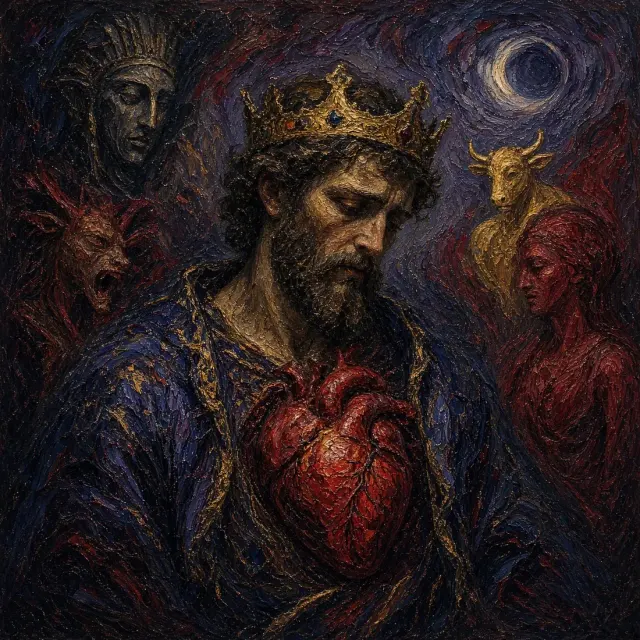
Hadad’s opposition reaches backward into David’s wars before it reaches Solomon’s throne. He is introduced as an adversary raised up by the LORD, then the Book of 1 Kings explains that he survived Joab’s devastation of Edom as a child from the royal line. That history gives the later hostility a human memory. Solomon’s celebrated peace now looks different when seen through a survivor whose family and country were shattered before Solomon ever reigned. Egypt gives Hadad almost everything a displaced prince could need: house, food, land, marriage into Pharaoh’s family, and a son raised in the royal household. Yet when David and Joab are dead, material security does not persuade him to remain. Pharaoh asks what he lacks, and Hadad answers, in effect, nothing. He still wants to go home. The account does not have to invent a speech about revenge to make the pull clear. Comfort in Egypt cannot erase Edom, and the old war has produced a living consequence for Solomon’s peace.
Deep dive
The introduction says the LORD raised an adversary, then reaches backward to explain who that adversary is. Hadad was a child from Edom’s royal line when he escaped Joab’s campaign. His survival gives a human history to the later opposition. The peace celebrated elsewhere in Solomon’s reign is viewed here from a family displaced by the wars that preceded it.
Egypt supplies Hadad with a house, food, land, and a marriage into Pharaoh’s household. His son is raised among Pharaoh’s sons. When news arrives that David and Joab are dead, Hadad nevertheless asks to leave. Pharaoh can identify no material lack, and Hadad concedes none. The exchange makes the insufficiency of comfort visible without disclosing every private motive. He wants his own country. The chapter’s placement of this earlier history under the heading of divine opposition does not make every event begin after Solomon’s apostasy; the flashback explicitly reaches into David’s reign.
Words to trace: Hadad, Pharaoh, Edom, Egypt, gave, Joab
Verse-by-verse path
- 1 Kings 11:14
“Adversary” is satan, the ordinary Hebrew word for an opponent. In 5:4 Solomon told Hiram he had “neither adversary nor evil occurrent”, using the same word. Now the LORD raises one.
- 1 Kings 11:15
David’s war in Edom appears in 2 Samuel 8:13–14, and the heading of Psalm 60 credits Joab with twelve thousand Edomites slain in the Valley of Salt. Joab stayed to bury Israel’s dead, which is how the killing stretched out.
- 1 Kings 11:16
Six months of systematic killing is a long occupation. “Every male” is a claim the next verse immediately qualifies, since at least one royal child escaped, and Edom would have kings again.
- 1 Kings 11:17
“A little child” is na‘ar qatan, the phrase Solomon used of himself at Gibeon: “I am but a little child” (3:7). Two royal boys, one who inherited a kingdom and one who fled from the wreck of his.
- 1 Kings 11:18
Midian lay east of the Gulf of Aqaba, Paran in the Sinai wilderness. The refugees cross the ground of Israel’s wilderness years in the other direction, down into Egypt, where Pharaoh gives them house, bread and land.
- 1 Kings 11:19
Tahpenes is not known from Egyptian records. Her name may be an Egyptian title, “the king’s wife”, rather than a personal name. Marrying Hadad to a queen’s sister bound a future Edomite king to the Egyptian court.
- 1 Kings 11:20
Weaning in the ancient world came around the age of two or three and was marked by a feast (Genesis 21:8). Genubath grew up among Pharaoh’s sons, as Moses had, an outsider raised inside Egypt’s royal house.
- 1 Kings 11:21
Hadad waits for two deaths, not one. David ordered the Edom campaign, but Joab carried it out, and the exile does not move until both men are gone.
- 1 Kings 11:22
Hadad’s answer is one Hebrew word, lo’, “no”, and then a doubled verb, “sending, send me”. A foreigner asking Pharaoh to let him leave Egypt reverses the plea of Exodus, though the book does not draw the comparison itself.
1 Kings 11:14-22
King James Version14And the LORD stirred up an adversary unto Solomon, Hadad the Edomite: he was of the king’s seed in Edom.
15For it came to pass, when David was in Edom, and Joab the captain of the host was gone up to bury the slain, after he had smitten every male in Edom;
16(For six months did Joab remain there with all Israel, until he had cut off every male in Edom:)
17That Hadad fled, he and certain Edomites of his father’s servants with him, to go into Egypt; Hadad being yet a little child.
18And they arose out of Midian, and came to Paran: and they took men with them out of Paran, and they came to Egypt, unto Pharaoh king of Egypt; which gave him an house, and appointed him victuals, and gave him land.
19And Hadad found great favour in the sight of Pharaoh, so that he gave him to wife the sister of his own wife, the sister of Tahpenes the queen.
20And the sister of Tahpenes bare him Genubath his son, whom Tahpenes weaned in Pharaoh’s house: and Genubath was in Pharaoh’s household among the sons of Pharaoh.
21And when Hadad heard in Egypt that David slept with his fathers, and that Joab the captain of the host was dead, Hadad said to Pharaoh, Let me depart, that I may go to mine own country.
22Then Pharaoh said unto him, But what hast thou lacked with me, that, behold, thou seekest to go to thine own country? And he answered, Nothing: howbeit let me go in any wise.
1 Kings 11:23-28
Pressure from Damascus and from the Workforce
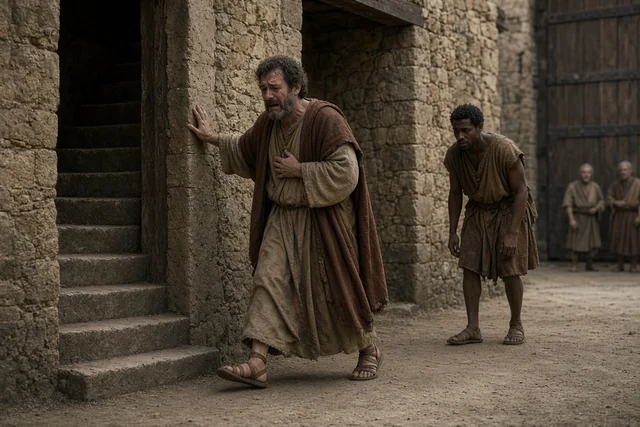
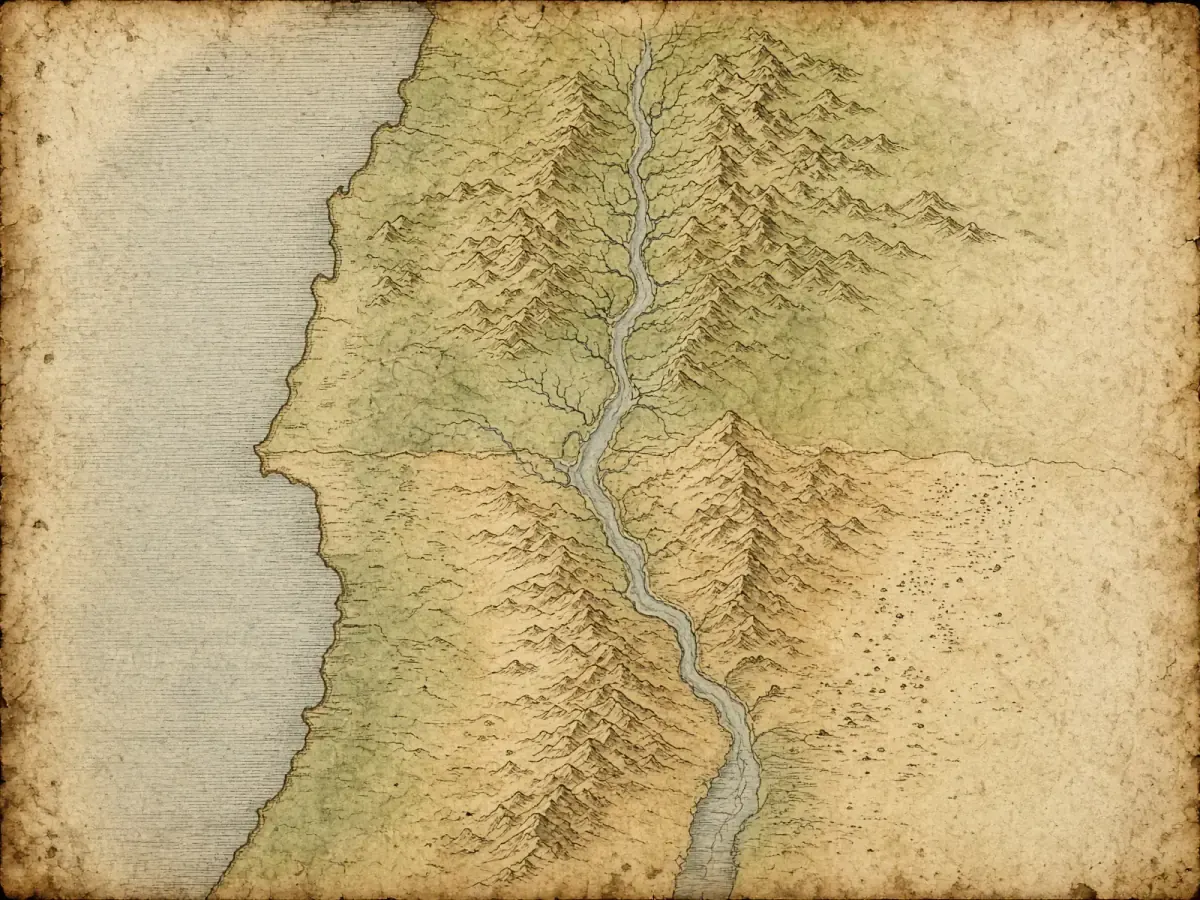
Pressure gathers both outside Solomon’s borders and inside his administration. Rezon, another survivor of conflict from David’s era, establishes himself in Damascus and becomes a persistent adversary. His presence complicates broad descriptions of Solomon’s peace without simply canceling them; a reign can be generally secure and still contain enduring hostility. Then Jeroboam appears from within the king’s own system. Solomon recognizes him as capable and industrious and gives him authority over the labor of the house of Joseph. The future rival is therefore not an unknown outsider who suddenly materializes against the crown. His rise is partly a consequence of Solomon’s own judgment about talent. Even the immediate setting, work on Millo and the city of David, ties him to the building machine that has defined so much of the reign. The king’s administrative success has placed responsibility in the hands of the man who will soon receive ten pieces of a torn garment. Opposition is now developing through structures Solomon himself helped create.
Deep dive
Rezon, like Hadad, emerges from the aftermath of David’s wars. He gathers a band, takes a position in Damascus, and becomes an enduring adversary. The statement that his hostility lasted through Solomon’s days complicates any reading of the earlier peace descriptions as an exhaustive day-by-day claim that no opposition existed anywhere. The Book of 1 Kings can summarize the reign’s prosperity and then disclose the persistent pressures within it.
Jeroboam’s introduction moves the danger inside Solomon’s own system. The king recognizes his industry and gives him charge over the labor of the house of Joseph. The building work at Millo and the repairs in the city of David provide the immediate setting. The future rival is therefore neither an anonymous outsider nor a man wholly overlooked by Solomon. His administrative authority comes from the king whose rule he will oppose. The passage identifies his capability and promotion before the prophetic encounter explains his larger role.
Words to trace: king, Solomon, adversary, Damascus, David, hand
Verse-by-verse path
- 1 Kings 11:23
Hadadezer of Zobah, an Aramean kingdom north of Damascus, was defeated by David in 2 Samuel 8:3–8. Rezon deserted his own master in the collapse and built something for himself from the wreckage.
- 1 Kings 11:24
“A band” is gedud, a raiding troop, the kind of outlaw company David himself had led when fleeing Saul (1 Samuel 22:2). Damascus becomes the seat of the Aramean kingdom whose kings, the Ben-hadads, will trouble Israel through the rest of the book.
- 1 Kings 11:25
“Syria” is Aram in Hebrew. The Hebrew letters for Aram and Edom differ only by resh and daleth, which look alike, and the Greek applies the last clause to Hadad reigning in Edom. The two adversaries are easily confused on the page.
- 1 Kings 11:26
“Ephrathite” here means Ephraimite. His mother’s name Zeruah means “leprous”, possibly a slur preserved by his enemies, and some Greek manuscripts call her a harlot. Like Hiram the craftsman (7:14), he is a widow’s son.
- 1 Kings 11:27
“Repaired the breaches” is literally “closed the breach” in the wall of the city of David. The verse promises the cause of the rebellion and gives only its setting: a building site, with a breach closed in the wall while one opens in the kingdom.
- 1 Kings 11:28
“Mighty man of valour”, gibbor chayil, is Gideon’s title (Judges 6:12). The house of Joseph is Ephraim and Manasseh, Jeroboam’s own people. Solomon put him in charge of his own tribe’s forced labour, the people most likely to resent it.
1 Kings 11:23-28
King James Version23And God stirred him up another adversary, Rezon the son of Eliadah, which fled from his lord Hadadezer king of Zobah:
24And he gathered men unto him, and became captain over a band, when David slew them of Zobah: and they went to Damascus, and dwelt therein, and reigned in Damascus.
25And he was an adversary to Israel all the days of Solomon, beside the mischief that Hadad did: and he abhorred Israel, and reigned over Syria.
26And Jeroboam the son of Nebat, an Ephrathite of Zereda, Solomon’s servant, whose mother’s name was Zeruah, a widow woman, even he lifted up his hand against the king.
27And this was the cause that he lifted up his hand against the king: Solomon built Millo, and repaired the breaches of the city of David his father.
28And the man Jeroboam was a mighty man of valour: and Solomon seeing the young man that he was industrious, he made him ruler over all the charge of the house of Joseph.
1 Kings 11:29-39
A New Garment, Twelve Pieces, a Conditional Future
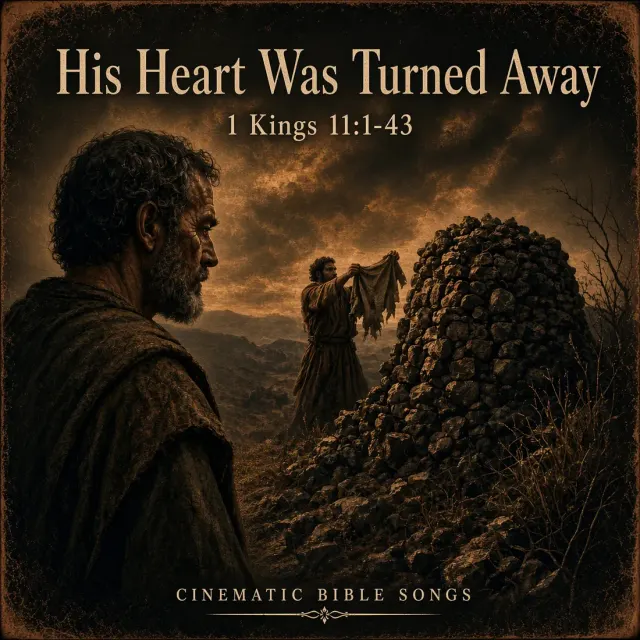
Ahijah turns a new garment into a kingdom that cannot stay whole. Alone with Jeroboam outside Jerusalem, the prophet tears the cloth into twelve pieces and gives ten away. The action is dramatic, but its meaning is not left open for political spin. Ahijah explains the division as judgment for abandoning the LORD and worshiping other gods. At the same time, the speech preserves a continuing place for David’s line and Jerusalem, which is why the pieces should not be forced into a simplistic tribal census. The prophecy is about two realms and a preserved Davidic light, not about solving every later border question in advance. Most strikingly, Jeroboam receives more than an opportunity. He receives a conditional promise resembling David’s: if he listens, walks rightly, and keeps the commandments, God will be with him and build him a sure house. His future security does not require religious improvisation. Chapter 12 will make his decision to create alternative worship sites all the more revealing because a different foundation had already been offered.
Deep dive
The encounter occurs away from the capital with only the prophet and Jeroboam present. A new garment becomes a visible picture of a kingdom not meant to remain intact. Ahijah gives ten pieces to Jeroboam and explains the division through the abandonment of the LORD. The act is not an invitation for Jeroboam to supply whatever explanation best serves him; the prophetic speech fixes its meaning.
The promise to preserve one tribe for David’s successor sits beside the twelve-piece sign. The chapter is describing two realms around Jeroboam and the Davidic house rather than providing a tidy census of every tribe’s later alignment. Chapter 12 will mention Benjamin alongside Judah. The phrasing preserves a continuing light for David in Jerusalem while announcing the loss of most of the kingdom.
Jeroboam receives a strikingly substantial offer: divine presence and an enduring house comparable to the one established for David. The condition is equally substantial. He must listen, walk rightly, and keep the commandments. Northern kingship does not require him to invent an alternative worship system in order to survive. Chapter 12’s calculations about losing the people to Jerusalem will stand in direct tension with this offered basis for security. The closing limitation on David’s affliction also prevents the tearing of the garment from becoming a declaration that the Davidic line has no future.
Words to trace: David, Israel, hand, kingdom, sake, servant
Verse-by-verse path
- 1 Kings 11:29
Shiloh was where the tabernacle stood in Eli’s day. Solomon had banished Abiathar, Eli’s descendant, from the priesthood (2:27), and now a prophet from Shiloh announces the loss of Solomon’s kingdom. The clothing belongs to Ahijah, the likeliest reading of the Hebrew.
- 1 Kings 11:30
“Garment” is salmah, a word that sounds close to Shelomoh, Solomon; scholars have long noted the play. The garment is new, never worn thin, and still it is torn apart.
- 1 Kings 11:31
“Take thee” makes Jeroboam an active party: he has to pick up the pieces. From here on, “Israel” will increasingly mean the ten northern tribes, while the south is called Judah.
- 1 Kings 11:32
Ten and one make eleven, leaving a piece unaccounted for, and some Greek manuscripts read “two sceptres” here. The King James sets the verse in brackets, an aside inside the oracle protecting David’s house before the reasons are even given.
- 1 Kings 11:33
The Hebrew verbs are plural, “they have forsaken”, while the Greek and Syriac read “he”, Solomon. The same three deities of verses 5 and 7 are now called “god” and “goddess” rather than “abomination”, in the flatter language of an indictment.
- 1 Kings 11:34
“Prince” is nasi’, a leader’s title lower than king. Solomon keeps his royal seat for life, but the oracle describes his remaining years in reduced terms, held for another man’s sake.
- 1 Kings 11:35
It will happen fast. Rehoboam loses the ten tribes at Shechem within days of claiming them (12:16), in the very assembly called to crown him.
- 1 Kings 11:36
“Light” is nir, a lamp. A lamp still burning in a house meant the household still lived, and David’s men called him “the light of Israel” (2 Samuel 21:17). The phrase returns in 15:4 and 2 Kings 8:19 as the reason Judah survives bad kings.
- 1 Kings 11:37
“According to all that thy soul desireth” suggests Jeroboam already wanted a throne. Abner used almost the same words to David (2 Samuel 3:21): a promise that a man’s ambition would be met.
- 1 Kings 11:38
The promise is of a “sure house”, bayit ne’eman, the same terms as David’s in 2 Samuel 7:16. But Jeroboam’s lacks the words “for ever”, which David’s repeated again and again; this dynasty is conditional from the start.
- 1 Kings 11:39
“Afflict” is ‘anah, to humble or bring low, the verb used of Egypt afflicting Israel (Exodus 1:11). The last words set a term on the humbling, and the book will hold David’s line to that promise through many reigns.
1 Kings 11:29-39
King James Version29And it came to pass at that time when Jeroboam went out of Jerusalem, that the prophet Ahijah the Shilonite found him in the way; and he had clad himself with a new garment; and they two were alone in the field:
30And Ahijah caught the new garment that was on him, and rent it in twelve pieces:
31And he said to Jeroboam, Take thee ten pieces: for thus saith the LORD, the God of Israel, Behold, I will rend the kingdom out of the hand of Solomon, and will give ten tribes to thee:
32(But he shall have one tribe for my servant David’s sake, and for Jerusalem’s sake, the city which I have chosen out of all the tribes of Israel:)
33Because that they have forsaken me, and have worshipped Ashtoreth the goddess of the Zidonians, Chemosh the god of the Moabites, and Milcom the god of the children of Ammon, and have not walked in my ways, to do that which is right in mine eyes, and to keep my statutes and my judgments, as did David his father.
34Howbeit I will not take the whole kingdom out of his hand: but I will make him prince all the days of his life for David my servant’s sake, whom I chose, because he kept my commandments and my statutes:
35But I will take the kingdom out of his son’s hand, and will give it unto thee, even ten tribes.
36And unto his son will I give one tribe, that David my servant may have a light alway before me in Jerusalem, the city which I have chosen me to put my name there.
37And I will take thee, and thou shalt reign according to all that thy soul desireth, and shalt be king over Israel.
38And it shall be, if thou wilt hearken unto all that I command thee, and wilt walk in my ways, and do that is right in my sight, to keep my statutes and my commandments, as David my servant did; that I will be with thee, and build thee a sure house, as I built for David, and will give Israel unto thee.
39And I will for this afflict the seed of David, but not for ever.
1 Kings 11:40-43
Egypt Shelters the Man Solomon Would Kill
Solomon ends the episode by trying to kill Jeroboam. The Book of 1 Kings does not record how the king learned enough about the threat to act, so no secret council or intercepted prophecy needs to be invented. What it does record is a striking reversal in the geography of Solomon’s reign. Egypt, once the source of a prestigious marriage alliance, now shelters the servant who will receive most of the kingdom. Jeroboam remains with Shishak until Solomon dies. Then the book closes the reign in familiar royal form: other acts and wisdom are referred to another record, forty years of rule are noted, Solomon dies, and Rehoboam succeeds him. There is no final repentance scene supplied to soften chapter 11, and none should be manufactured. The king remembered for extraordinary wisdom leaves his son a throne already under judgment. Rehoboam inherits wealth, institutions, building projects, labor burdens, foreign pressures, and a prophetic announcement that the kingdom will not remain intact.
Deep dive
Solomon’s response to the emerging rival is an attempt to kill him. The king who received the gift of a listening heart is not here described as listening to the implication of Ahijah’s word. The text does not report the conversation by which Solomon learned of it, and there is no need to invent one. Jeroboam survives by leaving the kingdom.
Egypt, once the source of a marriage alliance enhancing Solomon’s standing, now shelters the servant who will take much of his realm. The Book of 1 Kings names Shishak and lets Jeroboam remain there until Solomon’s death. The closing notice preserves the reign’s forty years and its wisdom while refusing to provide an unrecorded final repentance. Rehoboam takes the throne, but the succession does not restore an untouched starting point. He inherits the burdens, the religious failures, and the announced consequences accumulated under his father.
Words to trace: Solomon, Egypt, acts, Jeroboam, reigned, arose
Verse-by-verse path
- 1 Kings 11:40
Shishak is Sheshonq I, founder of Egypt’s Twenty Second Dynasty and the first pharaoh in the Bible who can be named and dated from Egyptian records. A new dynasty explains why Egypt now shelters Solomon’s enemies instead of sending him brides.
- 1 Kings 11:41
“The book of the acts of Solomon” is the first source the Book of 1 Kings cites, and the only one named for a single king. Later reigns refer to the chronicles of the kings of Israel or of Judah. None of these works survives.
- 1 Kings 11:42
Forty years matches David’s reign (2:11) and the round figure for a generation. On the usual chronology it runs from about 970 to 930 BC.
- 1 Kings 11:43
“Slept with his fathers” is the book’s formula for a death in peace. Rehoboam’s name probably means “the people is enlarged”; he will preside over its shrinking to a single tribe and a half.
1 Kings 11:40-43
King James Version40Solomon sought therefore to kill Jeroboam. And Jeroboam arose, and fled into Egypt, unto Shishak king of Egypt, and was in Egypt until the death of Solomon.
41And the rest of the acts of Solomon, and all that he did, and his wisdom, are they not written in the book of the acts of Solomon?
42And the time that Solomon reigned in Jerusalem over all Israel was forty years.
43And Solomon slept with his fathers, and was buried in the city of David his father: and Rehoboam his son reigned in his stead.
Questions to keep in mind while reading
- Track who acts, who speaks, who is affected, and what changes.
- Notice repeated promises, failures, rescues, and consequences.
- Do not assume the account approves every action that is reported.
Text first
Where readers differ
The chapter summary begins with what the passage says and how its parts fit together. It does not assume one denomination has already settled every question. Where a conclusion depends on a tradition, literary theory, or historical reconstruction, that dependence is named openly.
The KJV text is presented first. Interpretive conclusions are labeled, and differences are introduced only when they help a reader understand why serious communities do not always reach the same answer.
Comparative interpretive notes for this chapter are in preparation. Until reviewed notes are ready, this page separates the KJV text from summary and application without claiming that serious readers agree on every question.
Questions beneath the surface
- What account of God, human freedom, responsibility, and the good life emerges from 1 Kings 11?
- Which tension does the chapter refuse to resolve quickly?
- What changes when the chapter is read as part of the whole canon rather than as an isolated moral lesson?
- Where might a sincere reader confuse a familiar tradition with something the text states directly?
Questions for serious personal contemplation
These open-ended questions make room for tension, honest response, prayer, and conclusions that remain accountable to the chapter.
Observe without rushing
What part of 1 Kings 11 makes you stop, feel unsettled, or feel surprised, and why?
Which detail in the passage would be easiest to overlook? How does that detail change your understanding?
Where do you see tension between what happens and this focus: Solomon’s divided devotion as foreign shrines rise and adversaries emerge?
What important question does the passage leave open instead of resolving quickly?
Examine your inner life honestly
Which person, response, fear, or desire in the passage feels most like your own life right now?
What assumption about God, other people, or yourself does this text challenge?
Which part would you rather soften, avoid, or explain away too quickly? What might that reaction reveal?
If this Scripture could ask you one direct question, what do you think it would ask?
Respond with wisdom and courage
What do you need to remember, confess, grieve, thank God for, or trust after reading this passage?
How might another faithful person read this situation differently without ignoring the text?
What obedient response would be costly, uncomfortable, or slow, yet still faithful to Scripture?
What question will you carry into prayer this week, and which verses will you keep in front of you?
Music and video connected to the passage
Related media appears when its Scripture reference overlaps this study. Music and video can illuminate a theme while the biblical text remains the foundation.