
The big picture
Antioch becomes a sending church by listening before it sends. Barnabas and Saul are already serving among a varied group of prophets and teachers when the Holy Ghost separates them for work, and the congregation answers with fasting, prayer, and laying on of hands. Cyprus immediately shows that the work will involve both hearing and obstruction. Sergius Paulus wants the word of God; Elymas tries to turn him away and receives a temporary blindness that oddly echoes Saul's own earlier dependence. From there Paul moves to Pisidian Antioch, where a synagogue invitation becomes a sweeping argument that Israel's history has been carrying a promise toward Jesus. David dies and sees corruption; the promised heir is raised and does not. The speech reaches its point in forgiveness and justification through him, then meets sharply divided responses. The next sabbath brings a larger crowd, opposition, and an explicit turn toward the Gentiles through Isaiah's language of light reaching the ends of the earth. Expulsion moves the messengers on, but not the word.
In this chapter
- A Sending Church Listens Before It Sends Acts 13:1-3
The missionary movement begins inside worship, fasting, and a leadership group broad enough that Barnabas and Saul are only two names among several.
- A Man Who Resists the Light Must Be Led by the Hand Acts 13:4-12
Cyprus brings the missionaries into a contest over whether a man who wants to hear the word of God will be allowed to hear it clearly.
- Israel’s History Has a Direction Acts 13:13-25
John Mark leaves the company at Perga, and the Book of Acts gives no reason in this chapter.
- The Promised Heir Does Not Remain in the Grave Acts 13:26-37
Paul's argument turns on a severe irony.
- The Argument Reaches Its Offer and Its Warning Acts 13:38-43
After a long sweep through Israel's history and Scripture, Paul reaches the point with remarkable directness: forgiveness of sins is preached “through this man.” The benefit cannot be detached from the risen Jesus just proclaimed.
- The Light Is Not Confined to One Audience Acts 13:44-52
The next sabbath nearly the whole city gathers, and the size of the audience brings a conflict into the open.


Scripture beside the summary
Acts · King James Version · 52Acts 13:1-3
A Sending Church Listens Before It Sends
The missionary movement begins inside worship, fasting, and a leadership group broad enough that Barnabas and Saul are only two names among several. Simeon called Niger, Lucius of Cyrene, Manaen with his connection to Herod's household, Barnabas, and Saul are presented as prophets and teachers serving together. The Book of Acts gives enough detail to make them distinct people without inviting unsupported biographies. In that setting the Holy Ghost says, “Separate me Barnabas and Saul for the work whereunto I have called them.” The wording places the call before the congregation's commissioning. Fasting, prayer, and the laying on of hands recognize and release what the Spirit has already claimed rather than creating a mission from human ambition. The church is active without pretending to be the ultimate source. The next verse will even call Barnabas and Saul sent by the Holy Ghost. Divine initiative and deliberate communal participation are allowed to stand together, neither canceling the other.

Deep dive
The list of prophets and teachers places Barnabas and Saul within a company rather than above a congregation serving merely as their departure lounge. Lucius is identified with Cyrene, Manaen with Herod's household connection, and Simeon with the surname Niger. These are distinct people with distinct associations. Acts supplies enough to show a varied leadership, not enough to reconstruct every man's ancestry or earlier life.
The Spirit names both the workers and the claim upon them: the work is one to which he has already called them. The congregation's laying on of hands acknowledges and commissions that calling; it does not manufacture it. Fasting and prayer surround both the command and the departure. The next verse will describe these same men as sent by the Holy Ghost, holding divine initiative and the church's deliberate participation together without treating them as competing explanations.
Words to trace: Barnabas, fasted, Saul, Antioch, certain, church
Verse-by-verse path
- Acts 13:1
Niger is Latin for black, a nickname that may point to African origin; linking him with Simon of Cyrene (Mark 15:21) is a guess. Manaen is Menahem, “comforter”. “Brought up with” is suntrophos, a foster brother or companion raised at court, so he grew up beside Herod Antipas, the tetrarch who beheaded John the Baptist.
- Acts 13:2
“Ministered” is leitourgeo, the word for priestly service in the temple, used of Zechariah’s course of duty (Luke 1:23) and the root of the English liturgy. “Separate” is aphorizo, the verb Paul later uses of himself: “separated unto the gospel of God” (Romans 1:1), set apart “from my mother’s womb” (Galatians 1:15).
- Acts 13:3
A second fast, now with prayer, follows the command; the church does not hurry. “Sent them away” is apoluo, to release or let go, a softer word than the Spirit’s “sent forth” in the next verse. When they return in 14:26, Antioch is described as the place “from whence they had been recommended to the grace of God”.
Acts 13:1-3
King James Version1Now there were in the church that was at Antioch certain prophets and teachers; as Barnabas, and Simeon that was called Niger, and Lucius of Cyrene, and Manaen, which had been brought up with Herod the tetrarch, and Saul.
2As they ministered to the Lord, and fasted, the Holy Ghost said, Separate me Barnabas and Saul for the work whereunto I have called them.
3And when they had fasted and prayed, and laid their hands on them, they sent them away.
Acts 13:4-12
A Man Who Resists the Light Must Be Led by the Hand
Cyprus brings the missionaries into a contest over whether a man who wants to hear the word of God will be allowed to hear it clearly. Sergius Paulus is introduced as prudent and curious enough to summon Barnabas and Saul. Elymas stands in the way, trying to turn the deputy from the faith. Paul's rebuke therefore is not a random display of spiritual force against a rival performer. It answers an attempt to obstruct another person's hearing. Here Saul is also identified as Paul, without the Book of Acts claiming that Jesus renamed him on the Damascus road. The temporary blindness pronounced on Elymas is especially striking because it echoes Paul's own earlier condition. Another opponent of the message now gropes for someone to lead him by the hand. The parallel stops there; the account gives Elymas no conversion or restoration. When Sergius Paulus believes, his astonishment is connected to “the doctrine of the Lord.” The sign exposes the obstruction, but the teaching remains the point toward which the episode turns.
Deep dive
The opposition is sharply personal: Sergius Paulus has summoned Barnabas and Saul because he desires to hear God's word, and Elymas attempts to interfere with that hearing. The deputy's request and the sorcerer's obstruction explain the confrontation. Paul's rebuke concerns the perversion of the Lord's ways, not a contest staged to determine which traveling wonder-worker deserves top billing.
Here Acts identifies Saul as also called Paul. It does not describe Jesus giving him a new name on the Damascus road. The naming occurs within the Cyprus mission, and Paul becomes the usual name thereafter. Elymas's sudden darkness also recalls Saul's own earlier blindness: another opponent now seeks someone to lead him by the hand. The parallel is striking, although Acts does not supply Elymas with Saul's subsequent repentance or restoration.
The sentence is limited to a season, not announced as permanent. When the deputy believes, Acts says he is astonished at the Lord's doctrine. The visible sign exposes the obstruction and gives the teaching a hearing, but the account directs attention to what the deputy learns, not merely to what happens to Elymas's eyes.
Words to trace: deputy, Lord, Ghost, hand, Holy, name
Verse-by-verse path
- Acts 13:4
Seleucia Pieria was Antioch’s port, about sixteen miles west near the mouth of the Orontes, where the harbour walls can still be traced. From there Cyprus lies some sixty miles out to sea to the south-west. Barnabas was a Cypriot (4:36), so the first stop is his home ground.
- Acts 13:5
Salamis, on Cyprus’s east coast, was the island’s largest city, with enough Jews to need several synagogues. “Minister” here is huperetes, an assistant, the word for the synagogue attendant who took the scroll back from Jesus at Nazareth (Luke 4:20). What John Mark actually did for them is not specified.
- Acts 13:6
They crossed about ninety miles to Paphos, the Roman capital on the west coast, known for its shrine of Aphrodite. Bar-jesus means son of Jesus, that is, of Joshua, a name built on “the LORD saves”. He is the first figure Acts calls a false prophet, and a Jew at the court of a Roman governor.
- Acts 13:7
“Deputy” is anthupatos, proconsul, and it is exactly the right title: Cyprus became a senatorial province governed by a proconsul in 22 BC. A Lucius Sergius Paullus is named in a Roman inscription as a curator of the Tiber banks under Claudius, possibly the same man. “Prudent” is sunetos, intelligent, discerning.
- Acts 13:8
“By interpretation” is a puzzle, since Elymas is no translation of Bar-jesus; proposals include an Arabic word for a learned man and an Aramaic word for a dream-reader. “Turn away” is diastrepho, to twist, and Paul throws the same verb back at him two verses later: “pervert the right ways of the Lord”.
- Acts 13:9
The Roman name Paulus, meaning small, appears for the first time in front of a Roman official who shares it, and from here on Acts uses nothing else except when Paul retells his conversion. He had likely borne both names from birth, a Hebrew one and a Roman one, as many Jews with citizenship did.
- Acts 13:10
“Subtilty” is dolos, deceit, and “mischief” is rhadiourgia, reckless villainy, found only here. “Child of the devil” turns his name inside out: Bar-jesus, son of salvation, is called son of the accuser. “Pervert” means to make crooked, against the ways the Baptist was sent to make straight (Luke 3:4–5).
- Acts 13:11
Two chapters earlier “the hand of the Lord was with” the preachers at Antioch (11:21); here it is “upon” a man for judgment, as it came “upon thy cattle” in Egypt (Exodus 9:3). “Mist” is achlus, a term Greek medical writers used for clouding of the eyes. First a mist, then full darkness.
- Acts 13:12
“Astonished at the doctrine” uses the same verb as the crowd in Capernaum who “were astonished at his doctrine: for his word was with power” (Luke 4:32). The proconsul is struck by the teaching more than by the blinding; he is the first provincial governor in Acts said to believe.
Acts 13:4-12
King James Version4So they, being sent forth by the Holy Ghost, departed unto Seleucia; and from thence they sailed to Cyprus.
5And when they were at Salamis, they preached the word of God in the synagogues of the Jews: and they had also John to their minister.
6And when they had gone through the isle unto Paphos, they found a certain sorcerer, a false prophet, a Jew, whose name was Bar-jesus:
7Which was with the deputy of the country, Sergius Paulus, a prudent man; who called for Barnabas and Saul, and desired to hear the word of God.
8But Elymas the sorcerer (for so is his name by interpretation) withstood them, seeking to turn away the deputy from the faith.
9Then Saul, (who also is called Paul,) filled with the Holy Ghost, set his eyes on him,
10And said, O full of all subtilty and all mischief, thou child of the devil, thou enemy of all righteousness, wilt thou not cease to pervert the right ways of the Lord?
11And now, behold, the hand of the Lord is upon thee, and thou shalt be blind, not seeing the sun for a season. And immediately there fell on him a mist and a darkness; and he went about seeking some to lead him by the hand.
12Then the deputy, when he saw what was done, believed, being astonished at the doctrine of the Lord.
Acts 13:13-25
Israel’s History Has a Direction
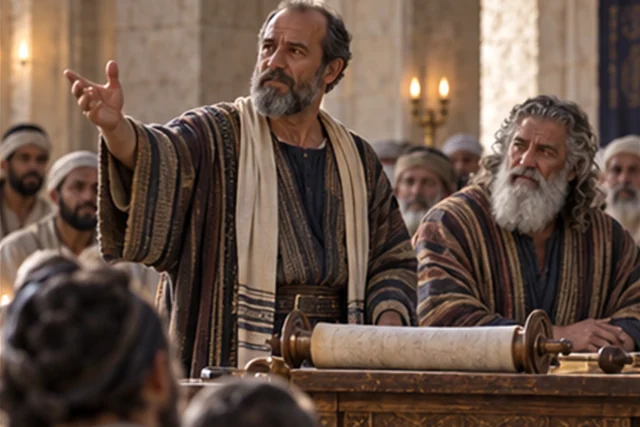
John Mark leaves the company at Perga, and the Book of Acts gives no reason in this chapter. Later disagreement will show that Paul considered the departure serious, but here the account refuses to invent a motive. The journey continues to Pisidian Antioch, where the synagogue's regular reading of the law and prophets creates an invitation for Paul to speak. He addresses both Israelites and those who fear God, then tells Israel's history with God as the grammatical subject of one action after another: choosing, exalting, bringing out, bearing with, giving, and raising up. Egypt, wilderness, land, judges, Saul, and David are not a parade of disconnected eras. They carry a promise forward. David matters because God has pledged something through his seed, and that line reaches Jesus, named as the promised Saviour. John the Baptist then appears not to collect status but to refuse it, pointing beyond himself to the coming one whose sandals he is unworthy to loosen. The history is moving toward fulfillment, not merely remembering the past.
Deep dive
Mark's return to Jerusalem receives one sentence and no explanation. Its significance emerges in chapter 15, when Paul regards the departure as a serious failure. Here the account keeps moving to the synagogue, where readings from the law and prophets create the occasion for the address. Paul speaks to Israelites and to those who fear God, recognizing more than one kind of attachment to Israel's worship among his hearers.
The opening history is carried by God's actions: choosing, exalting, bringing out, bearing with, giving, and raising up. The people pass through Egypt, wilderness, land, judges, and kings, but the speech is not simply ticking off administrations. Each transition advances the promise toward David and, from David's seed, Jesus. The kingdom is important because of the promise it carries, not because Paul intends to deliver a lecture on royal succession.
John's appearance brings the account to the threshold of fulfillment. Even his refusal of the identity people suspect matters: he directs attention away from himself to the coming one whose shoes he is unworthy to loose. The opening movement thus ends with a witness relinquishing status, preparing for a Savior whose identity will be established through rejection and resurrection.
Words to trace: Israel, people, gave, John, land, years
Verse-by-verse path
- Acts 13:13
“Paul and his company” is literally “those around Paul”: from here Barnabas is usually named second, and Paul leads. Perga stood a few miles inland from the south coast of Asia Minor on the river Cestrus. John Mark’s return is told in one clause; its cost comes out in 15:38.
- Acts 13:14
Pisidian Antioch was a Roman colony about 3,600 feet up, reached from Perga by a hard hundred-mile road through the Taurus mountains. Some, following W. M. Ramsay, connect the climb with the “infirmity of the flesh” Paul mentions to the Galatians (4:13), a guess. Sitting down in the synagogue marked them as ready to be called on.
- Acts 13:15
The service followed an order still recognisable: prayers, a reading from the Law, a reading from the Prophets, then an address. The “rulers of the synagogue” arranged it; Jairus held that office (Luke 8:41). “Word of exhortation” is the phrase the Letter to the Hebrews uses to describe itself (Hebrews 13:22): a sermon.
- Acts 13:16
Paul stands to speak, where Jesus at Nazareth sat down after the reading (Luke 4:20); customs of posture varied. His address names two audiences in one breath, Israelites by birth and Gentiles who worship Israel’s God. “Give audience” is simply “listen”.
- Acts 13:17
“With an high arm” is the Septuagint’s phrase for the exodus, the Greek of “stretched out arm” in Exodus 6:6 and Deuteronomy 5:15. “Dwelt as strangers” is paroikia, a sojourn in someone else’s land. Paul begins where Stephen began (7:2–7), with the fathers and Egypt.
- Acts 13:18
“Suffered he their manners” is etropophoresen, “he put up with their ways”. Many manuscripts read etrophophoresen, differing by one letter: “he carried them as a nurse carries a child”. The same pair of readings occurs in the Septuagint of Deuteronomy 1:31, the verse Paul is echoing, where God bore Israel “as a man doth bear his son”.
- Acts 13:19
The seven nations are listed in Deuteronomy 7:1: Hittites, Girgashites, Amorites, Canaanites, Perizzites, Hivites and Jebusites. “Divided their land to them by lot” is one Greek verb meaning to give as an inheritance, recalling Joshua 14:2, where the land was assigned by lot among the tribes.
- Acts 13:20
The King James attaches the 450 years to the judges, which clashes with 1 Kings 6:1, where 480 years run from the exodus to Solomon’s temple. The oldest manuscripts put the figure before “after that”, so it covers the 400 years in Egypt, 40 in the wilderness and the conquest, and the problem mostly disappears.
- Acts 13:21
Paul names the first Saul, “a man of the tribe of Benjamin”, and Paul himself is a Saul of that same tribe (Philippians 3:5). The Old Testament never gives Saul’s reign a clear length; 1 Samuel 13:1 is damaged in the Hebrew. Josephus also gives forty years in one place, so Paul reflects a known reckoning.
- Acts 13:22
“Removed” is methistemi, to depose. The divine testimony is stitched from three texts: “I have found David my servant” (Psalm 89:20), “a man after his own heart” (1 Samuel 13:14), and “shall perform all my pleasure”, said of Cyrus in Isaiah 44:28. Paul quotes the sense of all three as one word of God.
- Acts 13:23
The promise is the one given through Nathan: “I will set up thy seed after thee” (2 Samuel 7:12). “Saviour” and the name Jesus reinforce each other, since Yeshua means “the LORD saves”. In the Greek, Jesus is the last word of the sentence, held back for emphasis.
- Acts 13:24
“Before his coming” is literally “before the face of his entrance”, a Hebrew-flavoured expression. This is Paul’s only mention of John the Baptist in his recorded speeches, and he stresses the reach of John’s preaching: “to all the people of Israel”. In 19:3–4 Paul meets disciples at Ephesus who knew only John’s baptism.
- Acts 13:25
“Fulfilled his course” is dromos, a runner’s race, the word Paul uses of his own life in 20:24 and in 2 Timothy 4:7, “I have finished my course.” Loosing a master’s sandals was a slave’s job, and a later rabbinic saying excused a disciple from it; John claims to be below even that.
Acts 13:13-25
King James Version13Now when Paul and his company loosed from Paphos, they came to Perga in Pamphylia: and John departing from them returned to Jerusalem.
14But when they departed from Perga, they came to Antioch in Pisidia, and went into the synagogue on the sabbath day, and sat down.
15And after the reading of the law and the prophets the rulers of the synagogue sent unto them, saying, Ye men and brethren, if ye have any word of exhortation for the people, say on.
16Then Paul stood up, and beckoning with his hand said, Men of Israel, and ye that fear God, give audience.
17The God of this people of Israel chose our fathers, and exalted the people when they dwelt as strangers in the land of Egypt, and with an high arm brought he them out of it.
18And about the time of forty years suffered he their manners in the wilderness.
19And when he had destroyed seven nations in the land of Chanaan, he divided their land to them by lot.
20And after that he gave unto them judges about the space of four hundred and fifty years, until Samuel the prophet.
21And afterward they desired a king: and God gave unto them Saul the son of Cis, a man of the tribe of Benjamin, by the space of forty years.
22And when he had removed him, he raised up unto them David to be their king; to whom also he gave testimony, and said, I have found David the son of Jesse, a man after mine own heart, which shall fulfil all my will.
23Of this man’s seed hath God according to his promise raised unto Israel a Saviour, Jesus:
24When John had first preached before his coming the baptism of repentance to all the people of Israel.
25And as John fulfilled his course, he said, Whom think ye that I am? I am not he. But, behold, there cometh one after me, whose shoes of his feet I am not worthy to loose.
Acts 13:26-37
The Promised Heir Does Not Remain in the Grave
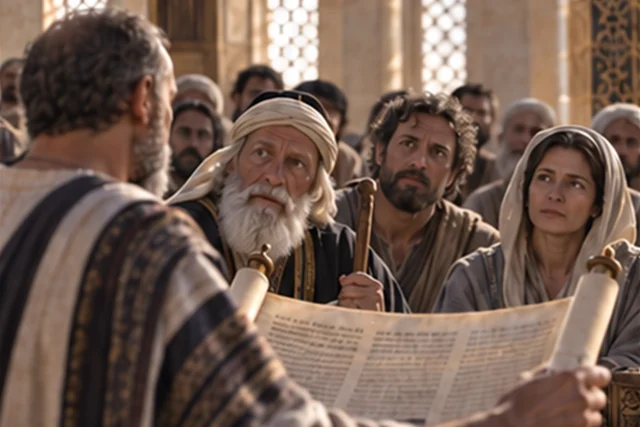
Paul's argument turns on a severe irony. The voices of the prophets are read every sabbath in Jerusalem, yet Jesus is not recognized, and the rulers fulfill those words by condemning the one they do not understand. Regular hearing does not guarantee recognition. Paul also notes that no sufficient cause of death was found, separating the fact of execution from any claim that the verdict proved Jesus guilty. Then comes the decisive contrast: “But God raised him from the dead.” Witnesses who knew Jesus before the crucifixion see him afterward, and Paul brings several Scriptures into the resurrection claim. Psalm 2, Isaiah's sure mercies of David, and Psalm 16 do different work inside one argument about promise, sonship, and escape from corruption. David himself dies, is laid with his fathers, and sees corruption. The promised heir does not. The Book of Acts lets an honored David remain honored while still insisting that the resurrection language reaches beyond him to the one God raised never to return to decay.

Deep dive
The irony turns on what is heard every sabbath. Jerusalem's rulers did not recognize Jesus or the voices of the prophets, yet their condemnation fulfilled those same prophetic words. Regular exposure and actual recognition are not treated as identical. Paul also distinguishes the absence of a sufficient cause for death from the successful request to Pilate for an execution. The verdict against Jesus is not presented as proof of his guilt.
Against that human action stands God's raising of Jesus and the testimony of those who saw him afterward. Paul then brings several texts into a single argument: Psalm 2 identifies the Son, Isaiah 55 supplies the sure mercies promised to David, and Psalm 16 speaks of the Holy One not seeing corruption. These references do different work; they are not three decorative quotations saying vaguely the same thing.
David served his own generation and died. That honorable service does not make him the final referent of a promise about escaping corruption. Paul's point depends on the difference between David's grave and Jesus' resurrection. The Davidic promise reaches its fulfillment in an heir whom death no longer holds, allowing the assurance made to the fathers to become good news addressed to their children.
Words to trace: corruption, raised, fulfilled, children, David, dead
Verse-by-verse path
- Acts 13:26
Paul turns and addresses the room again with a warmer title, “children of the stock of Abraham”, then again the God-fearers. “Salvation” picks up “Saviour” from verse 23. The word “sent” is exapostello: the message itself is dispatched, as the apostles were.
- Acts 13:27
The hearers in Pisidian Antioch had just heard the Law and the Prophets read aloud that morning (verse 15), so Paul’s phrase “read every sabbath day” points at their own service. “Knew him not” is agnoeo, the ignorance Peter also names in 3:17: “through ignorance ye did it, as did also your rulers.”
- Acts 13:28
“Cause of death” is the phrase Pilate used when he said the third time, “I have found no cause of death in him” (Luke 23:22). “Desired” is aiteo, to request, the same verb used for the crowd asking Pilate for Barabbas (Luke 23:25). They asked for the one and demanded the death of the other.
- Acts 13:29
Paul compresses: the ones who took Jesus down and buried him were Joseph of Arimathea and Nicodemus (Luke 23:50–53, John 19:38–39), both council members, so “they” loosely covers Jerusalem’s leaders. “Fulfilled all that was written” recalls Luke 18:31, where Jesus said everything written by the prophets would be accomplished.
- Acts 13:30
In Greek the verse is six words long, the shortest in the speech, and it turns the whole argument. The three verses before it had “they” as their subject, Jerusalem and its rulers doing everything to Jesus; now “God” is the subject and the direction reverses.
- Acts 13:31
The “many days” are the forty of 1:3. Paul here cites the Galilean witnesses and does not add himself, although in 1 Corinthians 15:8 he counts his own encounter, “last of all he was seen of me also”. In a synagogue far from Jerusalem, he rests the case on those who knew Jesus before and after.
- Acts 13:32
“Declare glad tidings” is euangelizomai, announce good news. “The promise which was made unto the fathers” is the phrase Paul returns to before King Agrippa, saying he stands on trial “for the hope of the promise made of God unto our fathers” (26:6).
- Acts 13:33
Codex Bezae reads “the first psalm”, which reflects an old custom of counting Psalms 1 and 2 as one; the Talmud records that the two were once joined. “Raised up” here may mean bringing Jesus onto the scene, as God “raised up” David in verse 22, before verse 34 speaks of raising from the dead.
- Acts 13:34
Isaiah 55:3 in the Septuagint promises “the holy things of David, the sure ones”, ta hosia. Verse 35 quotes Psalm 16 on God’s “Holy One”, hosios, the same root. Linking two texts by a shared word was an established Jewish method of interpretation, and Paul uses it here.
- Acts 13:35
Psalm 16:10 is the verse Peter used at Pentecost (2:27). “Corruption” is diaphthora, bodily decay, and in the New Testament the word appears only in these two speeches, six times in all, in Acts 2 and here. Two apostles, years apart, rest on the same line of David.
- Acts 13:36
“Fell on sleep” is koimao, the word for Stephen’s death (7:60), and “laid unto his fathers” echoes 1 Kings 2:10, “David slept with his fathers”. The Greek allows “served his own generation” or “served the will of God in his own generation”; either way his service had a term, and it ended.
- Acts 13:37
The verse is the whole contrast in miniature. Peter made the same point at Pentecost by pointing to David’s tomb, “with us unto this day” (2:29); in Pisidian Antioch, far from Jerusalem, Paul makes it without the landmark. “Raised again” is egeiro, the verb of verse 30.
Acts 13:26-37
King James Version26Men and brethren, children of the stock of Abraham, and whosoever among you feareth God, to you is the word of this salvation sent.
27For they that dwell at Jerusalem, and their rulers, because they knew him not, nor yet the voices of the prophets which are read every sabbath day, they have fulfilled them in condemning him.
28And though they found no cause of death in him, yet desired they Pilate that he should be slain.
29And when they had fulfilled all that was written of him, they took him down from the tree, and laid him in a sepulchre.
30But God raised him from the dead:
31And he was seen many days of them which came up with him from Galilee to Jerusalem, who are his witnesses unto the people.
32And we declare unto you glad tidings, how that the promise which was made unto the fathers,
33God hath fulfilled the same unto us their children, in that he hath raised up Jesus again; as it is also written in the second psalm, Thou art my Son, this day have I begotten thee.
34And as concerning that he raised him up from the dead, now no more to return to corruption, he said on this wise, I will give you the sure mercies of David.
35Wherefore he saith also in another psalm, Thou shalt not suffer thine Holy One to see corruption.
36For David, after he had served his own generation by the will of God, fell on sleep, and was laid unto his fathers, and saw corruption:
37But he, whom God raised again, saw no corruption.
Acts 13:38-43
The Argument Reaches Its Offer and Its Warning
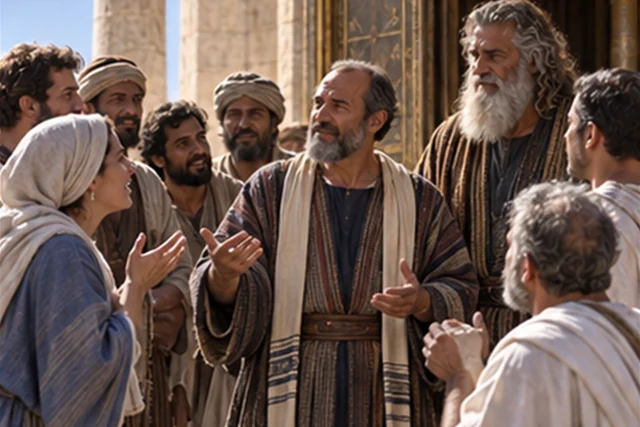
After a long sweep through Israel's history and Scripture, Paul reaches the point with remarkable directness: forgiveness of sins is preached “through this man.” The benefit cannot be detached from the risen Jesus just proclaimed. Paul then announces justification to all who believe, including release from what the law of Moses could not justify them from. The Book of Acts does not use this synagogue sermon to develop every later Pauline argument about law and justification, but the contrast is already substantial. It is spoken to religious hearers, not to people being asked to choose between faith and no religion at all. Habakkuk then supplies a warning that God's astonishing work can be declared and still be despised. Hearing does not guarantee reception. The immediate response, however, is mixed with real hunger. Gentiles ask to hear the words again the next sabbath, and many Jews and religious proselytes follow Paul and Barnabas afterward. The formal sermon ends, but persuasion continues in conversation as they are urged to continue in the grace of God.
Deep dive
The speech's long movement through Israel's history comes to a very direct announcement: forgiveness is preached through this man. The phrase locates the benefit in the risen Jesus just identified, rather than in an abstract principle detached from him. Justification follows, with the law of Moses named as unable to provide the comprehensive release Paul now announces to believers.
The word "all" gives the announcement its breadth, both in the people who believe and in the matters from which they are justified. Paul is addressing a synagogue, so the contrast is not between religion and having no religion. It concerns what the law can accomplish and what God has accomplished through Jesus. The speech states that distinction without here developing every argument later found in Paul's letters.
Habakkuk 1:5 supplies a warning that God's astonishing work can meet with unbelief. The conclusion therefore does not assume that hearing the promise guarantees receiving it. Yet the immediate response includes requests for more teaching and people who follow Paul and Barnabas afterward. The apostles urge them to continue in grace, making the conversation after the formal address part of the chapter's movement.
Words to trace: work, believe, Jews, justified, preached, Barnabas
Verse-by-verse path
- Acts 13:38
“Be it known unto you” is the formula Peter used to open at Pentecost (2:14) and before the council (4:10). Paul uses it to bring a historical survey to a personal address: forgiveness is “preached unto you”, in this room, this sabbath.
- Acts 13:39
This is the first time Acts uses “justified”, dikaioo, in the sense Paul’s letters make famous: “a man is not justified by the works of the law, but by the faith of Jesus Christ” (Galatians 2:16). Whether the sentence implies the law justifies from some things but not all is argued; most read it as saying the law could not do what Christ does.
- Acts 13:40
“Beware” is blepete, literally “look”, the same verb Jesus used for “take heed”. “The prophets” may mean the Book of the Twelve, the minor prophets, which circulated as a single scroll; the quotation that follows comes from Habakkuk, one of that collection.
- Acts 13:41
Habakkuk 1:5 is quoted from the Septuagint, which has “ye despisers” where the Hebrew reads “among the heathen”. In Habakkuk the unbelievable work was the Chaldean invasion; Paul applies the warning to God’s present act. The prophet’s audience refused to believe a coming judgment, and Paul warns against the same deafness.
- Acts 13:42
The oldest manuscripts read simply “as they went out, they besought them”, without naming “the Jews” or “the Gentiles”; the King James follows a later text that fills in both. “The next sabbath” may also mean “in the meantime”, since the Greek metaxu can mean between.
- Acts 13:43
“Religious proselytes” combines two words usually kept apart: proselytes were full converts, while “religious” or “devout” normally described uncircumcised worshippers. “Continue in” is prosmeno, the verb Barnabas used in 11:23 when he urged the Antioch believers to cleave unto the Lord.
Acts 13:38-43
King James Version38Be it known unto you therefore, men and brethren, that through this man is preached unto you the forgiveness of sins:
39And by him all that believe are justified from all things, from which ye could not be justified by the law of Moses.
40Beware therefore, lest that come upon you, which is spoken of in the prophets;
41Behold, ye despisers, and wonder, and perish: for I work a work in your days, a work which ye shall in no wise believe, though a man declare it unto you.
42And when the Jews were gone out of the synagogue, the Gentiles besought that these words might be preached to them the next sabbath.
43Now when the congregation was broken up, many of the Jews and religious proselytes followed Paul and Barnabas: who, speaking to them, persuaded them to continue in the grace of God.
Acts 13:44-52
The Light Is Not Confined to One Audience
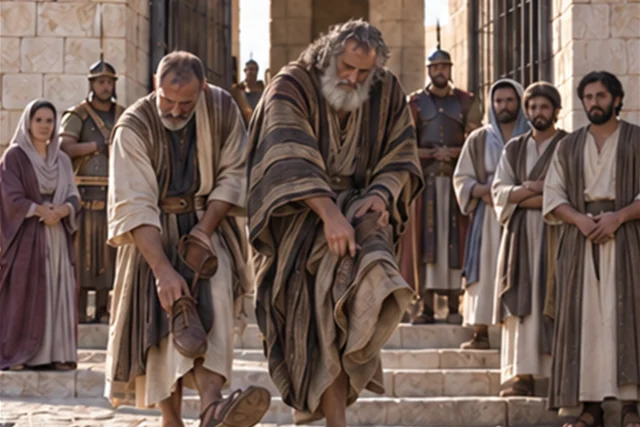
The next sabbath nearly the whole city gathers, and the size of the audience brings a conflict into the open. The Book of Acts names envy among the opponents but does not collapse the entire Jewish population into one response. Jews and proselytes have already followed Paul and Barnabas, so the argument concerns the people now contradicting and blaspheming. Paul and Barnabas affirm that the word was rightly spoken to them first, then explain the turn toward Gentiles through Isaiah's language of a light reaching the nations and salvation reaching the ends of the earth. Gentile inclusion is therefore not presented as an emergency substitute after Israel has ruined the plan. It is read from Israel's own Scripture. The verse about those “ordained to eternal life” has received differing theological explanations, and the passage itself places divine appointment beside accountable human rejection without stopping to systematize the relation. Opposition eventually expels the missionaries from the region. The disciples remain filled with joy and the Holy Ghost, showing once more that removing messengers from a place is not the same thing as removing the message from it.
Deep dive
The sight of the crowds provokes the jealousy Acts explicitly names. The dispute is not reducible to one population accepting and another rejecting: some Jews and religious proselytes have already followed the speakers. Paul and Barnabas address the particular opponents now contradicting them. The priority of speaking God's word to them is affirmed even as their rejection becomes the occasion for carrying it farther.
Isaiah 49:6 gives the turn its scriptural explanation. The servant's light reaches the Gentiles and salvation reaches the ends of the earth. Paul and Barnabas understand their work within that commission, not as an improvised substitute for a failed promise. Gentile joy therefore belongs inside the argument about Israel's Scriptures.
The phrase "ordained to eternal life" has received different theological readings. Some understand it as God's prior election of particular persons; others emphasize God's appointment of believers to life without finding a complete account of predestination here. Acts places divine appointment beside the opponents' accountable rejection, without explaining their relationship through a developed system. Persecution expels the missionaries, but it does not empty the disciples of joy or the Holy Ghost. Removal of the speakers and defeat of the message are not the same event.
Words to trace: word, Gentiles, Lord, Paul, Barnabas, city
Verse-by-verse path
- Acts 13:44
A week has passed, filled with the conversations of verse 43, and the word has spread. “Almost the whole city” is broad language for a Roman colony of several thousand, but it signals something practical as well: Gentiles filling a synagogue built for a Jewish congregation.
- Acts 13:45
“Filled with envy” is the same phrase as in 5:17, where the high priest’s party “were filled with indignation”; the Greek word zelos means both zeal and jealousy. “Blaspheming” can mean reviling a person as well as God, and the Greek leaves open whether the abuse fell on Jesus, Paul, or both.
- Acts 13:46
“Waxed bold” is parresiazomai, to speak openly, a keyword of Acts (4:29, 31). “First” matches Paul’s own “to the Jew first, and also to the Greek” (Romans 1:16). The phrase “judge yourselves unworthy” turns their verdict on Paul back on themselves. This and verse 48 are the only mentions of eternal life in Acts.
- Acts 13:47
Isaiah 49:6 is the servant’s commission, and Simeon had already applied it to the infant Jesus: “a light to lighten the Gentiles” (Luke 2:32). Paul and Barnabas take the servant’s “thee” as their own charge. “Unto the ends of the earth” is the phrase of Jesus’ last words in 1:8.
- Acts 13:48
“Glorified the word of the Lord” is an unusual phrase: praise given to the message itself. “Ordained” is tasso, to arrange or appoint, originally a military word for posting soldiers in their ranks; Acts uses it elsewhere for things “appointed” (22:10) and for a day set (28:23).
- Acts 13:49
“Published” is diaphero, carried through or spread abroad. “Region” is chora, the countryside around a city; Pisidian Antioch was the chief administrative centre of its district, and its roads carried the word out to the farms and villages around it.
- Acts 13:50
Women of rank were often drawn to the synagogue; Josephus says most of the wives of Damascus were attached to the Jewish religion. “Chief men” would be the colony’s magistrates. “Coasts” in 1611 meant borders or territory, not seashore; Antioch was far inland.
- Acts 13:51
Jesus had told the Twelve and the Seventy to shake the dust off their feet against a town that refused them (Luke 9:5, 10:11). Jews returning from Gentile lands reportedly did the same, treating foreign soil as unclean. Iconium, modern Konya, lay about ninety miles to the east-south-east along the Via Sebaste.
- Acts 13:52
The disciples here are the new believers left behind in Antioch, not only the two missionaries. “Were filled” is in the imperfect tense, “kept being filled”, a continuing condition rather than a single moment. Paul and Barnabas will come back through the city in 14:21–22 to strengthen them.
Acts 13:44-52
King James Version44And the next sabbath day came almost the whole city together to hear the word of God.
45But when the Jews saw the multitudes, they were filled with envy, and spake against those things which were spoken by Paul, contradicting and blaspheming.
46Then Paul and Barnabas waxed bold, and said, It was necessary that the word of God should first have been spoken to you: but seeing ye put it from you, and judge yourselves unworthy of everlasting life, lo, we turn to the Gentiles.
47For so hath the Lord commanded us, saying, I have set thee to be a light of the Gentiles, that thou shouldest be for salvation unto the ends of the earth.
48And when the Gentiles heard this, they were glad, and glorified the word of the Lord: and as many as were ordained to eternal life believed.
49And the word of the Lord was published throughout all the region.
50But the Jews stirred up the devout and honourable women, and the chief men of the city, and raised persecution against Paul and Barnabas, and expelled them out of their coasts.
51But they shook off the dust of their feet against them, and came unto Iconium.
52And the disciples were filled with joy, and with the Holy Ghost.
Questions to keep in mind while reading
- Track who acts, who speaks, who is affected, and what changes.
- Notice repeated promises, failures, rescues, and consequences.
- Do not assume the account approves every action that is reported.
Text first
Where readers differ
The chapter summary begins with what the passage says and how its parts fit together. It does not assume one denomination has already settled every question. Where a conclusion depends on a tradition, literary theory, or historical reconstruction, that dependence is named openly.
The KJV text is presented first. Interpretive conclusions are labeled, and differences are introduced only when they help a reader understand why serious communities do not always reach the same answer.
Comparative interpretive notes for this chapter are in preparation. Until reviewed notes are ready, this page separates the KJV text from summary and application without claiming that serious readers agree on every question.
Questions beneath the surface
- What account of God, human freedom, responsibility, and the good life emerges from Acts 13?
- Which tension does the chapter refuse to resolve quickly?
- What changes when the chapter is read as part of the whole canon rather than as an isolated moral lesson?
- Where might a sincere reader confuse a familiar tradition with something the text states directly?
Questions for serious personal contemplation
These open-ended questions make room for tension, honest response, prayer, and conclusions that remain accountable to the chapter.
Observe without rushing
What part of Acts 13 makes you stop, feel unsettled, or feel surprised, and why?
Which detail in the passage would be easiest to overlook? How does that detail change your understanding?
Where do you see tension between what happens and this focus: Acts 13 develops its own movement around word, Lord, Paul, raised, Barnabas?
What important question does the passage leave open instead of resolving quickly?
Examine your inner life honestly
Which person, response, fear, or desire in the passage feels most like your own life right now?
What assumption about God, other people, or yourself does this text challenge?
Which part would you rather soften, avoid, or explain away too quickly? What might that reaction reveal?
If this Scripture could ask you one direct question, what do you think it would ask?
Respond with wisdom and courage
What do you need to remember, confess, grieve, thank God for, or trust after reading this passage?
How might another faithful person read this situation differently without ignoring the text?
What obedient response would be costly, uncomfortable, or slow, yet still faithful to Scripture?
What question will you carry into prayer this week, and which verses will you keep in front of you?
Music and video connected to the passage
Related media appears when its Scripture reference overlaps this study. Music and video can illuminate a theme while the biblical text remains the foundation.