The big picture
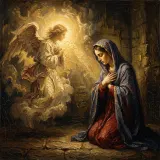
The Book of Luke 6 puts Sabbath arguments, chosen apostles, blessings and woes, enemy-love, judgment, speech, and foundations under one searching question: what kind of life does Jesus' teaching actually produce? The Sabbath disputes reveal a sharp contrast between a restored hand and people watching for grounds of accusation. After a night of prayer, Jesus chooses twelve from among a much larger body of disciples, then addresses that community amid crowds seeking healing. His blessings and woes overturn easy confidence in present comfort, while enemy-love breaks the ordinary economy of repayment by grounding mercy in the Father's kindness even toward the unthankful and evil. The warning against judging is not a ban on seeing any fault; the beam must come out so the eye can see clearly enough to help. Trees are known by fruit, hearts by what they produce, and houses by what the flood reveals about their hidden foundations. The chapter ends by making admiration insufficient: hearing becomes meaningful only when it reaches conduct.
In this chapter
- A Restored Hand and an Accusation in Search of a Case Luke 6:1-11
The first Sabbath dispute is about what may be done on the Sabbath, not about theft.
- Twelve Names After a Night of Prayer Luke 6:12-19
The Book of Luke places an entire night of prayer before the naming of the Twelve.
- Four Blessings Face Four Warnings Luke 6:20-26
Jesus looks directly at his disciples before saying words that refuse to let present conditions serve as final verdicts.
- Love Crosses the Line of Repayment Luke 6:27-36
Enemy-love is not left as a warm attitude with no verbs attached.
- A Beam Is Poor Equipment for Eye Surgery Luke 6:37-42
The overflowing measure sits inside a chain about judging, condemning, forgiving, and giving, which keeps it from becoming a detached formula for multiplying money.
- The Flood Tests What the Confession Built Luke 6:43-49
Fruit makes the invisible source visible without requiring anyone to claim direct access to every hidden motive.

Scripture beside the summary
Luke · King James Version · 49Luke 6:1-11
A Restored Hand and an Accusation in Search of a Case
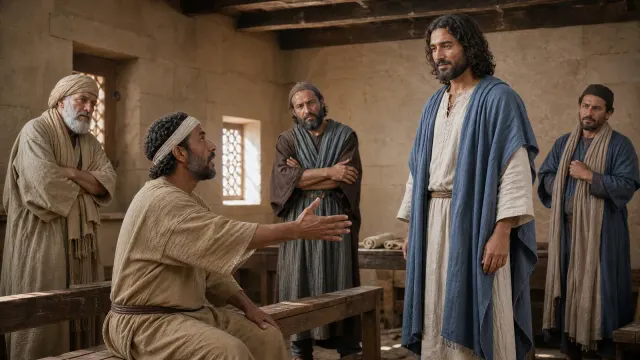
The first Sabbath dispute is about what may be done on the Sabbath, not about theft. The disciples pluck grain because they are hungry, and Jesus answers by reaching back to David's use of consecrated bread. The appeal does more than offer a technical exception; it presses the critics' reading of lawful conduct against a scriptural case in which human need complicated a rigid boundary. Then comes the larger claim: "the Son of man is Lord also of the sabbath." On another Sabbath the controversy moves into a synagogue, where the opponents are explicitly watching for an accusation. Jesus puts the man with the withered hand in the middle and asks whether the day is for doing good or evil, saving or destroying. The hand is restored. The observers, instead of celebrating a man's recovery, begin discussing what they might do to Jesus. The Book of Luke hardly needs to comment on the contrast. A disabled hand becomes whole while an accusation in search of a case hardens into a plan.
Deep dive
The grain-field dispute concerns the Sabbath, not an accusation that the disciples are stealing. Jesus answers with David's use of the consecrated bread in 1 Samuel 21, placing the critics' reading of permitted conduct alongside a scriptural case involving hunger. His conclusion then makes the larger claim: the Son of man is Lord of the Sabbath.
The unusual phrase "second sabbath after the first" reflects a difficult Greek expression, deuteroprotos, literally "second-first." Proposed explanations connect it with festival counting, but its exact calendar reference is uncertain, and some manuscripts omit it. The disagreement about the disciples' action does not depend on solving that calendar problem.
The second incident brings the disputed principle into the synagogue. The watchers are explicitly seeking an accusation, while Jesus places the man with the withered hand in the middle. His question contrasts doing good with doing evil, saving with destroying. After the hand is restored, Luke describes the opponents discussing what to do to Jesus. The arrangement supplies its own severe contrast: a hand is made whole while a plan against the healer begins to form.
Words to trace: sabbath, hand, Jesus, lawful, corn, days
Verse-by-verse path
- Luke 6:1
“Corn” in 1611 meant any grain, here wheat or barley. Only Luke mentions “rubbing them in their hands”. Later rabbinic law listed reaping and threshing among the thirty-nine kinds of work forbidden on the sabbath, and plucking ears and rubbing out the husks could be classed as both, two offences in one mouthful.
- Luke 6:2
Luke says “certain of the Pharisees”, some, not the whole party. The question is put to the disciples, not to Jesus. It rests on an interpretation of Exodus 34:21: “in earing time and in harvest thou shalt rest.”
- Luke 6:3
“Have ye not read so much as this” is pointed irony to men who read the Scriptures daily: not even this? David was fleeing Saul when he came to the priests at Nob (1 Samuel 21:1–6). Mark 2:26 names Abiathar as high priest; Luke leaves the name out.
- Luke 6:4
The shewbread was the bread of the Presence, twelve loaves set out on the golden table and replaced each sabbath, the old ones eaten by the priests (Leviticus 24:5–9). Since the loaves were changed on the sabbath, later rabbis reasoned that David’s visit also fell on one.
- Luke 6:5
Luke leaves out the line Mark records here, “The sabbath was made for man”. One ancient manuscript, Codex Bezae, moves this verse and puts in its place a saying found nowhere else: Jesus sees a man working on the sabbath and tells him he is blessed if he knows what he is doing.
- Luke 6:6
Only Luke says it was the right hand, the working hand, the one a man earned his bread with. “Withered” means dried up, shrunken. Luke also notes that Jesus was teaching, so the healing interrupts a lesson.
- Luke 6:7
“Watched” means watched closely, lay in wait; Luke uses the same verb when the leaders “watched him, and sent forth spies” (20:20). The Mishnah allowed the sabbath to be set aside where life was in danger, and a withered hand was no emergency. It could have waited a day.
- Luke 6:8
“Stand forth in the midst” is literally stand into the middle. Jesus stages the question in full view of everyone, so the watchers cannot keep their accusation private. The man obeys twice over: he arose, and he stood.
- Luke 6:9
The watchers came to put a question to Jesus; he puts one to them. “Life” is psyche, which can also mean soul. The way he frames it leaves no neutral option: on the sabbath, declining to do good is placed on the side of doing harm.
- Luke 6:10
Mark says Jesus looked around “with anger” (3:5); Luke keeps the look and leaves out the anger. “Restored” is the verb used in Acts for the restoring of the kingdom (1:6) and the restitution of all things (3:21).
- Luke 6:11
“Madness” is anoia, literally mindlessness, a rage that drives out reason. Luke is milder than Mark, who has the Pharisees plot with the Herodians how to destroy him; here they discuss “what they might do”, and leave it open.
Luke 6:1-11
King James Version1And it came to pass on the second sabbath after the first, that he went through the corn fields; and his disciples plucked the ears of corn, and did eat, rubbing them in their hands.
2And certain of the Pharisees said unto them, Why do ye that which is not lawful to do on the sabbath days?
3And Jesus answering them said, Have ye not read so much as this, what David did, when himself was an hungred, and they which were with him;
4How he went into the house of God, and did take and eat the shewbread, and gave also to them that were with him; which it is not lawful to eat but for the priests alone?
5And he said unto them, That the Son of man is Lord also of the sabbath.
6And it came to pass also on another sabbath, that he entered into the synagogue and taught: and there was a man whose right hand was withered.
7And the scribes and Pharisees watched him, whether he would heal on the sabbath day; that they might find an accusation against him.
8But he knew their thoughts, and said to the man which had the withered hand, Rise up, and stand forth in the midst. And he arose and stood forth.
9Then said Jesus unto them, I will ask you one thing; Is it lawful on the sabbath days to do good, or to do evil? to save life, or to destroy it?
10And looking round about upon them all, he said unto the man, Stretch forth thy hand. And he did so: and his hand was restored whole as the other.
11And they were filled with madness; and communed one with another what they might do to Jesus.
Luke 6:12-19
Twelve Names After a Night of Prayer
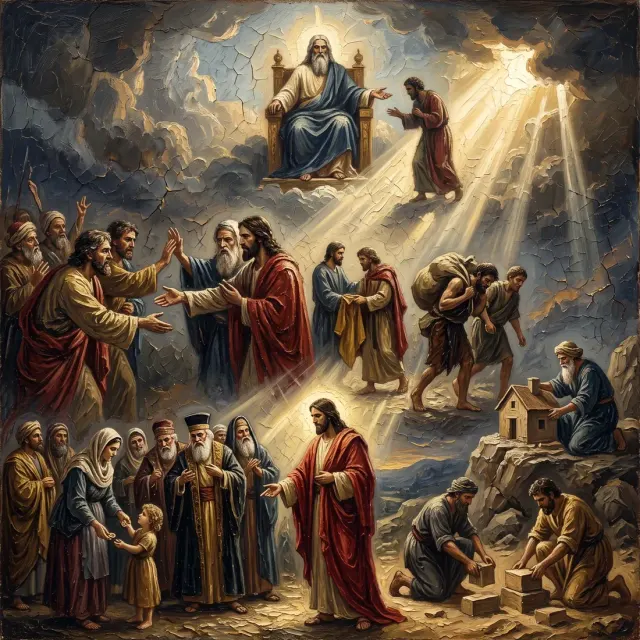
The Book of Luke places an entire night of prayer before the naming of the Twelve. He does not reveal the prayer's words, but the placement makes the selection feel less like an organizational reshuffle and more like an act carried within dependence on God. The Twelve are also chosen "of" the disciples, which matters. Apostle is a particular commission within a larger company of followers, not a synonym for everyone who belongs to Jesus. The names include brothers, distinguishing descriptions, and Judas Iscariot with the dark notice that he became the traitor. His inclusion prevents chosen status from being confused with identical outcomes. Jesus then descends with them into a broad human field: disciples, crowds from Judea and Jerusalem, and people from the coastal region around Tyre and Sidon. They come to hear and to be healed. The Book of Luke uses "virtue" here to mean power, and the scene makes that power bodily and public before the teaching begins. The chosen messengers stand inside a needy crowd, not above one.
Deep dive
The selection follows an entire night of prayer. Luke does not report the content of that prayer, but its placement makes the choice of the Twelve part of Jesus' dependence on God rather than a spontaneous administrative decision. The distinction between disciples and apostles is also explicit: the Twelve are chosen from among the disciples, not identified as the only followers he has.
The list includes family relationships, distinguishing names, and the notice that Judas Iscariot became the traitor. That final identification lets the coming betrayal cast a shadow without explaining the motives or future of every man in advance. Their being chosen is not a claim that each response will be identical.
Jesus then comes down and stands in a level place with people from Judea, Jerusalem, and the coastal region of Tyre and Sidon. The teaching belongs within a ministry that also addresses bodily suffering. The KJV's "virtue" here means power, not moral respectability flowing out as a substance. The crowd seeks healing, and the disciples are about to receive instruction in what their relationship to this healer entails.
Words to trace: healed, James, brother, disciples, Judas, multitude
Verse-by-verse path
- Luke 6:12
The Greek says literally that he spent the night “in the prayer of God”, a phrase found nowhere else in the New Testament. “A mountain” is the mountain, the hills rising above the lake.
- Luke 6:13
“Apostles” means envoys, men sent with a commission. Luke uses the word six times in his gospel, far more than the other gospels. Twelve matches the tribes of Israel, and Jesus later promises the twelve thrones judging those tribes (22:30).
- Luke 6:14
Peter is Greek for rock, the Aramaic Kepha. Andrew and Philip are Greek names, Philip meaning lover of horses. Bartholomew is not a first name but an Aramaic patronymic, son of Talmai; he is often identified with the Nathanael of John 1:45, though that is a guess.
- Luke 6:15
Luke does not say that this Matthew is the Levi of 5:27, as Matthew’s gospel does. Thomas is Aramaic for twin. Zelotes means zealous; Mark and Matthew give the Aramaic equivalent, Cananaean. Whether it meant a political party or religious zeal is debated.
- Luke 6:16
The Greek says only “Judas of James”, which usually means son of James; the King James reads brother, by analogy with Jude 1. Mark and Matthew have Thaddaeus in this place. Iscariot “also was the traitor” is more exactly “became a traitor”: he was not one when chosen.
- Luke 6:17
“The plain” is a level place, which can be a plateau on a hillside; Matthew sets the same teaching on a mountain. Tyre and Sidon were Gentile ports forty or fifty miles away; Sidon was the region of the widow Elijah was sent to (4:26).
- Luke 6:18
“Vexed” meant tormented, troubled. Luke keeps two groups distinct, the diseased and those troubled by unclean spirits, but says both were healed. The verb is imperfect: they were being healed, one after another.
- Luke 6:19
“Sought” is imperfect, they kept trying to touch him. The same phrase returns when the woman with the issue of blood touches his garment and Jesus says, “I perceive that virtue is gone out of me” (8:46).
Luke 6:12-19
King James Version12And it came to pass in those days, that he went out into a mountain to pray, and continued all night in prayer to God.
13And when it was day, he called unto him his disciples: and of them he chose twelve, whom also he named apostles;
14Simon, (whom he also named Peter,) and Andrew his brother, James and John, Philip and Bartholomew,
15Matthew and Thomas, James the son of Alphæus, and Simon called Zelotes,
16And Judas the brother of James, and Judas Iscariot, which also was the traitor.
17And he came down with them, and stood in the plain, and the company of his disciples, and a great multitude of people out of all Judæa and Jerusalem, and from the sea coast of Tyre and Sidon, which came to hear him, and to be healed of their diseases;
18And they that were vexed with unclean spirits: and they were healed.
19And the whole multitude sought to touch him: for there went virtue out of him, and healed them all.
Luke 6:20-26
Four Blessings Face Four Warnings
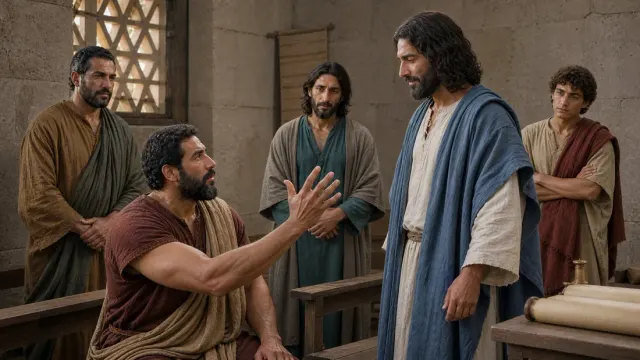
Jesus looks directly at his disciples before saying words that refuse to let present conditions serve as final verdicts. The blessings in the Book of Luke are concrete: the poor, those hungry now, those weeping now, and those rejected for the Son of man's sake. The matching woes face them from the other side: rich, full, laughing now, and universally praised. The pairings do not make deprivation automatically virtuous or every laugh sinful. They break the assumption that comfort, abundance, and approval can be read as reliable proof of standing in God's kingdom. The repeated "now" gives the whole section a temporal edge. Present conditions are real, but they are not permanent. The prophet comparisons sharpen the final pair. Rejection can place disciples in the company of faithful prophets, while universal applause can resemble the reception of false ones. Public approval is therefore not a neutral measuring instrument. The decisive context is allegiance to the Son of man and the reversals associated with the kingdom he announces.
Deep dive
Luke directs attention to Jesus' eyes upon his disciples before the blessings begin. The language is personal and concrete: poor, hungry now, weeping now, and rejected for the Son of man's sake. It should not be silently rewritten to match the different wording of Matthew's Beatitudes. Luke's material conditions matter, and "now" makes the contrast with the promised future explicit.
Each blessing meets a corresponding woe. Poverty faces wealth, hunger faces fullness, weeping faces laughter, and rejection faces universal approval. The warnings challenge the assumption that present comfort reliably reveals a person's standing in God's kingdom. They do not require the added claim that every instance of laughter is wicked or every experience of deprivation is virtuous in itself.
The two references to the prophets sharpen the final pairing. Rejection for Jesus' sake can place disciples alongside faithful prophets, while being praised by everyone can resemble the reception of false prophets. Popularity is not a neutral verdict delivered from above the conflict. Jesus interprets these conditions within allegiance to himself and the kingdom, not as a free-standing ranking of personalities.
Words to trace: Blessed, fathers, hunger, laugh, prophets, weep
Verse-by-verse path
- Luke 6:20
Jesus lifts his eyes to his disciples, the listening circle within the crowd. “Blessed” is the form that opens the Psalms, “Blessed is the man” (Psalm 1:1), a pronouncement of good fortune. The poor are the ones to whom he said at Nazareth he was anointed to preach good news (4:18).
- Luke 6:21
“Filled” is the verb used when the five thousand “did eat, and were all filled” (9:17), a hunger actually satisfied. “Laugh” occurs in the New Testament only here and in verse 25. Psalm 126:5: “They that sow in tears shall reap in joy.”
- Luke 6:22
Four verbs build up: hate, separate, reproach, cast out. “Separate you from their company” may mean exclusion from the synagogue (John 9:22). “Cast out your name as evil” could mean the name “Christian”, first used at Antioch (Acts 11:26), which 1 Peter 4:16 shows was a charge in itself.
- Luke 6:23
“Leap for joy” is the verb used when John leaped in Elisabeth’s womb (1:41, 44). Jeremiah was beaten and put in the stocks by a priest of the temple (Jeremiah 20:2). The joy is commanded for the very day of rejection.
- Luke 6:24
“Received” is the commercial term for a receipt: paid in full. “Consolation” is paraklesis, the word for what Simeon waited for, “the consolation of Israel” (2:25). The rich have already had theirs.
- Luke 6:25
“Full” means filled up, glutted. The rich man in 16:19–25 acts this woe out: he fared sumptuously every day, and Abraham tells him, “thou in thy lifetime receivedst thy good things”.
- Luke 6:26
Jeremiah 5:31: “The prophets prophesy falsely ... and my people love to have it so.” In 1 Kings 22:13 Ahab’s four hundred prophets all speak with one voice and are told to agree, while Micaiah alone says otherwise and is struck in the face.
Luke 6:20-26
King James Version20And he lifted up his eyes on his disciples, and said, Blessed be ye poor: for yours is the kingdom of God.
21Blessed are ye that hunger now: for ye shall be filled. Blessed are ye that weep now: for ye shall laugh.
22Blessed are ye, when men shall hate you, and when they shall separate you from their company, and shall reproach you, and cast out your name as evil, for the Son of man’s sake.
23Rejoice ye in that day, and leap for joy: for, behold, your reward is great in heaven: for in the like manner did their fathers unto the prophets.
24But woe unto you that are rich! for ye have received your consolation.
25Woe unto you that are full! for ye shall hunger. Woe unto you that laugh now! for ye shall mourn and weep.
26Woe unto you, when all men shall speak well of you! for so did their fathers to the false prophets.
Luke 6:27-36
Love Crosses the Line of Repayment
Enemy-love is not left as a warm attitude with no verbs attached. Jesus says do good, bless, pray, give, lend, and refuse the reflex of retaliation. The examples begin with hostility itself: hatred, curses, abuse, striking, and loss of possessions. The teaching therefore crosses the ordinary line of repayment in both directions. Loving those who already love, benefiting those who repay, and lending where return is expected remain normal human exchange; Jesus asks what distinguishes such reciprocity when even sinners practice it. The ground he gives is not the enemy's eventual improvement but the Father's present character. God is kind "unto the unthankful and to the evil." Evil is still named as evil; mercy does not require renaming it before acting. The command "Be ye therefore merciful" gathers the section into one family resemblance. The measure is no longer whether the other person has become a safe investment. It is the generosity of the Father toward people who cannot claim to have earned it.

Deep dive
The repeated contrasts dismantle ordinary reciprocity. Loving those who already love, benefiting those who repay, and lending where repayment is secure do not distinguish the conduct Jesus is describing. Even those his hearers call sinners can maintain that arrangement. The teaching reaches beyond an exchange in which generosity is merely a delayed purchase.
The examples concern hostile actions: hatred, curses, abuse, striking, and taking possessions. Jesus answers with doing good, blessing, praying, giving, and refusing retaliation. These instructions should not be reduced to an agreeable feeling about enemies. Equally, the passage does not supply a complete legal procedure for every situation of danger; its specific focus is the disciple's response to hostility and claims on possessions.
The rationale arrives in the Father's kindness toward the unthankful and evil. Jesus does not rename evil as good in order to make kindness possible. Mercy acts toward people whose conduct is still named honestly. The closing call to be merciful gathers the examples under that family resemblance. The measure is the character of the Father, not the probability that the recipient will prove a satisfactory investment.
Words to trace: love, good, sinners, lend, thank, enemies
Verse-by-verse path
- Luke 6:27
“Which hear” turns from the rich, who are addressed but not present, to the people actually listening. The Law already commanded returning an enemy’s straying ox and helping his fallen donkey (Exodus 23:4–5). Jesus takes the command to love past his property to the enemy himself.
- Luke 6:28
“Despitefully use” means insult and mistreat. On the cross Jesus prays, “Father, forgive them; for they know not what they do” (23:34), and Stephen, dying, prays for the men stoning him (Acts 7:60). The command is carried out in Luke’s own pages.
- Luke 6:29
A blow to the cheek was an insult more than an injury. In Luke the robber takes the cloke, the outer robe, first and then the coat, the tunic beneath, as in a street robbery; in Matthew 5:40 it is a lawsuit, and the order is reversed.
- Luke 6:30
“Give” is a present imperative: keep on giving. “Ask them not again” means do not demand them back. Deuteronomy 15:7–8 had commanded Israel not to shut its hand against a poor brother but to open it wide.
- Luke 6:31
Tobit 4:15 gives the rule negatively, “Do that to no man which thou hatest”, and Hillel is said to have taught a pagan the whole Law in one sentence: what is hateful to you, do not do to your neighbour. Jesus states it positively, which asks for action, not only restraint.
- Luke 6:32
“Thank” is charis, grace or favour: what credit is that to you? Matthew has “publicans” where Luke has “sinners”. The comparison sets the standard below which the disciples’ love must not sink.
- Luke 6:33
Greek and Roman society ran on benefaction: gifts given in the expectation of honour or favour in return. Seneca wrote a whole treatise on the proper exchange of benefits. Jesus names that arrangement and says it earns no credit.
- Luke 6:34
Deuteronomy 15:9 warns against refusing a loan to a poor man as the seventh year approached, when debts would be cancelled. Later Jewish law, under Hillel, devised a legal document that let lenders avoid that cancellation. The pressure to lend only where repayment is secure is ancient.
- Luke 6:35
“Hoping for nothing again” translates a verb that usually means to despair, and some manuscripts read “despairing of no one”. “Children of the Highest” echoes the angel’s title for Jesus, “the Son of the Highest” (1:32). “Unthankful” is literally ungracious.
- Luke 6:36
“Merciful” is the word Exodus 34:6 uses in Greek when God proclaims himself “merciful and gracious”. The sentence has the shape of Leviticus 19:2: “Ye shall be holy: for I the LORD your God am holy.” Matthew’s parallel says “perfect” (5:48).
Luke 6:27-36
King James Version27But I say unto you which hear, Love your enemies, do good to them which hate you,
28Bless them that curse you, and pray for them which despitefully use you.
29And unto him that smiteth thee on the one cheek offer also the other; and him that taketh away thy cloke forbid not to take thy coat also.
30Give to every man that asketh of thee; and of him that taketh away thy goods ask them not again.
31And as ye would that men should do to you, do ye also to them likewise.
32For if ye love them which love you, what thank have ye? for sinners also love those that love them.
33And if ye do good to them which do good to you, what thank have ye? for sinners also do even the same.
34And if ye lend to them of whom ye hope to receive, what thank have ye? for sinners also lend to sinners, to receive as much again.
35But love ye your enemies, and do good, and lend, hoping for nothing again; and your reward shall be great, and ye shall be the children of the Highest: for he is kind unto the unthankful and to the evil.
36Be ye therefore merciful, as your Father also is merciful.
Luke 6:37-42
A Beam Is Poor Equipment for Eye Surgery
The overflowing measure sits inside a chain about judging, condemning, forgiving, and giving, which keeps it from becoming a detached formula for multiplying money. Pressed down, shaken together, and running over describes the fullness of the measure used, while Jesus' point concerns the standard one brings to other people and receives in return. Then the imagery becomes intentionally ridiculous. A blind guide offers direction; a person with a beam in his eye proposes delicate work on somebody else's speck. The humor has teeth because the problem is not that the speck is imaginary. Jesus eventually says it may be removed. The issue is who is fit to attempt the operation. "First" remove the beam, then sight becomes clear enough to help a brother. That sequence protects the teaching from two opposite evasions: hypocritical correction on one side and the claim that no moral discernment is ever permitted on the other. The image in the Book of Luke makes self-judgment a prerequisite for reliable correction, not a substitute for it.
Deep dive
The sequence joins judging, condemning, forgiving, and giving. The overflowing measure therefore belongs within a discussion of merciful relationships, not an isolated promise that a financial contribution guarantees a larger payment. Pressing and shaking the measure describes fullness; the point is the standard being used toward others and returned upon the one using it.
The blind guide and the teacher-disciple comparison ask what happens when an unprepared person becomes someone else's source of direction. That concern continues in the eye illustration. The absurdity is deliberate: a person with a beam obstructing his own sight offers delicate assistance with a speck in another person's eye. He has selected an ambitious moment to advertise precision.
Jesus does not conclude that the speck must remain forever untouched. The sequence is first the beam, then clearer sight to remove the speck. The criticism concerns hypocrisy and incapacity, not every act of moral discernment. Correction undertaken without the corresponding judgment of oneself becomes an exhibit of the very problem it claims to solve.
Words to trace: beam, mote, beholdest, blind, brother, brother’s
Verse-by-verse path
- Luke 6:37
“Forgive” is apolyo, release, the verb used when Pilate releases Barabbas (23:25). The passive verbs, ye shall not be judged, ye shall be forgiven, leave the actor unnamed, a common Jewish way of speaking about what God does.
- Luke 6:38
Grain was measured by filling a vessel, pressing it down, shaking it to settle, then heaping it until it spilled. The “bosom” is the fold of the robe above the belt, used as a pocket; Boaz poured six measures of barley into Ruth’s veil in the same way (Ruth 3:15).
- Luke 6:39
The “ditch” is a pit or cistern, open holes that were a real danger to anyone walking without sight. Matthew uses the saying against the Pharisees (15:14); Luke sets it among instructions to disciples who will become teachers.
- Luke 6:40
“Perfect” is katartizo, fully trained or fitted out, the verb Mark uses for James and John “mending their nets” (Mark 1:19). A student repaired and equipped becomes like his teacher, and no student can pass on what his teacher lacked.
- Luke 6:41
“Mote” is karphos, a speck, a chip of straw or wood. “Beam” is dokos, a roof joist. The image belongs to a carpenter’s workshop, where splinters fly and a man might picture a joist lodged in someone’s eye. “Perceivest” means consider carefully.
- Luke 6:42
“Brother, let me” is affectionate and polite, which makes it worse. “Hypocrite” first meant a stage actor, one who speaks behind a mask. This is the first time Luke uses the word.
Luke 6:37-42
King James Version37Judge not, and ye shall not be judged: condemn not, and ye shall not be condemned: forgive, and ye shall be forgiven:
38Give, and it shall be given unto you; good measure, pressed down, and shaken together, and running over, shall men give into your bosom. For with the same measure that ye mete withal it shall be measured to you again.
39And he spake a parable unto them, Can the blind lead the blind? shall they not both fall into the ditch?
40The disciple is not above his master: but every one that is perfect shall be as his master.
41And why beholdest thou the mote that is in thy brother’s eye, but perceivest not the beam that is in thine own eye?
42Either how canst thou say to thy brother, Brother, let me pull out the mote that is in thine eye, when thou thyself beholdest not the beam that is in thine own eye? Thou hypocrite, cast out first the beam out of thine own eye, and then shalt thou see clearly to pull out the mote that is in thy brother’s eye.
Luke 6:43-49
The Flood Tests What the Confession Built
Fruit makes the invisible source visible without requiring anyone to claim direct access to every hidden motive. Figs do not grow on thorns, grapes do not come from brambles, and speech rises from the heart's stored abundance. Jesus then aims the principle at religious language itself: "why call ye me, Lord, Lord, and do not the things which I say?" The problem is not lack of vocabulary. An impressive confession can become another piece of fruit revealing what is actually present when conduct contradicts it. The two builders make the same point structurally. Both hear. Only one turns hearing into action, digging deep enough to found the house on rock. Most of that decisive work disappears beneath the finished building, where no casual observer can admire it. Then the flood arrives. It does not create the difference between the houses; it exposes a difference already built into them. The Book of Luke closes with the great ruin of the foundationless house, making response, not admiration, the final test of the chapter's teaching.
Deep dive
The tree-and-fruit comparison moves from visible results to their source. Speech proceeds from the heart's stored abundance, so words are not treated as detachable ornaments laid over an otherwise unrelated life. The image does not encourage speculation about every hidden motive. It identifies a relationship between the kind of tree and the fruit it actually produces.
The repeated title "Lord, Lord" brings that relationship directly to Jesus. An impressive confession cannot substitute for doing what he says. Both builders in the concluding comparison hear; the decisive difference is that one acts and the other does not. Luke therefore ends this body of teaching by distinguishing reception of its sound from participation in its demands.
The competent builder digs deeply before laying the foundation on rock. Much of the decisive work happens where the completed house will conceal it. The flood does not create the difference between the houses; it reveals the difference already built into them. Luke's final emphasis on the great ruin gives refusal to act a consequence, rather than allowing the chapter to conclude with admiration for memorable teaching alone.
Words to trace: good, house, bringeth, evil, fruit, heart
Verse-by-verse path
- Luke 6:43
“Corrupt” is sapros, rotten or worthless. John the Baptist had used the same picture, every tree that brings not forth good fruit hewn down (3:9), and Jesus takes it up again.
- Luke 6:44
“His own fruit” is 1611 English for its own. “Bramble bush” is batos, the word the Greek Old Testament uses for the bush that burned before Moses (Exodus 3:2), which Luke uses again in 20:37. No one expects grapes from it.
- Luke 6:45
“Treasure” is thesauros, a storeroom or chest, what is kept inside. “Abundance” is overflow. Proverbs 4:23: “Keep thy heart with all diligence; for out of it are the issues of life.”
- Luke 6:46
The doubled “Lord, Lord” is an intense form of address, like God’s “Abraham, Abraham” (Genesis 22:11) or “Moses, Moses” (Exodus 3:4). Matthew puts it as a statement about the last day; Luke makes it a question to the people standing in front of him.
- Luke 6:47
Three verbs in sequence, comes, hears, does, and the third is the one that decides. “I will shew you” is the verb John used when he asked, “who hath warned you to flee?” (3:7), a word for pointing something out by example.
- Luke 6:48
The Greek has two verbs, “dug and went deep”. The flood is plemmyra, a river in spate, found only here in the New Testament. In winter rains the dry valleys of the land fill in minutes and sweep away anything not anchored in rock.
- Luke 6:49
“Ruin” is rhegma, a breaking, found only here in the New Testament, and the Greek sentence ends on the word “great”. Ezekiel 13:10–14 describes a wall daubed with untempered mortar that falls and lays bare its foundation.
Luke 6:43-49
King James Version43For a good tree bringeth not forth corrupt fruit; neither doth a corrupt tree bring forth good fruit.
44For every tree is known by his own fruit. For of thorns men do not gather figs, nor of a bramble bush gather they grapes.
45A good man out of the good treasure of his heart bringeth forth that which is good; and an evil man out of the evil treasure of his heart bringeth forth that which is evil: for of the abundance of the heart his mouth speaketh.
46And why call ye me, Lord, Lord, and do not the things which I say?
47Whosoever cometh to me, and heareth my sayings, and doeth them, I will shew you to whom he is like:
48He is like a man which built an house, and digged deep, and laid the foundation on a rock: and when the flood arose, the stream beat vehemently upon that house, and could not shake it: for it was founded upon a rock.
49But he that heareth, and doeth not, is like a man that without a foundation built an house upon the earth; against which the stream did beat vehemently, and immediately it fell; and the ruin of that house was great.
Questions to keep in mind while reading
- Watch what Jesus says and does, and how people respond.
- Trace kingdom, discipleship, opposition, cross, and resurrection in the evangelist’s own sequence.
- Let later doctrine clarify the scene without erasing its immediate setting.
Text first
Where readers differ
The chapter summary begins with what the passage says and how its parts fit together. It does not assume one denomination has already settled every question. Where a conclusion depends on a tradition, literary theory, or historical reconstruction, that dependence is named openly.
The KJV text is presented first. Interpretive conclusions are labeled, and differences are introduced only when they help a reader understand why serious communities do not always reach the same answer.
Comparative interpretive notes for this chapter are in preparation. Until reviewed notes are ready, this page separates the KJV text from summary and application without claiming that serious readers agree on every question.
Questions beneath the surface
- What account of God, human freedom, responsibility, and the good life emerges from Luke 6?
- Which tension does the chapter refuse to resolve quickly?
- What changes when the chapter is read as part of the whole canon rather than as an isolated moral lesson?
- Where might a sincere reader confuse a familiar tradition with something the text states directly?
Questions for serious personal contemplation
These open-ended questions make room for tension, honest response, prayer, and conclusions that remain accountable to the chapter.
Observe without rushing
What part of Luke 6 makes you stop, feel unsettled, or feel surprised, and why?
Which detail in the passage would be easiest to overlook? How does that detail change your understanding?
Where do you see tension between what happens and this focus: Luke 6 develops its own movement around good, evil, love, sabbath, house?
What important question does the passage leave open instead of resolving quickly?
Examine your inner life honestly
Which person, response, fear, or desire in the passage feels most like your own life right now?
What assumption about God, other people, or yourself does this text challenge?
Which part would you rather soften, avoid, or explain away too quickly? What might that reaction reveal?
If this Scripture could ask you one direct question, what do you think it would ask?
Respond with wisdom and courage
What do you need to remember, confess, grieve, thank God for, or trust after reading this passage?
How might another faithful person read this situation differently without ignoring the text?
What obedient response would be costly, uncomfortable, or slow, yet still faithful to Scripture?
What question will you carry into prayer this week, and which verses will you keep in front of you?
Music and video connected to the passage
Related media appears when its Scripture reference overlaps this study. Music and video can illuminate a theme while the biblical text remains the foundation.