The big picture
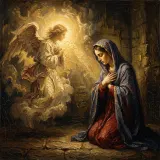
The Book of Luke opens with certainty built from testimony, then moves at once into two households where old promises acquire particular names. Zacharias receives glad tidings in the temple and leaves unable to speak; Mary receives a far larger announcement in Nazareth and answers without pretending to know more than she has been told. Elisabeth recognizes what is happening before either child can speak, and Mary's praise stretches her own low estate into God's remembered mercy toward Israel and Abraham. The relatives expect a familiar family name, but "His name is John" ends the discussion and restores Zacharias's voice. Even then, the father's prophecy looks beyond his own son to the Davidic salvation John will prepare. The chapter keeps pairing private lives with Israel's long expectation: barrenness and conception, silence and praise, an overlooked young woman and an endless kingdom. Before either ministry begins, the Book of Luke has already made clear that John and Jesus belong together without occupying the same place.
Central truth
Luke 1:1–25 establishes that God interrupts an ordinary priestly duty with a precisely timed promise: the aged Elizabeth will bear John, who will prepare a people for the Lord, while Zechariah’s unbelief is answered with both a sign and a season of silence. Luke 1:26–56 presents Mary receiving an impossible royal promise on the basis of God’s power, then shows that promise already beginning to reverberate through Elizabeth’s Spirit-filled blessing and Mary’s praise of the God who overturns human estimates of greatness. Luke 1:57–80 shows God’s promised mercy becoming public at John’s birth: the disputed child is named exactly as Gabriel commanded, Zechariah’s speech returns, and his first recorded words interpret John as the forerunner of the coming salvation.

The study notes have a page of their own
The movement by movement analysis, the words to trace, the verse by verse notes and where readers differ are written for someone studying alone. They are on the Deep Personal Reflections page for this chapter. This page is the lesson.
A chapter-specific teaching brief
These anchors come from this chapter itself. They help a teacher use the Level 1 overview, the Level 2 study, and the Scripture text as one lesson.
Open with the chapter’s first image
Luke 1:1: “Forasmuch as many have taken in hand to set forth in order a declaration of those things which are most surely believed among us,”
Slow down at the turning point
Luke 1:41: “And it came to pass, that, when Elisabeth heard the salutation of Mary, the babe leaped in her womb; and Elisabeth was filled with the Holy Ghost:”
Keep this word trail visible
Lord, angel, name, Elisabeth, holy, Mary
What to explain, in order
Teach the passage in this order. Each step names the verses it rests on, so every point can be shown in the text before it is applied.
Luke 1:1–25
Luke 1:1-4
Why Luke writes
Begin with the prologue, because it tells the class what kind of book they are holding. Others have "taken in hand to set forth in order a declaration" of these things, handed down by those "which from the beginning were eyewitnesses, and ministers of the word". Luke adds his own careful account so that Theophilus may know "the certainty" of what he was taught. Explain that "most excellent" is a courteous title, used later of Roman governors in Acts. Teaching this first sets the expectation that the angel and the temple that follow are written as events in history, set down by a careful investigator.
Luke 1:5-10
A righteous couple and an ordinary duty
Introduce Zacharias and Elisabeth with everything the Book of Luke says before the angel comes: the reign of Herod, a priest of the course of Abia, a wife of the daughters of Aaron, both "righteous before God", no child, both old. Explain "course" as one of the twenty four divisions of priests who served in turn, and "well stricken in years" as far advanced in age. Then slow down on the lot and the incense, with the people praying outside. This order matters because the class should feel the waiting and the faithfulness of the couple before the promise breaks into it.
Luke 1:11-17
The promise about John
Read the angel's appearing, Zacharias' fear and the first word of the message, "Fear not". Point to "thy prayer is heard" and let the class ask which prayer: the text leaves open whether he prayed for a son or for Israel's redemption, and the answer covers both. Then list John's identity and mission from verses 13 to 17. Explain "Elias" as the Greek form of Elijah and read Malachi 4:5-6 so the class hears the source of "to turn the hearts of the fathers to the children". Teach the mission as preparation: John is not the Lord; he readies a people for him.
Luke 1:18-22
The question that receives a sign
Put Zacharias' question beside the promise just heard. He asks "Whereby shall I know this?" and gives his reason, his age and his wife's. Gabriel answers with his name and his standing, "I am Gabriel, that stand in the presence of God", and then with the silence. Explain "dumb" in the older sense of unable to speak, and do not let anyone hear it as an insult. Teach this after the promise so the class sees the contrast: the message is good news, "glad tidings", and the failure is not asking a question but refusing to trust the one who brings it.
Luke 1:23-25
Home, conception, and Elisabeth's words
Finish with the quiet ending. Zacharias completes "the days of his ministration" and goes home, still unable to speak, and the promise begins to come true without ceremony: Elisabeth conceives. Note that she "hid herself five months" and that the Book of Luke does not explain why; resist inventing a reason. Give Elisabeth the last word in the lesson as she has it in the passage, because her sentence in 1:25 interprets the whole unit: the Lord has dealt with her and looked on her. This prepares directly for the sixth month in 1:26, where the next announcement begins.
Luke 1:26–56
Luke 1:26-29
Same angel, a different house
Begin by setting this scene beside the last one. The same Gabriel comes "in the sixth month", but not to a priest in the temple; he goes to a young woman in Nazareth, a town in Galilee, betrothed to Joseph of the house of David. Explain "espoused" as betrothed, a binding engagement before the couple lived together. Then read the greeting, "Hail, thou that art highly favoured", and note that Mary is troubled and thinks about what kind of greeting this is. Teaching the contrast first lets the class feel how far God's promise reaches beyond the expected places.
Luke 1:30-33
A king in David's line
Read the promise slowly and write it up in parts: conceive, bring forth a son, call him JESUS, great, Son of the Highest, the throne of David, reign over the house of Jacob for ever, a kingdom with no end. Explain that Jesus is the Greek form of Joshua, meaning the Lord saves, which Matthew 1:21 makes explicit. Read 2 Samuel 7:12-16 so the class hears the old promise this answers. Teach the royal language before the question of verse 34 so the class grasps how large the announcement is that Mary must take in.
Luke 1:34-38
How, and the answer of the handmaid
Mary's question is about means, and Gabriel answers it: the Holy Ghost will come upon her, the power of the Highest will "overshadow" her, and the child will be called "the Son of God". Explain overshadow with Exodus 40:34-35, where the cloud covers the tabernacle; the word pictures God's presence resting on her. Then give the sign, Elisabeth, and the reason, 1:37. Finish on 1:38: "Behold the handmaid of the Lord; be it unto me according to thy word." Teach her consent as the response this whole lesson invites: trust given before anything can be seen.
Luke 1:39-45
Two mothers and the Holy Ghost
Follow Mary into the hill country of Juda, where she goes "with haste" to Elisabeth. When the greeting is heard the child leaps and Elisabeth is filled with the Holy Ghost. Teach this as the first confirmation from outside: before Mary says anything about the angel, Elisabeth knows. Point to her phrase "the mother of my Lord" and to 1:45, which blesses Mary for believing. Put this step before the song because the song is Mary's answer to Elisabeth's blessing, and the class should hear what was said to her first.
Luke 1:46-50
The song begins with Mary's own low estate
Mary's song, often called the Magnificat after its first word in Latin, starts in the first person: "My soul doth magnify the Lord". Explain magnify as to declare great. She praises "God my Saviour", who has regarded her low estate, so that all generations will call her blessed. Teach the reason she gives, "he that is mighty hath done to me great things; and holy is his name": the honour belongs to the one who acts. Then 1:50 widens the mercy to all who fear him, from generation to generation, preparing for the reversals.
Luke 1:51-56
Reversal and the promise to Abraham
Read the verbs in a row: shewed strength, scattered, put down, exalted, filled, sent empty away, holpen. Point out that they are in the past tense, as if already done; the Book of Luke lets Mary sing God's future as settled. Explain "seats" as thrones. Then close on Abraham in 1:55, so the class ends with God's faithfulness to an old promise rather than with a social programme. Note the plain ending of 1:56: Mary stays about three months and returns home, which brings her near Elisabeth's time of delivery in 1:57.
Luke 1:57–80
Luke 1:57-58
Mercy that the neighbours see
Start with the plain fulfilment: Elisabeth's "full time came" and she bore a son. Then point to how the neighbours and cousins describe it: they heard "how the Lord had shewed great mercy upon her", and they rejoiced with her. Teach this first because it fulfils 1:14, "many shall rejoice at his birth", and because it shows the reproach of 1:25 being lifted in public. The woman who hid herself for five months is now surrounded by people who share her joy. Let the class notice that a promise kept is a community event, not only a private one.
Luke 1:59-64
The name that comes from God
Explain the eighth day with Genesis 17:12 and Leviticus 12:3: circumcision on the eighth day marked a son as part of the covenant, and naming went with it. The family expects Zacharias; Elisabeth says John; the relatives appeal to the father with signs. Point out that the signs suggest Zacharias may also have lost his hearing, and say honestly that the text does not settle it. Then the "writing table", a small tablet covered with wax. Teach the naming as the turning point of the unit: obedience to God's word ends the silence.
Luke 1:65-66
What manner of child
Widen the lens to the hill country. Fear, here reverent awe, comes on the whole neighbourhood, and the sayings spread. People lay them up in their hearts, the same habit Mary has in 2:19. Then read the Book of Luke's own comment, "the hand of the Lord was with him". Teach this short step before the prophecy because the question of the crowd is what the prophecy answers: Zacharias, filled with the Holy Ghost, tells what kind of child this is and why it matters.
Luke 1:67-75
Blessing God for the coming salvation
The song, often called the Benedictus from its first word in Latin, begins not with John but with God and with David's house. Explain "visited" as God coming near to act, and "horn of salvation" as a strong saviour, using Psalm 132:17. Show the line of promise backwards: David, the prophets, the fathers, Abraham. Then show its purpose forwards in 1:74-75: delivered so that we "might serve him without fear, In holiness and righteousness before him, all the days of our life". Teach salvation here as rescue for worship, not only rescue from enemies.
Luke 1:76-80
John's task and the dawn from on high
Now Zacharias speaks to his son. Show the three parts of John's work: called the prophet of the Highest, going before the Lord to prepare his ways, and giving knowledge of salvation through forgiveness of sins. Then the image of the dayspring, the dawn breaking on people who sit in darkness. Finish with 1:80: the child grows, becomes strong in spirit, and lives in the deserts until his public appearing. Teach this last because it leaves the class waiting for chapter 3, where John comes out of the wilderness to preach.
Where learners get stuck
The misreadings this passage tends to produce, and how to answer each from the text.
Luke 1:1–25
"Zacharias was punished because God does not like questions."
Mary asks a question in 1:34, "How shall this be", and receives an answer without rebuke. The difference is in what Gabriel names in 1:20: "thou believest not my words". Zacharias asks for proof of a promise spoken by a messenger who stands in God's presence, while Mary asks how a promise she accepts will come about. Teach the class that honest questions are welcome in Scripture, and that unbelief is a refusal to trust, not the act of asking.
"Elisabeth had no children because of some hidden sin."
Luke 1:6 closes that door before 1:7 opens the subject: they were "both righteous before God, walking in all the commandments and ordinances of the Lord blameless". The reproach of 1:25 was the judgement of people, "among men", not of God. Handle this with care, because childlessness and infertility may be present in the room. Let the text say that God saw Elisabeth, and do not promise any learner that the same outcome is coming for them.
"John was Elijah come back to life."
Gabriel says John will go before the Lord "in the spirit and power of Elias" (1:17). That is a likeness of calling and strength, not a claim that Elijah himself returns in John's body. John is born to Elisabeth as a new child and named at his birth in 1:63. Readers in different traditions discuss how Malachi's promise is fulfilled; keep the lesson on what Luke says, the spirit and power of Elijah in a new prophet.
"Luke was not there, so he is just repeating rumours."
Luke says the opposite of passing on rumours. He writes from what was "delivered" by eyewitnesses and ministers of the word (1:2), after "perfect understanding of all things from the very first" (1:3), so that Theophilus may know the certainty (1:4). He does not claim to be an eyewitness, and he does not name his sources. Teach the class to respect both facts: careful research, and honest silence about the details of how he gathered it.
Luke 1:26–56
"Mary asked the same question as Zacharias, so why was she not struck dumb?"
Compare the two questions. Zacharias asks "Whereby shall I know this?" (1:18), asking for proof, and Gabriel names the problem: he did not believe (1:20). Mary asks "How shall this be" (1:34), asking about means, and Elisabeth later says "blessed is she that believed" (1:45). The words look similar, but the text tells us the hearts differed. Teach the class that God reads the trust behind a question, and that Mary's ends in "be it unto me according to thy word".
"Nothing shall be impossible means God will do whatever I ask if I believe enough."
In 1:37 the sentence explains a sign God has already given, Elisabeth's pregnancy, and supports a promise God has already made, the birth of Jesus. It is a statement about God's power to keep his word, not a guarantee that any request will be granted. Mary's response is to submit to God's word, not to set the terms. Be gentle with learners who have prayed for something that did not happen; the verse does not accuse them.
"Mary's song is a political manifesto against the rich."
The song praises what God has done, and it does so in the language of the Psalms and of Hannah's prayer in 1 Samuel 2:1-10. The proud, the mighty and the rich are brought low, and the humble and hungry are lifted, by God's arm (1:51), not by a party or a movement. The song begins with Mary's own low estate (1:48) and ends with God's promise to Abraham (1:55). Teach the reversals as God's character, and let each learner ask where pride or hunger sits in their own heart.
"This passage settles what Christians must believe about Mary."
Traditions read Mary's place differently, and this lesson does not settle those questions. What the text says is enough to teach: Gabriel says she has found favour with God (1:30), Elisabeth calls her blessed among women and the mother of her Lord (1:42-43), and Mary says all generations shall call her blessed (1:48). Teach these words as they stand, invite learners to honour what the text honours, and leave wider doctrine to their own churches.
Luke 1:57–80
"Elisabeth just picked a name she liked."
The name John was given by Gabriel to Zacharias in 1:13, "thou shalt call his name John". Elisabeth insists on it in 1:60, and Zacharias confirms it in writing in 1:63 without consulting her, so the two agree independently of the relatives. The text does not say how Elisabeth knew; perhaps Zacharias wrote it to her. What matters is that the parents obey God's word against family custom, and that the name, which means the Lord is gracious, fits the mercy of 1:58.
"The horn of salvation is John."
Zacharias says God has raised the horn "in the house of his servant David" (1:69). John is of priestly descent through Zacharias and Elisabeth, "of the daughters of Aaron" (1:5), not of David's house. Jesus is the son promised "the throne of his father David" in 1:32. Only at 1:76 does Zacharias turn to John, and there he is "the prophet of the Highest" who goes before the Lord. Teach the class to read the song in its two halves.
"Saved from our enemies means God promised political victory over Rome."
Zacharias uses the language of Israel's deliverance in 1:71 and 1:74, and his hearers may well have expected that. But the song defines the goal in 1:75, serving God "In holiness and righteousness", and defines the means in 1:77, "the remission of their sins". The Book of Luke goes on to show Jesus refusing to be that kind of king. Do not map these lines onto any modern nation or party; keep the class on the salvation Luke describes.
Learning objectives
- Trace Luke’s movement from his orderly prologue in verses 1–4 into the priestly setting of verses 5–10 and explain why the setting matters.
- Identify what Gabriel says John will be, do, and refuse in verses 13–17 without importing details from later chapters.
- Explain why Zechariah’s question in verse 18 receives a rebuke while the promised birth still proceeds.
- Describe the function of Zechariah’s muteness in verses 20–22 as both judgment and confirming sign.
- Connect Elizabeth’s conception and five-month seclusion in verses 24–25 to her own stated interpretation of what God has done.
- Distinguish what Luke explicitly claims to have investigated from what the passage does not tell us about his sources.
- Locate Nazareth, Judaea’s hill country, and the Davidic language in Gabriel’s announcement so learners can follow both the geography and the royal claim.
- Identify the specific titles and actions assigned to Mary’s son in verses 31–33.
- Explain Mary’s question in verse 34 and Gabriel’s answer in verses 35–37 without treating the conception as ordinary.
- Trace the signs of recognition when Mary reaches Elizabeth in verses 39–45.
- Analyze Mary’s song in verses 46–55 by listing what God has done, whom He brings down or lifts up, and which covenant promise she remembers.
- Distinguish Mary’s humility from passivity by observing her question, response, journey, greeting, and praise.
- Reconstruct the naming dispute in verses 57–66 and explain why the written name 'John' matters.
- Connect the restoration of Zechariah’s speech with the fulfillment of Gabriel’s sign in Luke 1:20.
- Separate what Zechariah says about the coming deliverer in verses 68–75 from what he says directly to John in verses 76–79.
- Identify the covenant references to David and Abraham in Zechariah’s prophecy.
- Explain the images 'dayspring from on high' and guiding feet into the way of peace in their immediate poetic setting.
- Describe what verse 80 tells and does not tell about John’s years before public ministry.
Teacher preparation
- Read 1 Chronicles 24:10 and note that Abijah, written Abia in the KJV, names the priestly course to which Zechariah belonged.
- Review Exodus 30:1–10 and the daily incense service so you can explain why Zechariah is inside while the people pray outside in Luke 1:9–10.
- Mark every future-tense statement Gabriel makes about John in verses 13–17.
- Prepare to explain the older KJV expression 'well stricken in years' in verses 7 and 18 simply as advanced age.
- Read Malachi 4:5–6 alongside Luke 1:17.
- Read 2 Samuel 7:12–16 before class.
- Review Isaiah 7:14 and note the KJV wording 'a virgin shall conceive.' Do not make the class solve every debate about Isaiah before seeing that Luke himself emphasizes Mary’s virginity in Luke 1:27 and 34.
- Mark the parallel movements between Mary and Elizabeth: greeting, leaping child, filling with the Holy Ghost, blessing, and praise.
- Prepare to explain 'handmaiden' in verse 38 as a female servant.
- Read Hannah’s prayer in 1 Samuel 2:1–10.
- Re-read Luke 1:13 and 20 so the class can hear the payoff when the child is named John and Zechariah’s mouth is opened.
- Prepare to explain first-century naming expectations without exaggeration.
- Divide Zechariah’s prophecy before class at verse 76.
- Read Genesis 22:16–18 and 2 Samuel 7:12–16 so references to Abraham’s oath and David’s house can be identified rather than treated as devotional background noise.
- Note the KJV phrase 'day spring' in verse 78.
Evidence and interpretation checks
Explicit
Luke 1:13–17 explicitly says Elizabeth will bear a son named John, that many will rejoice at his birth, that he will be great in the sight of the Lord, filled with the Holy Ghost from his mother’s womb, and active in turning many in Israel toward the Lord. Luke 1:31–33 explicitly says Mary will conceive and bear Jesus, that He will be great, called the Son of the Highest, receive David’s throne, reign over Jacob’s house forever, and have a kingdom without end. Luke 1:63–64 explicitly reports that Zechariah wrote 'His name is John,' after which his mouth was opened and he spoke, praising God.
Scripture-supported
Luke 1:17 uses language from Malachi 4:5–6 about turning hearts and links John’s ministry with the spirit and power of Elijah. Luke 1:35 grounds the holy child’s identity in the action of the Holy Ghost and the power of the Highest overshadowing Mary. Luke 1:76–77 directly assigns John the role of prophet of the Highest who will go before the Lord to prepare His ways and give knowledge of salvation to His people by the remission of sins.
Strong inference
Because the lot placed Zechariah at the incense altar and the people were praying outside in verses 9–10, the announcement is strongly framed as occurring during representative priestly service for Israel, not during a private devotional moment. Elizabeth’s unborn child leaps at Mary’s greeting in verses 41 and 44, Elizabeth is filled with the Holy Ghost, and she calls Mary 'the mother of my Lord.' Taken together, the passage strongly presents recognition of Jesus before His birth. Because Zechariah’s first recorded speech after months of silence is praise and prophecy rather than complaint, the account strongly frames the restored voice as a response to fulfilled promise and renewed understanding.
Possible or traditional reading
Some readers connect John’s abstinence from wine and strong drink in verse 15 with a Nazirite vow. Christian tradition calls Mary’s song the Magnificat, from its opening in Latin, and Elizabeth’s blessing is often used liturgically. Zechariah’s prophecy is traditionally called the Benedictus from its Latin opening.
Limit
Luke 1:1–25 does not identify the eyewitnesses behind each detail, does not explain why Elizabeth hid herself for five months, and does not say that Zechariah lost hearing as well as speech. Luke does not tell us Mary’s exact age, the precise location of Elizabeth’s home, how Mary traveled, or the mechanics of the overshadowing described in verse 35. Verse 80 says John grew, became strong in spirit, and was in the deserts until his showing to Israel.
Discussion with answer guidance
1. Luke says he has 'perfect understanding of all things from the very first' and intends an orderly account.
What a good answer contains
Luke names his aim in 1:4: "That thou mightest know the certainty of those things, wherein thou hast been instructed." A good answer connects the method of 1:3, careful understanding "from the very first" and writing "in order", to that purpose: Theophilus has already been taught, and the Gospel is written so his faith can rest on reliable ground. A weak answer treats the prologue as throat clearing and skips it, or claims Luke is correcting false Gospels, which the text does not say.
Show teacher guidance
Expect the answer to center on certainty concerning the things in which Theophilus had been instructed.
2. What details in verses 5–10 make Zechariah’s encounter unusually public even though he is alone at the altar?
What a good answer contains
The answer gathers the public frame around a private moment. Zacharias serves "in the order of his course" (1:8), the course of Abia (1:5); the duty falls to him by lot "the custom of the priest's office" (1:9); he is inside "the temple of the Lord"; and "the whole multitude of the people were praying without at the time of incense" (1:10). A strong answer sees that he stands at the altar on behalf of the praying nation, so the promise is heard at the heart of Israel's worship. A weak answer calls the scene a private vision.
Show teacher guidance
Look for his priestly course, the casting of the lot, the temple setting, the hour of incense, and the praying multitude outside.
3. List Gabriel’s claims about John in verses 13–17.
What a good answer contains
Gather everything from 1:13-17 in Gabriel's own order: a son from Elisabeth, named John; joy and gladness, with "many shall rejoice at his birth"; "great in the sight of the Lord"; drinking "neither wine nor strong drink"; "filled with the Holy Ghost, even from his mother's womb"; turning many in Israel "to the Lord their God"; going before him "in the spirit and power of Elias"; and "to make ready a people prepared for the Lord". A good answer separates who John is from what he will do. A weak answer adds details from chapter 3, such as the baptizing in the Jordan.
Show teacher guidance
Identity includes his name, greatness before the Lord, abstinence, and filling with the Holy Ghost.
4. Why is Zechariah made unable to speak according to verse 20?
What a good answer contains
Gabriel gives the reason in plain words: "because thou believest not my words, which shall be fulfilled in their season" (1:20). The silence answers the question of 1:18, "Whereby shall I know this?", by giving a sign in his own body. A good answer holds both sides: it is a rebuke for unbelief, and it is also the very sign he asked for, lasting "until the day that these things shall be performed". A weak answer calls it simple punishment and misses that the promise is not withdrawn.
Show teacher guidance
Require the reason the angel gives: because Zechariah believed not Gabriel’s words.
5. What do the people conclude in verse 22 when Zechariah emerges unable to speak?
What a good answer contains
They conclude "that he had seen a vision in the temple" (1:22). Their reasoning comes from what they see: he has delayed so long that they "marvelled that he tarried so long in the temple" (1:21), and when he comes out he cannot speak, "for he beckoned unto them, and remained speechless". A good answer notices that the crowd learns something happened without learning what was said, so the content of the promise stays with Zacharias until 1:63. A weak answer assumes the people heard the angel.
Show teacher guidance
They perceive that he has seen a vision in the temple.
6. How does Elizabeth interpret her pregnancy in verse 25?
What a good answer contains
Elisabeth reads her pregnancy as the Lord's personal attention: "Thus hath the Lord dealt with me in the days wherein he looked on me, to take away my reproach among men" (1:25). A strong answer notes three parts: the Lord acted, he "looked on" her, and the result is the removal of public shame. Connect it to 1:7, where barrenness is stated plainly, and to 1:6, where the couple is called righteous, so her reproach was never a verdict on her life. A weak answer makes her barrenness a punishment, which 1:6 rules out.
Show teacher guidance
She says the Lord has dealt with her and taken away her reproach among people.
7. What three royal claims does Gabriel make about Jesus in verses 32–33?
What a good answer contains
Gabriel says "the Lord God shall give unto him the throne of his father David" (1:32), that "he shall reign over the house of Jacob for ever", and that "of his kingdom there shall be no end" (1:33). Add the title that comes first, "the Son of the Highest". A strong answer hears 2 Samuel 7:12-16 behind these lines: the promise to David of a son whose throne is established for ever. A weak answer lists the claims without seeing that Mary is hearing Israel's royal hope applied to her own child.
Show teacher guidance
Expect David’s throne, reign over the house of Jacob, and a kingdom with no end, along with the title Son of the Highest.
8. Mary asks, 'How shall this be' in verse 34.
What a good answer contains
A good answer reads the whole verse: "How shall this be, seeing I know not a man?" Mary is betrothed but not yet living with Joseph (1:27), so she asks about the means, not whether God can be trusted. Gabriel answers the means in 1:35, by the Holy Ghost and "the power of the Highest". Then 1:38 shows that the question sat beside willing trust. A weak answer treats her question as the same as Zacharias' in 1:18, which Gabriel answers very differently.
Show teacher guidance
The verse itself says she has not known a man.
9. What sign does Gabriel give Mary in verses 36–37, and what conclusion accompanies it?
What a good answer contains
The sign is Elisabeth: "thy cousin Elisabeth, she hath also conceived a son in her old age: and this is the sixth month with her, who was called barren" (1:36). The conclusion is 1:37, "For with God nothing shall be impossible." A strong answer notices that Mary did not ask for a sign, and receives one that she can go and see for herself, which she does in 1:39. A weak answer quotes 1:37 alone as a general slogan and loses the concrete sign it explains.
Show teacher guidance
Elizabeth has conceived in old age and is in her sixth month.
10. What happens in Elizabeth’s household the moment Mary’s greeting is heard?
What a good answer contains
Three things happen at once in 1:41: "the babe leaped in her womb", and "Elisabeth was filled with the Holy Ghost", and she cries out with a loud voice. Her blessing follows in 1:42-45: Mary blessed among women, the fruit of her womb blessed, the question "whence is this to me, that the mother of my Lord should come to me?", and the blessing on faith, "blessed is she that believed". A good answer notes that Elisabeth calls the unborn child "my Lord". A weak answer forgets the blessing on Mary's belief in 1:45.
Show teacher guidance
Name the child leaping in Elizabeth’s womb, Elizabeth being filled with the Holy Ghost, and her blessing of Mary.
11. In Mary’s song, who is scattered, put down, exalted, filled, and sent away empty?
What a good answer contains
Read verses 51 to 53 as three reversals. The proud are "scattered" in the imagination of their hearts; the mighty are put down "from their seats" and those "of low degree" exalted; "the hungry" are filled with good things and "the rich he hath sent empty away". A strong answer connects this to 1:48, where Mary's own "low estate" was regarded, so she sings what has already happened to her. A weak answer turns the song into a programme for one group against another; Mary praises what God does.
Show teacher guidance
Use verses 51–53.
12. Where does Mary place the coming mercy in Israel’s longer history?
What a good answer contains
Mary places it in God's covenant faithfulness: "He hath holpen his servant Israel, in remembrance of his mercy; As he spake to our fathers, to Abraham, and to his seed for ever" (1:54-55). A good answer explains "holpen" as helped and connects the verse to the promise to Abraham in Genesis 12 and 22. The point is that the new thing is the old promise kept. A weak answer reads the song as about Mary alone and misses that it ends with Israel and Abraham, not with her.
Show teacher guidance
Verse 55 names Abraham and his seed.
13. Why do the neighbors and relatives object to Elizabeth’s chosen name in verses 59–61?
What a good answer contains
They follow custom: on the eighth day "they called him Zacharias, after the name of his father" (1:59), and when Elisabeth says "Not so; but he shall be called John" (1:60) they object, "There is none of thy kindred that is called by this name" (1:61). A good answer sees that the relatives are not wicked; they expect family names to carry family identity. The point is that this child's identity comes from God's word in 1:13, not from his kindred. A weak answer misses that Elisabeth already knows the name without having heard the angel speak.
Show teacher guidance
They expect the child to be named after his father and say none of the kindred bears the name John.
14. What changes the moment Zechariah writes, 'His name is John'?
What a good answer contains
Everything changes at once. Zacharias asks for a writing table, writes "His name is John", and "they marvelled all" (1:63). Then "his mouth was opened immediately, and his tongue loosed, and he spake, and praised God" (1:64). A strong answer links this to 1:20: the silence was to last "until the day that these things shall be performed", and his obedience in naming the child marks that day. Notice too that his first restored words are praise, not complaint. A weak answer misses that the sign ends exactly when he aligns himself with Gabriel's word.
Show teacher guidance
Verse 64 says his mouth is opened immediately, his tongue loosed, and he speaks and praises God.
15. What effect do these events have on the surrounding region in verses 65–66?
What a good answer contains
Then "fear came on all that dwelt round about them" (1:65), the news is "noised abroad throughout all the hill country" of Judaea, and all who heard "laid them up in their hearts" (1:66). They ask what manner of child this will be, and the Book of Luke adds "the hand of the Lord was with him". A good answer sees the movement from a household to a region, and that the response is reverent wonder and a question waiting for an answer. A weak answer calls the fear terror; here it is awe at God's evident work.
Show teacher guidance
Fear comes on the neighbors, the sayings are discussed throughout the hill country of Judaea, and people ask what manner of child John will be.
16. Which promises in Zechariah’s prophecy reach backward to David and Abraham?
What a good answer contains
Zacharias blesses God for raising "an horn of salvation for us in the house of his servant David" (1:69), "As he spake by the mouth of his holy prophets" (1:70), and then goes further back: "To perform the mercy promised to our fathers, and to remember his holy covenant; The oath which he sware to our father Abraham" (1:72-73). A strong answer explains horn as a picture of strength and sees that the promises to David and to Abraham are both kept in one act. A weak answer misses that the Davidic horn is Jesus, not John, who is from the priestly line.
Show teacher guidance
Use verses 69–73.
17. Beginning at verse 76, what does Zechariah say John himself will do?
What a good answer contains
He turns to the baby: "And thou, child, shalt be called the prophet of the Highest: for thou shalt go before the face of the Lord to prepare his ways" (1:76), and his task is "To give knowledge of salvation unto his people by the remission of their sins" (1:77). A good answer notices that John's role is to prepare and to give knowledge; he points to salvation, he is not its source. Remission means forgiveness, the release of a debt. A weak answer gives John the role of the coming king, which 1:69 has already given to David's house.
Show teacher guidance
John will be called prophet of the Highest, go before the Lord, prepare His ways, and give knowledge of salvation by remission of sins.
18. What picture closes the prophecy in verses 78–79?
What a good answer contains
Light at dawn: "the dayspring from on high hath visited us" (1:78), "To give light to them that sit in darkness and in the shadow of death, to guide our feet into the way of peace" (1:79). Explain dayspring as the dawn or the rising sun, and connect it with Isaiah 9:2 and Malachi 4:2. A strong answer notes that this comes "Through the tender mercy of our God", so the whole picture rests on mercy. A weak answer reads the darkness as only ignorance and misses the shadow of death that the dawn breaks.
Show teacher guidance
The dayspring from on high visits those sitting in darkness and the shadow of death, guiding feet into peace.
Responsible application
Heart and habits
Invite learners to compare Zechariah’s reaction in verse 18 with Gabriel’s concrete promise in verses 13–17.
Relationships and community
Use the praying crowd in verse 10 and Elizabeth’s words in verse 25 to discuss how private burdens can sit inside public worship without the community knowing their full weight.
When waiting becomes part of the lesson
Ask the class why the passage gives Zechariah months of silence before the promise is fulfilled.
The reversals Mary sings
List the reversals in verses 51–53 and ask what kinds of human status look unstable under Mary’s vision of God’s action.
Use the right name
The relatives have a sensible custom in mind, but Elizabeth and Zechariah obey a command that cuts across that expectation.
Session plans
Two timings of the same lesson. The shorter keeps the reading, the central discussion and one response; the longer gives the confusions and the application their own time.
Luke 1:1–25
45 minutes
Luke's purpose
Read 1:1-4 and ask question one. Write the word certainty on the board and leave it there for the session.
The priest and the people
Read 1:5-10. Ask question two and sketch the temple: the altar inside, the crowd outside. Take confusion two briefly from 1:6.
Gabriel's promise
Read 1:11-17. Ask question three and list John's identity and mission in two columns. Read Malachi 4:5-6 and deal with confusion three.
Silence as rebuke and sign
Read 1:18-22. Ask questions four and five, then take confusion one with Luke 1:34 read beside verse 18.
Elisabeth's interpretation
Read 1:23-25 and ask question six. Let her sentence stand as the summary of the passage.
Handout and prayer
Read the key verse together, give out the sheet, and pray for anyone who is still waiting on God.
90 minutes
What makes an account trustworthy
Ask the group how they decide whether a report of something remarkable is reliable. Then read 1:1-4 and ask question one. Take confusion four.
The setting in the temple
Read 1:5-10 with 1 Chronicles 24:10 and Exodus 30:7-8. Explain the courses and the incense. Ask question two.
Righteous and waiting
Reread 1:6-7. Take confusion two with care, and give the room a moment of quiet before moving on.
The shape of John's calling
Read 1:11-17. Ask question three, build the two column list, then read Malachi 4:5-6. Take confusion three.
The question and the silence
Read 1:18-22 and then 1:34-37. Ask questions four and five. Take confusion one and let the group name the difference between asking and refusing to trust.
Elisabeth's sentence
Read 1:23-25 and ask question six. Point ahead to 1:26 and the sixth month.
Application
Work through the application on waiting. In pairs, each person names one promise of God they find hard to trust and one thing in the text that answers that difficulty.
Handout and prayer
Read the key verse together, point to the take-home line, and close in prayer for those who wait.
Luke 1:26–56
45 minutes
Nazareth, not the temple
Read 1:26-29 and contrast the setting with 1:5-10. Ask what is different about where Gabriel goes this time.
The royal promise
Read 1:30-33 and ask question one. List the claims on the board and read 2 Samuel 7:16 beside them.
How shall this be
Read 1:34-38. Ask questions two and three, then take confusion one with 1:18 read beside 1:34.
Elisabeth's greeting
Read 1:39-45 and ask question four. Point to the blessing on faith in 1:45.
Mary's song
Read 1:46-56 aloud together. Ask questions five and six and take confusion three.
Handout
Read the key verse together and give out the sheet. Close by praying Mary's words of trust.
90 minutes
Where God chooses to work
Ask where the group would expect God to announce the most important birth in history. Then read 1:26-29 and compare it with the temple scene in 1:5-10.
The son of David
Read 1:30-33 and ask question one. Read 2 Samuel 7:12-16 and Isaiah 9:6-7. Let the group trace how the promise to David is picked up.
The question and the consent
Read 1:34-38. Ask questions two and three. Explain overshadow with Exodus 40:34-35. Take confusions one and two.
The visit
Read 1:39-45 and ask question four. Discuss why Elisabeth's knowledge, before Mary tells her anything, confirms the angel's word.
The song and its roots
Read 1:46-56, then Hannah's prayer in 1 Samuel 2:1-10. Ask questions five and six. Take confusion three, and then confusion four if anyone raises doctrine about Mary.
Application
Use the application on trust. Each learner writes one area where they find it hard to say be it unto me according to thy word, and one line from the song that answers it.
Handout and prayer
Read the key verse together, point to the take-home line, and pray through the song phrase by phrase.
Luke 1:57–80
45 minutes
Joy among the neighbours
Read 1:57-58 and ask the class which earlier promise this fulfils. Read 1:14 again.
Not so, he shall be called John
Read 1:59-64. Ask questions one and two, then take confusion one. Show a picture of a wax writing tablet if you can.
What manner of child
Read 1:65-66 and ask question three. Leave the crowd's question on the board for the next step.
The prophecy about David's house
Read 1:67-75. Ask question four and take confusion two. Draw a line back from Jesus to David to Abraham.
John and the dawn
Read 1:76-80. Ask questions five and six. Turn off a light and then open a curtain if the room allows.
Handout
Read the key verse together, give out the sheet, and close by thanking God for his tender mercy.
90 minutes
Names that carry meaning
Ask a few learners whether their name was chosen after someone in the family, and why. Then read 1:57-58 and 1:14.
The eighth day and the name
Read Genesis 17:12 and then 1:59-64. Ask questions one and two. Take confusion one and link the restored speech to 1:20.
Fear and wonder
Read 1:65-66 and ask question three. Compare the hearts that lay things up here with Mary in 2:19.
Promises to David and Abraham
Read 1:67-75 with Psalm 132:17 and Genesis 22:16-18. Ask question four. Take confusions two and three.
The prophet and the dayspring
Read 1:76-80 with Isaiah 9:2 and Malachi 4:2. Ask questions five and six.
Application
Use the application on obedience to God's word against custom. In small groups, learners name one place where faithfulness might cost them the approval of people close to them.
Handout and prayer
Read 1:78-79 together, point to the take-home line, and pray for those who sit in darkness.
Adapting the lesson
Luke 1:1–25
Children
Act out the temple scene with a box for the altar and a group of children outside pretending to pray. One child is Zacharias, one is the angel. When Zacharias asks how he can know, have him put a finger to his lips and stay quiet until the end of the lesson. Keep the message simple: God heard a prayer and kept his promise. Avoid suggesting that families without children are being punished.
Youth
Start with the question of what it would take for them to believe a promise that seemed impossible. Read 1:18 and ask whether Zacharias' doubt sounds reasonable to them. Then read 1:34 and compare. Let them work out the difference between questioning and unbelief from the two verses, and give room for students who doubt honestly to say so without being treated as the problem.
Adults
Give time to the historical frame: Herod, the priestly courses, the incense hour, Malachi's promise. Discuss Luke's prologue as a claim about reliable testimony. Many adults have waited years for something, and some have stopped praying for it; let the faithfulness of Zacharias and Elisabeth before the promise speak, and do not turn their miracle into a formula that every waiting couple should expect.
One to one
Read the passage aloud together and ask where the person would place themselves: in the crowd outside, at the altar, or at home with Elisabeth. If a long wait or a disappointment is part of their life, let 1:6 and 1:25 be heard together: righteous and still waiting, then seen by the Lord. Do not promise them Elisabeth's outcome. Offer to pray with them about the specific thing they carry.
Luke 1:26–56
Children
Tell the children an angel visited a young woman in a small town, not a palace. Show two pictures, one of Elisabeth and one of Mary, and talk about how happy they were to see each other. Let the children jump when you read that the baby leaped for joy. Teach the sentence be it unto me according to thy word as Mary saying yes to God. Leave out explanations of how babies are made; say that God made it happen.
Youth
Ask them what it would cost a young woman in a small town to say yes to this message, and let them name the risks: Joseph, her family, her reputation. Read 1:38 against that background. Then read the song as words from a teenager or young woman who believes God lifts the lowly. Be ready for questions about the virgin birth; answer from 1:34-35 and do not mock any honest doubt.
Adults
Give time to the Old Testament background: 2 Samuel 7, the overshadowing cloud of Exodus 40, Hannah's song in 1 Samuel 2. Discuss the contrast between Zacharias and Mary as a study in trust. Expect people from several traditions; teach what the text says about Mary's blessedness and leave further doctrine alone. Let the reversals of 1:51-53 search the comfortable as well as comfort the poor.
One to one
Read 1:38 together and ask what God might be asking them to accept that they cannot yet see. Do not pressure an answer. If they feel small or unnoticed, read 1:48 slowly, he hath regarded the low estate of his handmaiden, and let it be heard as God seeing them. Offer to pray Mary's words with them, or simply to read the song aloud together.
Luke 1:57–80
Children
Give each child a small card and ask them to write or draw their own name. Then show a card with John written on it, and tell them God chose this name before the baby was born. Have one child play Zacharias, unable to talk, writing on the card, and then suddenly speaking and praising God. End with a candle or torch to show the dawn coming into darkness.
Youth
Talk about the pressure to do what everyone in your family or group expects. Read 1:59-61 and ask how Elisabeth and Zacharias held out against relatives who meant well. Then read the prophecy as a description of a life with purpose: freed to serve God without fear. Let them pick one line from 1:74-79 that describes what they want their own life to be.
Adults
Give time to the Old Testament threads: circumcision on the eighth day, the horn of David, the oath to Abraham, Isaiah's light in the darkness. Discuss how salvation in 1:74-77 is defined as forgiveness and holy service, not only deliverance from enemies. Adults who have lived through a long silence may find Zacharias' first words of praise moving; give them room to say what they would say.
One to one
Read 1:78-79 slowly together. Ask whether any part of their life feels like sitting in darkness or the shadow of death, and listen without hurrying to fix it. Then point to the tender mercy of God as the source of the dawn. If they are grieving or afraid, offer to pray the words to guide our feet into the way of peace over them.
Song and video learning lab
A song or video may interpret, compress, or dramatize the text. Its value becomes clearer when its choices are compared with Scripture.
- Before the media: the exact passage and its central movement.
- During the media: the words, people, events, and emotions the artist emphasizes.
- After the media: what it clarifies, what it leaves out, and what belongs back in the biblical text.
Handout
One page for learners to take home. The print button prints this section alone.
Luke 1:1–25
The passage in brief
Luke begins by saying he has carefully studied everything so that Theophilus can be sure of what he was taught. Then he tells of Zacharias, an old priest, and his wife Elisabeth, who were faithful to God but had no children. While Zacharias burned incense in the temple, the angel Gabriel told him that Elisabeth would have a son named John, who would prepare people for the Lord. Zacharias doubted and could not speak until the promise came true. Elisabeth conceived and praised the Lord for looking on her.
A verse to keep
But the angel said unto him, Fear not, Zacharias: for thy prayer is heard; and thy wife Elisabeth shall bear thee a son, and thou shalt call his name John.
Luke 1:13 · King James Version
Questions to take home
Why does Luke say he wrote his Gospel (1:4)?
What would John be and do, according to Gabriel (1:15-17)?
How did Elisabeth explain what God had done for her (1:25)?
This week
Name one promise of God you find hard to trust, and pray about it honestly each day this week.
Luke 1:26–56
The passage in brief
Six months after he visited Zacharias, the angel Gabriel was sent to Mary, a young woman in Nazareth engaged to Joseph. He told her she would have a son named Jesus, who would be called the Son of God and reign on David's throne for ever. Mary asked how, since she had not been with a man, and the angel said the Holy Ghost would come upon her. She answered that she was the Lord's servant. Mary then visited Elisabeth, who blessed her, and Mary sang praise to God, who lifts up the humble.
A verse to keep
And Mary said, Behold the handmaid of the Lord; be it unto me according to thy word. And the angel departed from her.
Luke 1:38 · King James Version
Questions to take home
What did Gabriel say Mary's son would be (1:32-33)?
Why did Elisabeth call Mary blessed (1:45)?
In Mary's song, what does God do for the humble and the hungry (1:52-53)?
This week
Each morning this week, pray Mary's words, be it unto me according to thy word, about one specific part of your day.
Luke 1:57–80
The passage in brief
Elisabeth gave birth to a son, and her neighbours rejoiced at God's mercy. When the family wanted to name the baby after his father, Elisabeth said his name was John. Zacharias, still unable to speak, wrote the same name, and at once he could talk again and praised God. Filled with the Holy Ghost, Zacharias thanked God for keeping his promises to David and Abraham, and said John would prepare the way of the Lord and tell people about forgiveness of sins.
A verse to keep
And thou, child, shalt be called the prophet of the Highest: for thou shalt go before the face of the Lord to prepare his ways; To give knowledge of salvation unto his people by the remission of their sins,
Luke 1:76-77 · King James Version
Questions to take home
What happened when Zacharias wrote His name is John (1:63-64)?
Which two people from Israel's past does Zacharias remember in his song (1:69, 1:73)?
What did Zacharias say John would do (1:76-77)?
This week
Think of one person who is sitting in darkness right now, and pray for them by name every day this week.
Music and video connected to the passage
Related media appears when its Scripture reference overlaps this study. Music and video can illuminate a theme while the biblical text remains the foundation.