The big picture
The Book of Luke opens with certainty built from testimony, then moves at once into two households where old promises acquire particular names. Zacharias receives glad tidings in the temple and leaves unable to speak; Mary receives a far larger announcement in Nazareth and answers without pretending to know more than she has been told. Elisabeth recognizes what is happening before either child can speak, and Mary's praise stretches her own low estate into God's remembered mercy toward Israel and Abraham. The relatives expect a familiar family name, but "His name is John" ends the discussion and restores Zacharias's voice. Even then, the father's prophecy looks beyond his own son to the Davidic salvation John will prepare. The chapter keeps pairing private lives with Israel's long expectation: barrenness and conception, silence and praise, an overlooked young woman and an endless kingdom. Before either ministry begins, the Book of Luke has already made clear that John and Jesus belong together without occupying the same place.
In this chapter
- An Account Written for Certainty Luke 1:1-4
The Book of Luke begins by refusing the pose of a solitary writer dropping unheard information on an unsuspecting reader.
- The Priest Comes Out Without a Word Luke 1:5-25
Before the childlessness appears, the Book of Luke has already called Zacharias and Elisabeth righteous and blameless in their walk.
- A Throne Promised in Nazareth Luke 1:26-38
The scene changes from priestly Jerusalem to ordinary Nazareth, but Gabriel's language grows rather than shrinks.
- Recognition Before Either Child Speaks Luke 1:39-45
A greeting at the door becomes recognition before either promised child has spoken.
- Mary's Praise Widens Beyond Her Household Luke 1:46-56
Mary's praise begins close to home and then refuses to stay there.
- The Relatives Do Not Get to Name This Child Luke 1:57-66
The neighbors can recognize mercy in Elisabeth's child without knowing what his name is supposed to be.
- A Father Praises Someone Greater Than His Son Luke 1:67-80
Zacharias finally has his voice, and the striking thing is how long he speaks before getting to his own son.

Scripture beside the summary
Luke · King James Version · 80Luke 1:1-4
An Account Written for Certainty
The Book of Luke begins by refusing the pose of a solitary writer dropping unheard information on an unsuspecting reader. Others have already written, eyewitnesses have already delivered what they saw, and Theophilus has already been instructed. The distinctive promise is an orderly account grounded in careful acquaintance with that transmitted material, written so that instruction may rest on certainty rather than rumor. That makes the opening unusually candid about the route by which testimony becomes a written Gospel. The Book of Luke distinguishes the events, those who witnessed them, and the later task of arranging their testimony without separating those stages from one another. "From the beginning" belongs to the eyewitnesses, while the Book of Luke claims thorough understanding of the material. Even the respectful "most excellent Theophilus" remains restrained. A named recipient is enough. The Book of Luke supplies neither a profession nor a patronage arrangement, and he does not need an invented biography to explain why a careful account is worth writing.
Deep dive
Luke does not introduce the account as information nobody has heard before. Many have undertaken written accounts, eyewitnesses have handed on testimony, and Theophilus has already been instructed. The promised contribution is an ordered presentation that strengthens certainty. The opening therefore distinguishes the events, the people who witnessed them, and the subsequent work of preserving and arranging their testimony. Those stages belong together without being treated as identical.
The phrase "from the beginning" in verse 2 describes the eyewitnesses; the claim in verse 3 concerns Luke's thorough acquaintance with the material. The passage does not claim that Luke personally witnessed every event about to be described. Nor does "in order" require every incident to be placed in an uninterrupted day-by-day chronology. The arrangement will repeatedly connect events by subject and purpose. Theophilus's title, "most excellent," is respectful, but neither his occupation nor a proposed financial role in producing the book is supplied here. The account begins with a named recipient, not an invented biography.
Words to trace: order, beginning, believed, certainty, declaration, delivered
Verse-by-verse path
- Luke 1:1
Verses 1–4 are a single long sentence in polished literary Greek, the kind historians and medical writers put at the head of a serious work. At verse 5 the style changes abruptly into the cadence of the Greek Old Testament. “Most surely believed” can also be read as “fulfilled”, things brought to completion among us.
- Luke 1:2
“Delivered” is the technical verb for handing on tradition, the one Paul uses in 1 Corinthians 15:3. “Ministers” are attendants, hyperetai, the word Luke uses for the synagogue attendant who takes back the scroll in 4:20.
- Luke 1:3
“Perfect understanding” is literally “having followed closely and accurately”. “From the very first” is anothen, from the top, which can also mean from above. “In order” is a word only Luke uses in the New Testament. “Most excellent” is the address Acts uses for the governors Felix and Festus (23:26, 26:25).
- Luke 1:4
“Certainty” is asphaleia, security, firm footing, and Luke saves it for the last word of the Greek sentence. “Instructed” is katecheo, to teach by word of mouth, the root of “catechism”. Theophilus’ name means friend of God, or loved by God.
Luke 1:1-4
King James Version1Forasmuch as many have taken in hand to set forth in order a declaration of those things which are most surely believed among us,
2Even as they delivered them unto us, which from the beginning were eyewitnesses, and ministers of the word;
3It seemed good to me also, having had perfect understanding of all things from the very first, to write unto thee in order, most excellent Theophilus,
4That thou mightest know the certainty of those things, wherein thou hast been instructed.
Luke 1:5-25
The Priest Comes Out Without a Word
Before the childlessness appears, the Book of Luke has already called Zacharias and Elisabeth righteous and blameless in their walk. That ordering quietly prevents an easy equation between barrenness and concealed guilt. Gabriel's announcement answers a household grief, but it immediately outruns it: John will prepare a people for the Lord in the spirit and power of Elias. The promised son is therefore both deeply personal and deliberately secondary to the one whose way he prepares. Zacharias asks how he can know, and Gabriel names the request for what it is in this scene, unbelief. The resulting sign has almost comic precision. A priest receives "glad tidings" during public service and then walks back to the waiting congregation unable to say a word. His silence does not cancel what he doubted. Elisabeth conceives, withdraws for five months, and gets the final sentence herself, describing the removal of the reproach that other people had attached to her condition.
Deep dive
Before mentioning their childlessness, Luke identifies Zacharias and Elisabeth as righteous. That order matters: the absence of a child is not presented as evidence of concealed wrongdoing. Elisabeth later names the public reproach attached to her circumstances, but the book has already separated that reproach from God's assessment of the couple. The promise enters an existing life of faithful service rather than rewarding a sudden improvement in conduct.
John's assignment is larger than the answer to a family's prayer. Gabriel connects him with Elijah's prophetic work and the preparation of a people for the Lord, drawing on Malachi 4:5–6. The promised child will not simply be remarkable; he will point beyond himself. His abstinence from wine is specified, but Luke does not list every condition of a Nazirite vow, so that fuller identification should remain an inference.
Zacharias requests a basis for certainty, and Gabriel explicitly names his response as unbelief. The sign is exquisitely fitted to the scene: a priest receives glad tidings and emerges unable to announce them. The waiting congregation gets gestures instead. Yet his silence does not cancel the promise. Elisabeth conceives, and Luke allows her own words about the removal of reproach to close the episode.
Words to trace: Lord, Zacharias, angel, days, Elisabeth, wife
Verse-by-verse path
- Luke 1:5
Herod the Great died in 4 BC, which places these events before then. The course of Abia is Abijah, the eighth of the twenty-four priestly divisions drawn by lot in 1 Chronicles 24:10. Elisabeth bears the name of Aaron’s own wife, Elisheba (Exodus 6:23), so both husband and wife are of priestly descent.
- Luke 1:6
“Commandments and ordinances” is the pair the Greek Old Testament uses for the whole range of the Law’s requirements. “Walking” is the Hebrew picture of conduct as a road travelled. “Blameless” means no one could point to a failure, not that they were sinless.
- Luke 1:7
“Well stricken in years” repeats the phrase used of Abraham and Sarah in Genesis 18:11, righteous, old and childless. Luke’s first readers who knew their Scriptures would recognise the setting before any angel appears.
- Luke 1:8
Each of the twenty-four divisions served in the temple for a week, twice a year, and all served together at the great feasts. Zacharias is on duty in the ordinary rotation; nothing about the day is exceptional until verse 11.
- Luke 1:9
Priests were so numerous, around twenty thousand by Josephus’ reckoning, that duties were assigned by lot. The Mishnah says a priest who had once burned the incense could not be chosen for it again, so this was likely the one time in his life. “Temple” here means the sanctuary building itself, which only priests entered.
- Luke 1:10
Incense was offered at the morning and evening sacrifices, and the people gathered in the courts to pray while it burned. Psalm 141:2 makes the link: “Let my prayer be set forth before thee as incense.” Acts 3:1 names the ninth hour, mid-afternoon, as the hour of prayer.
- Luke 1:11
The golden altar of incense stood in the holy place just before the veil, between the lampstand and the table of shewbread (Exodus 30:1–6). The angel stands on its right side, the side of favour. Zacharias is alone in the room, and there is no one to share what he sees.
- Luke 1:12
Fear is the ordinary response to an angel in Scripture; Manoah, Samson’s father, is sure he will die for having seen one (Judges 13:22). Luke doubles the reaction: troubled, and fear fell upon him.
- Luke 1:13
Which prayer is heard is not stated. It may be the couple’s long prayer for a child, or the prayer for Israel’s redemption a priest would offer at the incense; the angel’s answer covers both. John is Yohanan, “the LORD has been gracious”.
- Luke 1:14
“Joy and gladness” is where Luke begins, and his book ends the same way, with the disciples returning to Jerusalem “with great joy” (24:52). The joy is not kept in the family; “many” will share it.
- Luke 1:15
“Strong drink” is sikera, fermented drink not made from grapes, such as date wine or beer. The pair was forbidden to priests on duty (Leviticus 10:9) and was part of Hannah’s vow for Samuel in the Greek of 1 Samuel 1:11. “Great in the sight of the Lord” is a measured greatness; compare verse 32.
- Luke 1:16
“Turn” is the prophets’ word for repentance, a return along a road already walked away from. The promise is for “many”, not all, a realistic expectation for any prophet in Israel’s history.
- Luke 1:17
“Before him” refers back to “the Lord their God” in verse 16, so John goes ahead of God himself. The angel quotes the first half of Malachi’s line and replaces the second with “the disobedient to the wisdom of the just”. Malachi’s closing threat of a curse is not repeated.
- Luke 1:18
“Whereby shall I know this?” is word for word Abraham’s question in the Greek of Genesis 15:8, asked about the land he was promised. Abraham received a sign in a covenant ceremony. Zacharias receives one too, of a very different kind.
- Luke 1:19
Gabriel appears only in Daniel in the Old Testament (8:16, 9:21), and in Daniel 9:21 he comes “about the time of the evening oblation”, the hour of incense. To “stand in the presence” is courtly language for a king’s close attendant, one who waits for his orders.
- Luke 1:20
The sign Zacharias asked for is given, and it is his own silence. “Dumb” renders a word that elsewhere can mean deaf as well as mute. “In their season” is kairos, the appointed time, which in this case is nine months away.
- Luke 1:21
The incense took only minutes, and a long delay in the sanctuary was alarming. The Mishnah says that on the Day of Atonement the high priest kept his prayer short so as not to frighten the people waiting outside. “Waited” is imperfect: they stood there waiting.
- Luke 1:22
After the incense, the officiating priests were to pronounce the priestly blessing of Numbers 6:24–26 over the people from the steps. Zacharias cannot say it. Luke’s gospel ends with Jesus lifting up his hands and blessing his disciples (24:50), the blessing the book began without.
- Luke 1:23
“Ministration” is leitourgia, public service, the root of the word liturgy. His week ended, he goes home to the hill country of Judea, the town left unnamed until Mary travels there in verse 39.
- Luke 1:24
Luke does not say why Elisabeth hid herself. One suggestion is that she waited until the pregnancy was visible and could not be doubted; that is an inference. Five months brings her to the sixth month in which verse 26 begins.
- Luke 1:25
“To take away my reproach” echoes Rachel at the birth of Joseph: “God hath taken away my reproach” (Genesis 30:23). Barrenness was widely read as disgrace. “Looked on me” means God’s attention turned to her.
Luke 1:5-25
King James Version5There was in the days of Herod, the king of Judæa, a certain priest named Zacharias, of the course of Abia: and his wife was of the daughters of Aaron, and her name was Elisabeth.
6And they were both righteous before God, walking in all the commandments and ordinances of the Lord blameless.
7And they had no child, because that Elisabeth was barren, and they both were now well stricken in years.
8And it came to pass, that while he executed the priest’s office before God in the order of his course,
9According to the custom of the priest’s office, his lot was to burn incense when he went into the temple of the Lord.
10And the whole multitude of the people were praying without at the time of incense.
11And there appeared unto him an angel of the Lord standing on the right side of the altar of incense.
12And when Zacharias saw him, he was troubled, and fear fell upon him.
13But the angel said unto him, Fear not, Zacharias: for thy prayer is heard; and thy wife Elisabeth shall bear thee a son, and thou shalt call his name John.
14And thou shalt have joy and gladness; and many shall rejoice at his birth.
15For he shall be great in the sight of the Lord, and shall drink neither wine nor strong drink; and he shall be filled with the Holy Ghost, even from his mother’s womb.
16And many of the children of Israel shall he turn to the Lord their God.
17And he shall go before him in the spirit and power of Elias, to turn the hearts of the fathers to the children, and the disobedient to the wisdom of the just; to make ready a people prepared for the Lord.
18And Zacharias said unto the angel, Whereby shall I know this? for I am an old man, and my wife well stricken in years.
19And the angel answering said unto him, I am Gabriel, that stand in the presence of God; and am sent to speak unto thee, and to shew thee these glad tidings.
20And, behold, thou shalt be dumb, and not able to speak, until the day that these things shall be performed, because thou believest not my words, which shall be fulfilled in their season.
21And the people waited for Zacharias, and marvelled that he tarried so long in the temple.
22And when he came out, he could not speak unto them: and they perceived that he had seen a vision in the temple: for he beckoned unto them, and remained speechless.
23And it came to pass, that, as soon as the days of his ministration were accomplished, he departed to his own house.
24And after those days his wife Elisabeth conceived, and hid herself five months, saying,
25Thus hath the Lord dealt with me in the days wherein he looked on me, to take away my reproach among men.
Luke 1:26-38
A Throne Promised in Nazareth
The scene changes from priestly Jerusalem to ordinary Nazareth, but Gabriel's language grows rather than shrinks. Mary is told that her son will receive David's throne, reign over Jacob for ever, and possess a kingdom without end. John will prepare; Jesus will reign. That difference keeps the two birth announcements in deliberate relation without flattening them into parallel versions of the same role. Mary's question also receives a different response from Zacharias's. She asks how conception will occur in her present circumstances and is answered rather than rebuked. Gabriel names the Holy Ghost and "the power of the Highest," giving the event a divine cause without pretending to give a physical mechanism. Elisabeth's pregnancy becomes a sign that joins the two households before the children meet. Mary's final words, "be it unto me according to thy word," are not a claim to understand the future. They are acceptance of a promise whose scale is far larger than anything visible in Nazareth.
Deep dive
The movement from the temple to Nazareth is substantial. Gabriel now addresses a woman outside the priestly setting, and the promised king has no visible throne awaiting him. The language of David's throne and an enduring kingdom recalls the promise in 2 Samuel 7:12–16. Luke does not reduce Jesus to another prophet in John's line: John prepares a people, while Jesus receives the kingdom and is called the Son of the Highest.
Mary's question concerns how conception can occur in her circumstances. Unlike Zacharias, she is not rebuked for unbelief. Gabriel answers by naming the Holy Ghost and the power of the Highest, not by supplying a physical mechanism. "Overshadow" communicates divine action without turning the announcement into a biological explanation. Elisabeth's pregnancy supplies a confirming sign and also joins the two households before their children are born.
Mary's final response accepts the word delivered to her; it does not claim full knowledge of the future. Luke gives her deliberation and her answer, but not the private speeches, exact age, or imagined reactions of neighbors often added to this scene. The KJV's "cousin" identifies kinship with Elisabeth without establishing the precise degree of their relationship.
Words to trace: angel, Mary, Lord, name, David, Highest
Verse-by-verse path
- Luke 1:26
“The sixth month” is counted from Elisabeth’s conception, tying the two announcements together. Nazareth is never mentioned in the Old Testament or by Josephus; it was a small village in the hills above the Jezreel valley. Luke calls it a city, the word for any settled town.
- Luke 1:27
Betrothal was a binding legal contract that only divorce could end, though the bride stayed in her father’s house until the wedding, often about a year later. “Of the house of David” belongs grammatically to Joseph. The word “virgin” appears twice in one verse.
- Luke 1:28
“Hail” is chaire, the ordinary Greek greeting, which literally means rejoice. “Highly favoured” is built on the same root, charis, grace: one who has been graced. The greeting and the title are a play on the same word.
- Luke 1:29
Zacharias was troubled at the sight of the angel (verse 12); Mary is troubled at his words. “Cast in her mind” is imperfect, she kept turning it over, and Luke gives her a thoughtful response before any question.
- Luke 1:30
“Found favour with God” is said of Noah in Genesis 6:8 and of Moses in Exodus 33:17. The favour is charis again, the word from verse 28, and the angel’s repetition answers Mary’s puzzlement over his greeting.
- Luke 1:31
The wording follows Isaiah 7:14 in the Greek Old Testament closely: conceive in the womb, bear a son, call his name. Luke does not cite Isaiah; Matthew does. Jesus is Yeshua, the same name as Joshua, meaning “the LORD saves”. Here Mary gives the name.
- Luke 1:32
“The Highest” translates the Hebrew Elyon, the title of God first heard from Melchizedek in Genesis 14:18. John was to be “great in the sight of the Lord” (verse 15); Jesus is simply “great”, without qualification.
- Luke 1:33
“No end” echoes Isaiah 9:7: “Of the increase of his government and peace there shall be no end, upon the throne of David.” The “house of Jacob” is Israel as a whole, all twelve tribes, not only the royal tribe of Judah.
- Luke 1:34
“Know not a man” is the Hebrew idiom for sexual relations, as in Genesis 4:1, “Adam knew Eve”. The Greek is present tense, describing her present state. Her question is about the means, how, not about whether God can do it.
- Luke 1:35
“Overshadow” is the verb used in the Greek of Exodus 40:35, where the cloud rested on the tabernacle and the glory filled it. Luke uses it once more, of the cloud on the mountain of the transfiguration (9:34). “That holy thing” is neuter in Greek, the holy one to be born.
- Luke 1:36
“Who was called barren” is what people said of her, the label about to be retired. The sign given to Mary can be checked: a kinswoman six months pregnant in her old age, a few days’ journey away. Mary goes to see it at once.
- Luke 1:37
The line recalls Genesis 18:14, “Is any thing too hard for the LORD?”, said to Sarah about a son in her old age. In Greek the word for “thing” is rhema, which also means word: no word from God will be without power.
- Luke 1:38
“Handmaid” is doule, a female slave, the lowest standing in a household, taken up willingly. “Be it unto me” is a Greek optative, the mood of wishing: may it happen so. Her last words to the angel echo his own, “according to thy word”.
Luke 1:26-38
King James Version26And in the sixth month the angel Gabriel was sent from God unto a city of Galilee, named Nazareth,
27To a virgin espoused to a man whose name was Joseph, of the house of David; and the virgin’s name was Mary.
28And the angel came in unto her, and said, Hail, thou that art highly favoured, the Lord is with thee: blessed art thou among women.
29And when she saw him, she was troubled at his saying, and cast in her mind what manner of salutation this should be.
30And the angel said unto her, Fear not, Mary: for thou hast found favour with God.
31And, behold, thou shalt conceive in thy womb, and bring forth a son, and shalt call his name JESUS.
32He shall be great, and shall be called the Son of the Highest: and the Lord God shall give unto him the throne of his father David:
33And he shall reign over the house of Jacob for ever; and of his kingdom there shall be no end.
34Then said Mary unto the angel, How shall this be, seeing I know not a man?
35And the angel answered and said unto her, The Holy Ghost shall come upon thee, and the power of the Highest shall overshadow thee: therefore also that holy thing which shall be born of thee shall be called the Son of God.
36And, behold, thy cousin Elisabeth, she hath also conceived a son in her old age: and this is the sixth month with her, who was called barren.
37For with God nothing shall be impossible.
38And Mary said, Behold the handmaid of the Lord; be it unto me according to thy word. And the angel departed from her.
Luke 1:39-45
Recognition Before Either Child Speaks
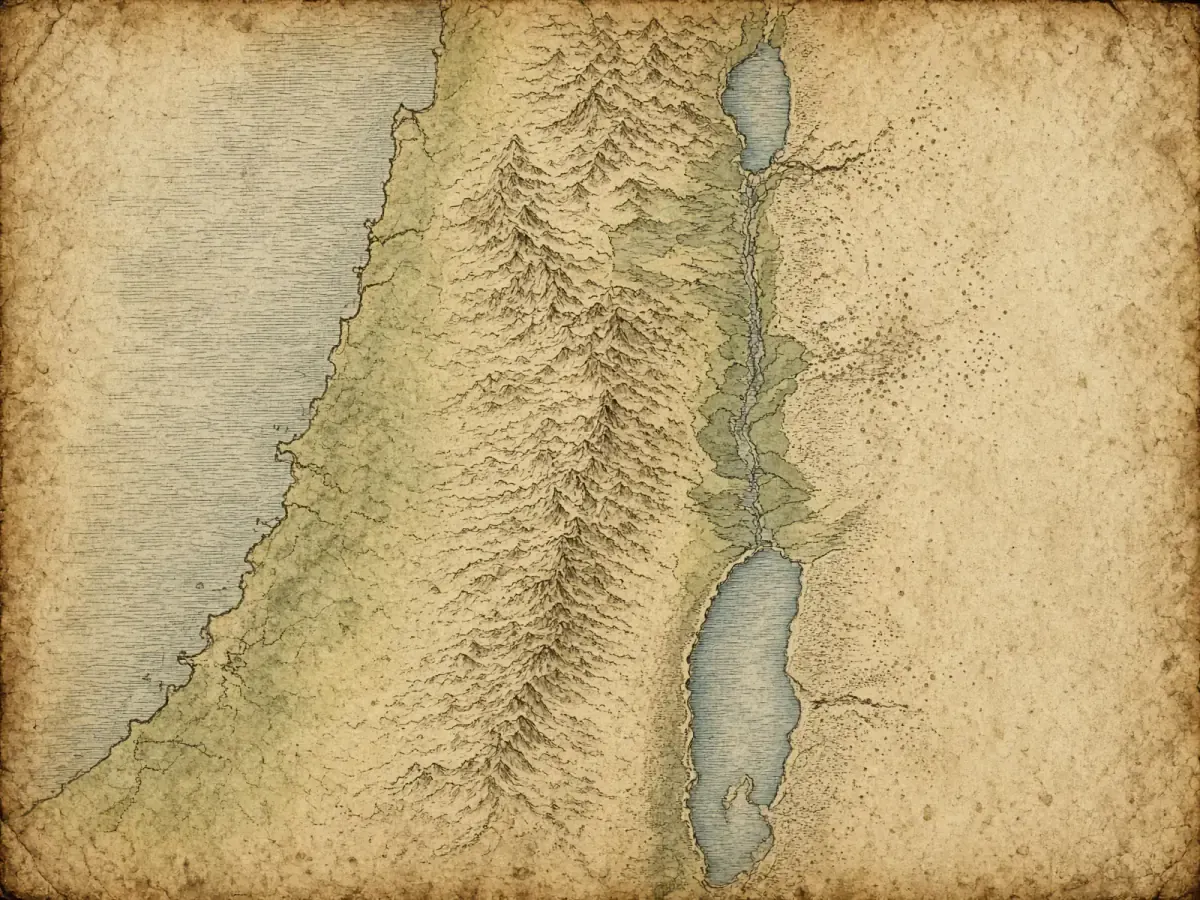
A greeting at the door becomes recognition before either promised child has spoken. The unborn John leaps, Elisabeth is filled with the Holy Ghost, and her first words concern Mary and "the mother of my Lord." The Book of Luke roots that recognition in the Spirit's action rather than in a chain of reports reaching Zacharias's house. The older woman does not guard her own remarkable pregnancy as though Mary's arrival has stolen the room. Instead, she interprets Mary's presence as blessing. Her closing words make belief part of the distinction: Mary is blessed because she believed that what the Lord had spoken would be performed. Zacharias's silence still hangs over the same household, which gives that sentence extra weight without turning him into a permanent example of faithlessness. He questioned the word in the temple; Elisabeth now recognizes its fulfillment at her door. The Book of Luke allows those responses to stand beside one another while the children themselves remain hidden from public view.
Deep dive
Mary's greeting sets off a sequence of recognition. The unborn John leaps, Elisabeth is filled with the Holy Ghost, and her speech identifies the visitor's child as her Lord. Luke locates that recognition in the Spirit's activity, not in Elisabeth having assembled a report from information already circulating. The elder woman does not treat the younger woman's visit as an intrusion on her own remarkable pregnancy.
Elisabeth's blessing rests not only on Mary's motherhood but on her belief that the Lord's word will be fulfilled. This creates a quiet contrast with Zacharias, whose inability to speak remains part of the household scene. He received an announcement in the temple and questioned its reliability; Elisabeth recognizes the fulfillment arriving at her door. The contrast does not make him permanently faithless or her omniscient. It shows how differently the announced word has been received at this point in Luke's account.
Words to trace: blessed, Elisabeth, womb, babe, leaped, Lord
Verse-by-verse path
- Luke 1:39
“With haste” can mean with eagerness as much as speed. The hill country of Judea lay some eighty or more miles south of Nazareth, a journey of four or five days. The town is not named; the tradition placing it at Ein Karem, west of Jerusalem, came centuries later.
- Luke 1:40
She enters the house of Zacharias but greets Elisabeth. The greeting would be the ordinary wish of peace. Luke gives no words for it, because what matters is what happens when it is heard.
- Luke 1:41
“Leaped” is the verb the Greek Old Testament uses for Jacob and Esau struggling in Rebekah’s womb (Genesis 25:22). The angel had promised that John would be filled with the Holy Ghost from his mother’s womb (verse 15); here it begins, and his mother is filled too.
- Luke 1:42
“Spake out” renders a verb used in the Greek of Chronicles for the Levites sounding their instruments before the ark (1 Chronicles 16:4–5). Jael (Judges 5:24) and Judith were praised as blessed among women for delivering Israel; Elisabeth gives Mary the same praise.
- Luke 1:43
Some readers hear David before the ark in 2 Samuel 6:9, “How shall the ark of the LORD come to me?”, especially since the ark stayed three months in the house of Obed-edom (6:11), as Mary stays three months (verse 56). The echo is suggestive, not stated. “My Lord” is the title used of God throughout the chapter.
- Luke 1:44
“For joy” is agalliasis, exultation, the root of Mary’s “my spirit hath rejoiced” three verses later (verse 47). Elisabeth describes the movement of her child as joyful, so the first to rejoice at Jesus’ coming is a child not yet born.
- Luke 1:45
“For” can equally be read as “that”: blessed is she who believed that there would be a fulfilment. “Performance” means accomplishment, the carrying through of what was said. Elisabeth speaks of Mary in the third person, as though pronouncing a blessing over her.
Luke 1:39-45
King James Version39And Mary arose in those days, and went into the hill country with haste, into a city of Juda;
40And entered into the house of Zacharias, and saluted Elisabeth.
41And it came to pass, that, when Elisabeth heard the salutation of Mary, the babe leaped in her womb; and Elisabeth was filled with the Holy Ghost:
42And she spake out with a loud voice, and said, Blessed art thou among women, and blessed is the fruit of thy womb.
43And whence is this to me, that the mother of my Lord should come to me?
44For, lo, as soon as the voice of thy salutation sounded in mine ears, the babe leaped in my womb for joy.
45And blessed is she that believed: for there shall be a performance of those things which were told her from the Lord.
Luke 1:46-56
Mary's Praise Widens Beyond Her Household
Mary's praise begins close to home and then refuses to stay there. She speaks of her own low estate and the great things done to her, yet almost immediately widens the frame to generations, the proud, the mighty, the low, the hungry, the rich, Israel, Abraham, and the remembered promise. Her blessedness is never presented as self-generated distinction. "He that is mighty hath done to me great things," and she names God as her Saviour. The reversals echo Hannah's older praise, making the coming of Jesus part of a long scriptural pattern in which divine mercy unsettles human estimates of strength and status. The language is confident enough to speak of these reversals as accomplished even while their public consequences still lie ahead. The ending with Abraham keeps the song from becoming a free-floating celebration of reversal for its own sake. Mercy has history, promise, and a people in view. Then, almost abruptly, Mary goes home.
Deep dive
Mary begins with what God has done for her, but her praise refuses to stay small. The movement is from an overlooked servant to generations, from her circumstances to the hungry, the powerful, and Israel. Her blessedness is not presented as independent greatness. The Mighty One has acted, and she names God as her Savior. The emphasis falls on the giver and the gift rather than on an unexplained superiority in the recipient.
The reversals of strength and weakness, hunger and plenty, recall Hannah's prayer in 1 Samuel 2:1–10. Luke's opening does not announce a God who has suddenly adopted different interests. Mary's words draw Jesus' coming into the older pattern of divine mercy overturning human expectations. The completed-action language gives the praise the confidence of an accomplished intervention, though the public consequences of Jesus' birth still lie ahead.
The ending names Abraham and his descendants, preventing these reversals from becoming a detached slogan. Mercy has a remembered promise and a particular people in view. Mary then returns home after about three months. Luke does not explicitly place her at John's birth, even though the timing naturally invites that reconstruction.
Words to trace: generation, Mary, mercy, mighty, abode, Abraham
Verse-by-verse path
- Luke 1:46
The song is called the Magnificat from its first word in the Latin Bible. To “magnify” is to declare great. A few Latin manuscripts give this verse to Elisabeth, but almost every Greek manuscript gives it to Mary.
- Luke 1:47
“Soul” and “spirit” are a Hebrew poetic pair, the same thing said twice, not two parts of her. “God my Saviour” echoes Habakkuk 3:18: “I will joy in the God of my salvation.” The verb shifts to the past tense: her spirit has already rejoiced.
- Luke 1:48
When Leah bore Asher she said, “the daughters will call me blessed” (Genesis 30:13); Mary widens it to “all generations”. “Low estate” is tapeinosis, lowliness or humiliation, a social station, not a mood.
- Luke 1:49
“He that is mighty” echoes Zephaniah 3:17, “the LORD thy God in the midst of thee is mighty”. Moses told Israel that God “hath done for thee these great and terrible things” (Deuteronomy 10:21). “Holy is his name” comes from Psalm 111:9.
- Luke 1:50
Close to Psalm 103:17: “the mercy of the LORD is from everlasting to everlasting upon them that fear him.” “Fear” is reverence toward God, the posture of those who take him seriously. The mercy is not limited to one generation, including hers.
- Luke 1:51
“Arm” is the Exodus picture of God’s power, the “stretched out arm” of Deuteronomy 5:15. Psalm 89:10 joins arm and scattering: “thou hast scattered thine enemies with thy strong arm.” “Imagination of their hearts” means the plans they laid.
- Luke 1:52
“Seats” are thrones. Ezekiel 21:26 says, “exalt him that is low, and abase him that is high.” Luke returns to the same reversal in Jesus’ own sayings: whoever exalts himself shall be abased (14:11, 18:14).
- Luke 1:53
Psalm 107:9: “he filleth the hungry soul with goodness.” Jesus will say the same thing in Luke’s version of the beatitudes: blessed are you who hunger now, and woe to you who are rich (6:21, 24). Mary’s song anticipates her son’s sermon.
- Luke 1:54
“Holpen” is the old past participle of help. The verb in Greek means to take hold of in order to support, the verb of Isaiah 41:9 in the Greek Old Testament, where God tells Israel his servant, “I have taken thee from the ends of the earth”.
- Luke 1:55
Micah 7:20 ends that prophet’s book: “Thou wilt perform the truth to Jacob, and the mercy to Abraham, which thou hast sworn unto our fathers from the days of old.” The song closes on “for ever”, its farthest horizon.
- Luke 1:56
“Her own house” means her family’s house: she is still betrothed and not yet living with Joseph. In the next chapter she travels to Bethlehem as “his espoused wife” (2:5).
Luke 1:46-56
King James Version46And Mary said, My soul doth magnify the Lord,
47And my spirit hath rejoiced in God my Saviour.
48For he hath regarded the low estate of his handmaiden: for, behold, from henceforth all generations shall call me blessed.
49For he that is mighty hath done to me great things; and holy is his name.
50And his mercy is on them that fear him from generation to generation.
51He hath shewed strength with his arm; he hath scattered the proud in the imagination of their hearts.
52He hath put down the mighty from their seats, and exalted them of low degree.
53He hath filled the hungry with good things; and the rich he hath sent empty away.
54He hath holpen his servant Israel, in remembrance of his mercy;
55As he spake to our fathers, to Abraham, and to his seed for ever.
56And Mary abode with her about three months, and returned to her own house.
Luke 1:57-66
The Relatives Do Not Get to Name This Child
The neighbors can recognize mercy in Elisabeth's child without knowing what his name is supposed to be. Their instinct is entirely intelligible: call him Zacharias and keep the family pattern moving. Elisabeth interrupts that expectation with "Not so," and when the relatives appeal to the silent father, they discover that the matter was settled before they arrived. Zacharias writes, "His name is John," not "I would like to call him John." The wording treats the name as an identity already given, not a preference awaiting committee approval. The relatives have gathered for a naming debate that the parents never actually joined. Immediately, Zacharias's mouth opens and the first use of restored speech is praise, reversing the silence that followed his unbelief. The surrounding reaction shifts from family surprise to fear and public discussion about the child's future. The Book of Luke does not answer every curiosity about Zacharias's condition. He keeps the focus on the promise, the assigned name, and the hand of the Lord resting upon the child.
Deep dive
The neighbors recognize mercy in the birth, yet the naming exposes a gap between what the household has been told and what the wider family expects. Calling the child Zacharias would preserve an intelligible family pattern. Elisabeth's answer interrupts that assumption, and the relatives appeal to the father as though the matter might still be negotiated. Their objection is genealogical; the instruction came from elsewhere.
Zacharias does not write a preference for a name. He writes "His name is John," confirming an identity already assigned in Gabriel's announcement. The relatives have convened an unnecessary naming committee. Elisabeth and Zacharias agree against the relatives' appeal to family precedent, so the name marks their reception of the announced promise.
His restored speech becomes praise, reversing the silence imposed after unbelief. The surrounding fear and discussion concern the child's future, and Luke closes with the Lord's hand upon him. The signs made to Zacharias may suggest that hearing was also affected, but the earlier announcement explicitly names speechlessness; the book does not provide a separate diagnosis.
Words to trace: name, child, father, John, Lord, abroad
Verse-by-verse path
- Luke 1:57
“Full time came” is literally “the time was fulfilled”, Luke’s favoured language of fulfilment, which he uses again for Mary in 2:6. The verse is brief because the angel’s promise has already said everything about this son.
- Luke 1:58
“Shewed great mercy” is literally “magnified his mercy”, the verb of Mary’s “My soul doth magnify” (verse 46). The rejoicing of neighbours fulfils the angel’s “many shall rejoice at his birth” (verse 14).
- Luke 1:59
Circumcision on the eighth day followed Genesis 17:12 and Leviticus 12:3. Old Testament children were usually named at birth, so this is early evidence for naming at circumcision. “They called him” is imperfect: they were going to call him, and were stopped.
- Luke 1:60
“Not so” is a firm no. Luke does not say how Elisabeth knew the name. Zacharias could have written it for her in the months of silence; that is an inference the text leaves room for.
- Luke 1:61
John, Yohanan, was a common name, borne by high priests and Maccabean princes. The objection is not that it is strange but that no one in the family has it. The relatives treat names as family property.
- Luke 1:62
Naming belonged to the father’s authority. When the dying Rachel named her son Benoni, Jacob overruled her and called him Benjamin (Genesis 35:18). The relatives expect the father to settle the dispute, perhaps against the mother.
- Luke 1:63
A “writing table” is a small wooden tablet with a wax surface, written on with a stylus. Everyone marvels, since the parents have agreed on a name no one expected. The father confirms the mother without either being heard by the other.
- Luke 1:64
“Immediately” is parachrema, a word Luke uses more than any other New Testament writer. The Greek has one verb for both mouth and tongue, and the King James adds “loosed” to make sense of it. More than nine months of silence end in praise.
- Luke 1:65
The fear is awe at God’s evident hand in events, not terror. “Noised abroad” means talked over from village to village. The hill country of Judea is the upland around and south of Jerusalem.
- Luke 1:66
Laying things up in the heart is what Mary will do twice in the next chapter (2:19, 51). “The hand of the Lord” is the Old Testament’s phrase for God’s power upon a prophet, used of Elijah when he ran before Ahab’s chariot (1 Kings 18:46).
Luke 1:57-66
King James Version57Now Elisabeth’s full time came that she should be delivered; and she brought forth a son.
58And her neighbours and her cousins heard how the Lord had shewed great mercy upon her; and they rejoiced with her.
59And it came to pass, that on the eighth day they came to circumcise the child; and they called him Zacharias, after the name of his father.
60And his mother answered and said, Not so; but he shall be called John.
61And they said unto her, There is none of thy kindred that is called by this name.
62And they made signs to his father, how he would have him called.
63And he asked for a writing table, and wrote, saying, His name is John. And they marvelled all.
64And his mouth was opened immediately, and his tongue loosed, and he spake, and praised God.
65And fear came on all that dwelt round about them: and all these sayings were noised abroad throughout all the hill country of Judæa.
66And all they that heard them laid them up in their hearts, saying, What manner of child shall this be! And the hand of the Lord was with him.
Luke 1:67-80
A Father Praises Someone Greater Than His Son
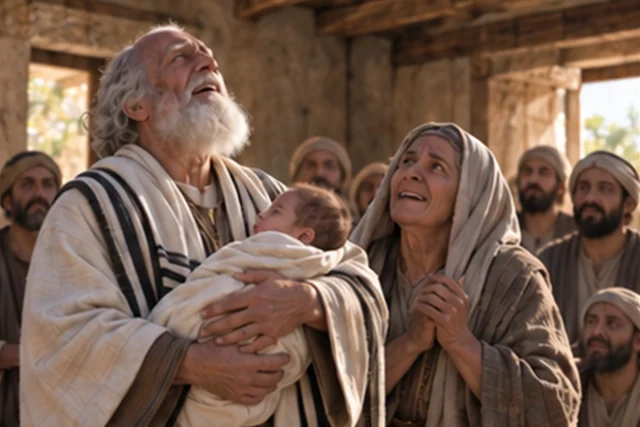
Zacharias finally has his voice, and the striking thing is how long he speaks before getting to his own son. The prophecy opens with God's visitation, redemption, David's house, the prophets, Abraham, covenant mercy, deliverance, and service before God. John's significance appears inside that larger movement rather than at its center. Only then does the father turn toward the child: "thou, child, shalt be called the prophet of the Highest." John is great because he prepares the way for someone greater. The prophecy also refuses to split external rescue from forgiveness as though they belonged to unrelated hopes. Enemies, covenant, holiness, remission of sins, mercy, light, and peace occupy one field of expectation. The "dayspring from on high" gives the coming visitation the feel of dawn reaching people in darkness and death's shadow. After all that language, the Book of Luke compresses years into one line. John grows, becomes strong in spirit, and remains in the deserts until his public appearing, with no invented years added to fill the silence.
Deep dive
Zacharias has finally gained his voice, but his prophecy does not begin by celebrating John's personal prospects. It begins with the Lord's visitation and a "horn of salvation" in David's house. That royal location distinguishes the promised deliverer from Zacharias's own priestly family. John's father understands his son's significance by identifying the greater work his son will serve.
Deliverance from enemies and the forgiveness of sins are not competing subjects in the prophecy. The movement joins covenant mercy, freedom to serve God, and the knowledge of salvation through remission. The promises to Abraham give the language a long memory; John's coming does not mean Israel's earlier history has been discarded. The rescue is directed toward a life before God, not simply a change in external circumstances.
Only in verse 76 does Zacharias address his child directly. John will prepare the way rather than occupy the center. The "dayspring" brings the image of dawning light into the language of visitation, reaching those in darkness and death's shadow. The final verse then passes over years in a sentence. Luke gives John's growth and wilderness preparation, but does not turn that silence into an account of an undocumented school or community.
Words to trace: holy, child, enemies, father, hand, Israel
Verse-by-verse path
- Luke 1:67
The song is called the Benedictus from its first word in Latin. A Jewish tradition held that prophecy had ceased in Israel after Malachi; in Luke’s first chapter the Spirit fills Elisabeth, then Zacharias, and prophecy is heard again.
- Luke 1:68
“Blessed be the Lord God of Israel” is, almost word for word, the doxology that closes the first and fourth books of the Psalms (41:13, 106:48). “Visited” is the word of Exodus 4:31, when Israel in Egypt heard that the LORD had visited them. “Redeemed” means paid the ransom.
- Luke 1:69
The horn was the image of an animal’s strength, and Psalm 132:17 had said, “There will I make the horn of David to bud.” A priest of Aaron’s line speaks of salvation rising from the royal house of David, not his own.
- Luke 1:70
Peter uses almost the same phrase in Acts 3:21: “spoken by the mouth of all his holy prophets since the world began.” Luke writes both books, and both reach back to the whole prophetic line. “Since the world began” means from of old.
- Luke 1:71
Psalm 106:10 describes the Exodus in nearly the same words: “he saved them from the hand of him that hated them, and redeemed them from the hand of the enemy.” The enemies are not named, and Zacharias’ hearers would have supplied their own.
- Luke 1:72
Some readers find the family’s names folded into these lines: John means “God is gracious” (mercy), Zacharias means “the LORD remembers” (remember), and Elisabeth, in the next verse, “my God is an oath”. Whether the wordplay is intended is uncertain, but all three are there.
- Luke 1:73
The oath to Abraham was sworn after the binding of Isaac: “By myself have I sworn, saith the LORD” (Genesis 22:16). An oath God swears by himself has nothing greater to appeal to. Abraham is called “our father”, the whole nation’s ancestor.
- Luke 1:74
In Greek “without fear” stands first in the clause, an emphatic place. “Serve” is latreuo, the word for worship and priestly service. A priest speaks of the whole delivered people performing that service.
- Luke 1:75
Zacharias served in the temple one week at a time; he speaks of a service before God “all the days of our life”. “Holiness and righteousness” pair devotion toward God with just dealing among people.
- Luke 1:76
The eight-day-old boy is addressed directly. He will be “the prophet of the Highest”, where Jesus is “the Son of the Highest” (verse 32). “Go before the face of the Lord to prepare his ways” combines Malachi 3:1 and Isaiah 40:3.
- Luke 1:77
The task is to give knowledge of salvation, not salvation itself. “Remission” is aphesis, release, the word that appears twice in Isaiah’s text when Jesus reads it at Nazareth: “deliverance to the captives” and “set at liberty” (4:18).
- Luke 1:78
“Tender mercy” is literally “the bowels of mercy”, the inward parts regarded as the seat of feeling. “Dayspring” is anatole, sunrise, but the Greek Old Testament uses the same word for the “Branch”, the shoot of David, in Jeremiah 23:5 and Zechariah 3:8.
- Luke 1:79
Isaiah 9:2: “they that dwell in the land of the shadow of death, upon them hath the light shined.” The people are sitting, unable to move in the dark; the verse ends with their feet guided onto a road.
- Luke 1:80
The same words are used of Jesus in 2:40: the child grew and waxed strong in spirit. “Deserts” is plural, the wild country of Judea sloping down to the Dead Sea. “Shewing” is anadeixis, a word used for the public installation of an official.
Luke 1:67-80
King James Version67And his father Zacharias was filled with the Holy Ghost, and prophesied, saying,
68Blessed be the Lord God of Israel; for he hath visited and redeemed his people,
69And hath raised up an horn of salvation for us in the house of his servant David;
70As he spake by the mouth of his holy prophets, which have been since the world began:
71That we should be saved from our enemies, and from the hand of all that hate us;
72To perform the mercy promised to our fathers, and to remember his holy covenant;
73The oath which he sware to our father Abraham,
74That he would grant unto us, that we being delivered out of the hand of our enemies might serve him without fear,
75In holiness and righteousness before him, all the days of our life.
76And thou, child, shalt be called the prophet of the Highest: for thou shalt go before the face of the Lord to prepare his ways;
77To give knowledge of salvation unto his people by the remission of their sins,
78Through the tender mercy of our God; whereby the dayspring from on high hath visited us,
79To give light to them that sit in darkness and in the shadow of death, to guide our feet into the way of peace.
80And the child grew, and waxed strong in spirit, and was in the deserts till the day of his shewing unto Israel.
Questions to keep in mind while reading
- Watch what Jesus says and does, and how people respond.
- Trace kingdom, discipleship, opposition, cross, and resurrection in the evangelist’s own sequence.
- Let later doctrine clarify the scene without erasing its immediate setting.
Text first
Where readers differ
The chapter summary begins with what the passage says and how its parts fit together. It does not assume one denomination has already settled every question. Where a conclusion depends on a tradition, literary theory, or historical reconstruction, that dependence is named openly.
The KJV text is presented first. Interpretive conclusions are labeled, and differences are introduced only when they help a reader understand why serious communities do not always reach the same answer.
Comparative interpretive notes for this chapter are in preparation. Until reviewed notes are ready, this page separates the KJV text from summary and application without claiming that serious readers agree on every question.
Questions beneath the surface
- What account of God, human freedom, responsibility, and the good life emerges from Luke 1?
- Which tension does the chapter refuse to resolve quickly?
- What changes when the chapter is read as part of the whole canon rather than as an isolated moral lesson?
- Where might a sincere reader confuse a familiar tradition with something the text states directly?
Questions for serious personal contemplation
These open-ended questions make room for tension, honest response, prayer, and conclusions that remain accountable to the chapter.
Observe without rushing
What part of Luke 1 makes you stop, feel unsettled, or feel surprised, and why?
Which detail in the passage would be easiest to overlook? How does that detail change your understanding?
Where do you see tension between what happens and this focus: Zechariah serving at the incense altar and receiving Gabriel’s message about John; Gabriel speaking with Mary, followed by Mary visiting Elizabeth and praising God; John born, Zechariah writing the child’s name, and then speaking his prophecy?
What important question does the passage leave open instead of resolving quickly?
Examine your inner life honestly
Which person, response, fear, or desire in the passage feels most like your own life right now?
What assumption about God, other people, or yourself does this text challenge?
Which part would you rather soften, avoid, or explain away too quickly? What might that reaction reveal?
If this Scripture could ask you one direct question, what do you think it would ask?
Respond with wisdom and courage
What do you need to remember, confess, grieve, thank God for, or trust after reading this passage?
How might another faithful person read this situation differently without ignoring the text?
What obedient response would be costly, uncomfortable, or slow, yet still faithful to Scripture?
What question will you carry into prayer this week, and which verses will you keep in front of you?
Music and video connected to the passage
Related media appears when its Scripture reference overlaps this study. Music and video can illuminate a theme while the biblical text remains the foundation.