The big picture
Joshua 21 finishes the distribution by giving the Levites what a tribe without a territorial block still needs: cities in which to live and surrounding land for livestock. The allocations are carefully organized among Aaron's priestly descendants, the remaining Kohathites, Gershon, and Merari, and the contributing cities come from tribes on both sides of Jordan. Repeated place-names require distinctions rather than confusion. Hebron can remain connected to Caleb's fields and villages, serve as a Levitical city, and function as a city of refuge because the chapter specifies the different claims. The six refuge cities reappear inside the Levitical network, tying provision for worship and provision for justice together geographically. The chapter then steps back from forty-eight individual cities to the whole promise: the LORD gave land, rest, and victory, and "all came to pass." The book's measure is fulfilled divine speech, not a monument to Joshua's reputation.
In this chapter
- Levi's Different Inheritance Still Includes a Place to Live Joshua 21:1-8
Levi's lack of a tribal territory never meant Levites were expected to live nowhere.
- Hebron Can Serve More Than One Stated Purpose Joshua 21:9-19
Hebron is a useful test of whether repeated place-names are being read carefully.
- The Other Kohathites Receive Their Own Share Joshua 21:20-26
The "remaining" Kohathites are not leftovers in quality or importance.
- The Levitical Provision Crosses the River Too Joshua 21:27-40
Gershon and Merari spread the Levitical network through a broad cross-section of Israel.
- The Conclusion Measures the Promise, Not Joshua's Reputation Joshua 21:41-45
After forty-eight cities have been counted, the chapter stops counting and delivers a verdict.
Scripture beside the summary
Joshua · King James Version · 45Joshua 21:1-8
Levi's Different Inheritance Still Includes a Place to Live
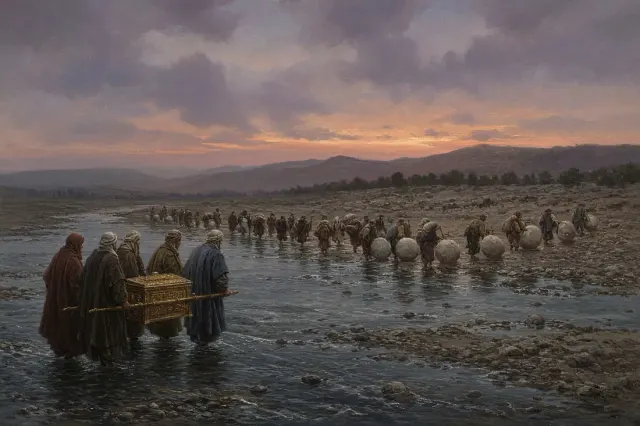
Levi's lack of a tribal territory never meant Levites were expected to live nowhere. Their leaders come to Eleazar, Joshua, and the tribal heads at Shiloh with a command already given through Moses, much as Zelophehad's daughters came with an earlier ruling behind them. The answer is cities "with their suburbs," meaning the surrounding land needed for livestock, not a modern belt of housing. That repeated pair keeps the grant practical. A city name without support for cattle would not meet the stated need. The allotment also reveals distinctions inside Levi that a quick reading can blur. Aaron's descendants are Kohathites and priests, but not every Kohathite is a priest. The remaining Kohathites, Gershonites, and Merarites receive their own totals. Forty-eight cities will eventually emerge from these separate family grants, supplied out of Israel's inheritances. Possession by the tribes therefore includes an obligation to provide within the larger national settlement.
Deep dive
The Levites approach the same authorities who heard Zelophehad's daughters: Eleazar, Joshua, and the tribal heads. Their request likewise rests on an existing command. Repeated statements that Levi has no territorial inheritance have not cancelled the need for its families to live somewhere and keep their cattle.
The KJV's "suburbs" refers here to the land surrounding the cities provided for livestock, not a modern residential district. The repeated pairing of cities and suburbs preserves both dwelling places and their means of support. Israel gives these places "out of their inheritance". The other tribes' receipt of land includes a responsibility within the distribution, rather than ending every claim upon it.
The opening totals also distinguish groups that can easily be confused. Aaron's descendants belong to the Kohathites and receive thirteen cities. The remaining Kohathites receive ten; Gershon's families receive thirteen; Merari's receive twelve. All are Levites, but the chapter identifies Aaron's descendants specifically as priests. The list is describing related families with distinct positions, not forty-eight interchangeable priestly settlements.
Words to trace: tribe, children, cities, families, Levites, Israel
Verse-by-verse path
- Joshua 21:1
Levi had three sons, Gershon, Kohath and Merari (Exodus 6:16), and the chapter is organised by them. Numbers 35:6–7 had fixed the number: six cities of refuge and forty two more, forty eight in all, the total this chapter will reach.
- Joshua 21:2
Numbers 35:4–5 had even set the measurements of the pasture: a thousand cubits out from the wall, and two thousand along each side. “In the land of Canaan” marks the difference from when the command was given, on the plains of Moab: the Levites now claim it where it can be kept.
- Joshua 21:3
Numbers 35:8 had set the principle for the contributions: “from them that have many ye shall give many; but from them that have few ye shall give few.” The tribes give “out of their inheritance”, at the commandment of the LORD, not as a favour.
- Joshua 21:4
All thirteen priestly cities come from Judah, Simeon and Benjamin, the tribes around the future Jerusalem. The priests were settled, by lot, within reach of the city where the temple would one day stand.
- Joshua 21:5
Moses himself was a Kohathite, the grandson of Kohath through Amram (Exodus 6:18–20), so his own descendants were among “the rest of the children of Kohath”, not the priests. In the wilderness the Kohathites carried the ark and the holy furniture (Numbers 4:15).
- Joshua 21:6
The Gershonites had carried the tabernacle’s curtains, coverings and hangings on the march (Numbers 4:24–26). Their thirteen cities lie in the north, in Galilee and in Bashan across the Jordan.
- Joshua 21:7
The Merarites carried the tabernacle’s boards, bars, pillars and sockets (Numbers 4:31–32), the heaviest loads. Their twelve cities are scattered furthest of all, in Zebulun and across the Jordan in Reuben and Gad.
- Joshua 21:8
The chapter moves from summary (verses 4–8) to full lists (9–40) to a grand total (41). Even the Levites’ towns are assigned “by lot”, and the formula “as the LORD commanded by the hand of Moses” from verse 2 is repeated to frame the summary.
Joshua 21:1-8
King James Version1Then came near the heads of the fathers of the Levites unto Eleazar the priest, and unto Joshua the son of Nun, and unto the heads of the fathers of the tribes of the children of Israel;
2And they spake unto them at Shiloh in the land of Canaan, saying, The LORD commanded by the hand of Moses to give us cities to dwell in, with the suburbs thereof for our cattle.
3And the children of Israel gave unto the Levites out of their inheritance, at the commandment of the LORD, these cities and their suburbs.
4And the lot came out for the families of the Kohathites: and the children of Aaron the priest, which were of the Levites, had by lot out of the tribe of Judah, and out of the tribe of Simeon, and out of the tribe of Benjamin, thirteen cities.
5And the rest of the children of Kohath had by lot out of the families of the tribe of Ephraim, and out of the tribe of Dan, and out of the half tribe of Manasseh, ten cities.
6And the children of Gershon had by lot out of the families of the tribe of Issachar, and out of the tribe of Asher, and out of the tribe of Naphtali, and out of the half tribe of Manasseh in Bashan, thirteen cities.
7The children of Merari by their families had out of the tribe of Reuben, and out of the tribe of Gad, and out of the tribe of Zebulun, twelve cities.
8And the children of Israel gave by lot unto the Levites these cities with their suburbs, as the LORD commanded by the hand of Moses.
Joshua 21:9-19
Hebron Can Serve More Than One Stated Purpose
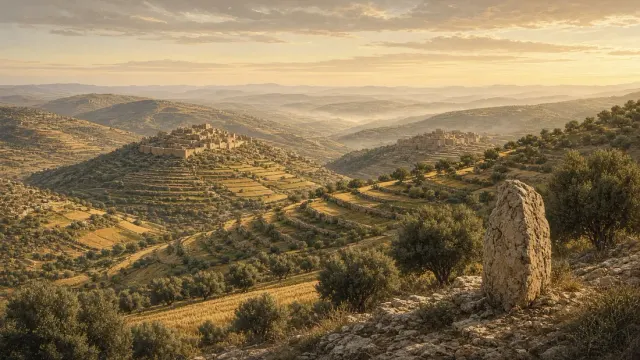
Hebron is a useful test of whether repeated place-names are being read carefully. Caleb has already received it, yet Joshua 21 can assign Hebron to Aaron's descendants without contradiction because the passage itself draws the line: Caleb retains the fields and villages, while the city and its surrounding provision serve the priestly family. Hebron is also a city of refuge. One place can therefore carry several stated functions and claims without any of them needing to erase the others. Gibeon makes the same point from a different angle. Its appearance in a priestly city list does not retroactively turn the people preserved there by oath into Aaron's descendants. The Book of Joshua expects the reader to remember earlier conditions rather than let a later register overwrite them. The thirteen cities of Aaron's descendants are a new allocation, but they sit inside a history that remains intact around each repeated name.
Deep dive
Hebron appears again, but the Book of Joshua does not simply forget that it has already been granted to Caleb. Verse 12 draws the distinction: the city's fields and villages remain Caleb's possession, while the city and its surrounding provision are assigned to Aaron's descendants. The explicit qualification explains how the later grant relates to the earlier one instead of treating the name Hebron as one indivisible property label.
Hebron is also named as a city of refuge, connecting the preceding chapter's legal provision to the Levitical allotment. Gibeon appears among the four cities supplied by Benjamin, bringing a place preserved through an oath into this register of priestly dwelling places. The notice does not turn its earlier inhabitants into Aaron's descendants. The family receiving an assigned city, the people previously associated with it, and the function attached to it are distinct matters that the repeated names bring together.
Words to trace: suburbs, children, cities, city, gave, Aaron
Verse-by-verse path
- Joshua 21:9
“Which are here mentioned by name” is literally “which he called by name”, a formal roll. 1 Chronicles 6:54–81 gives a parallel list of the Levitical cities, with a number of names spelled or given differently, and some dropped.
- Joshua 21:10
Kohath was Levi’s second son, but the first lot goes to his line because Aaron belonged to it. The priests draw first, the rest of the Kohathites second, Gershon third and Merari last.
- Joshua 21:11
Hebron, the priestly city, also became the royal city: the men of Judah anointed David king there (2 Samuel 2:4), and he reigned there before moving to Jerusalem. “With the suburbs thereof round about it” gives the priests the pasture ringing the town.
- Joshua 21:12
Leviticus 25:34 made the Levites’ pasture land permanent: “the field of the suburbs of their cities may not be sold; for it is their perpetual possession.” Hebron’s town and pasture belonged to the priests while its farmland and villages remained Caleb’s family property.
- Joshua 21:13
Numbers 35:6 required that the six cities of refuge be among the Levites’ cities. A fugitive therefore lived among priests and Levites while he waited for the high priest’s death. Libnah is the second of the priestly towns.
- Joshua 21:14
The Chronicler’s genealogies treat some towns as persons: “Ishbah the father of Eshtemoa” (1 Chronicles 4:17) means the founder of that town. Jattir and Eshtemoa both lay in the hills south of Hebron.
- Joshua 21:15
Holon appears as Hilen in 1 Chronicles 6:58, one of many spelling differences between the two lists. Debir, once a city of the Anakim and then Othniel’s prize, becomes a priestly city: the same town serves three chapters of history.
- Joshua 21:16
Ain appears as Ashan in 1 Chronicles 6:59, and Juttah is missing there. At Beth-shemesh, a priestly town, Levites lifted down the returned ark, and then men of the town looked into it and were struck (1 Samuel 6:15, 19).
- Joshua 21:17
Gibeon is where the LORD appeared to Solomon in a dream and asked, “Ask what I shall give thee” (1 Kings 3:5). Geba is where Jonathan struck the Philistine garrison and set off Saul’s war (1 Samuel 13:3).
- Joshua 21:18
Anathoth was the home of “Jeremiah the son of Hilkiah, of the priests that were in Anathoth” (Jeremiah 1:1), and the place to which Solomon banished the priest Abiathar (1 Kings 2:26). Almon appears as Alemeth in 1 Chronicles 6:60.
- Joshua 21:19
1 Chronicles 6:60 also totals thirteen priestly cities, though it names only eleven, lacking Juttah and Gibeon. The total survived in both lists even where the names did not.
Joshua 21:9-19
King James Version9And they gave out of the tribe of the children of Judah, and out of the tribe of the children of Simeon, these cities which are here mentioned by name,
10Which the children of Aaron, being of the families of the Kohathites, who were of the children of Levi, had: for theirs was the first lot.
11And they gave them the city of Arba the father of Anak, which city is Hebron, in the hill country of Judah, with the suburbs thereof round about it.
12But the fields of the city, and the villages thereof, gave they to Caleb the son of Jephunneh for his possession.
13Thus they gave to the children of Aaron the priest Hebron with her suburbs, to be a city of refuge for the slayer; and Libnah with her suburbs,
14And Jattir with her suburbs, and Eshtemoa with her suburbs,
15And Holon with her suburbs, and Debir with her suburbs,
16And Ain with her suburbs, and Juttah with her suburbs, and Beth-shemesh with her suburbs; nine cities out of those two tribes.
17And out of the tribe of Benjamin, Gibeon with her suburbs, Geba with her suburbs,
18Anathoth with her suburbs, and Almon with her suburbs; four cities.
19All the cities of the children of Aaron, the priests, were thirteen cities with their suburbs.
Joshua 21:20-26
The Other Kohathites Receive Their Own Share
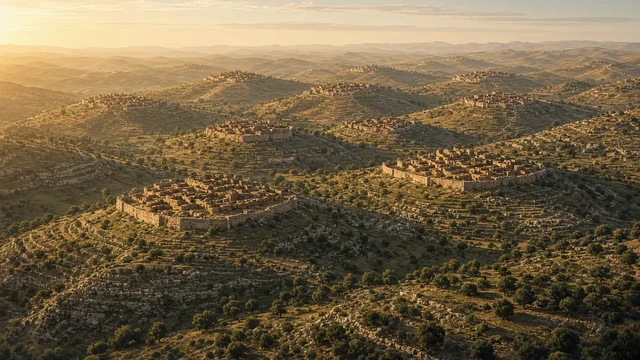
The "remaining" Kohathites are not leftovers in quality or importance. They are simply the Kohathite families not included in Aaron's priestly branch, and their ten cities are assigned by lot just as deliberately. Four come from Ephraim, four from Dan, and two from western Manasseh. Shechem is marked as a city of refuge, so the legal network from Joshua 20 is already woven into the Levitical distribution. The accounting works in two directions at once. The receiving families can be traced to actual dwelling places, and the tribes providing those places can be named just as clearly. That two-sided record matters because these cities come "out of" tribal inheritances rather than from an undefined reserve. The Book of Joshua treats the provision as a real transfer of use within the settled land, not as a symbolic honour. Levi's different form of inheritance is still concrete enough to put on a map.
Deep dive
The phrase describing the Kohathites who remain means those not included in Aaron's preceding allotment. It is a distinction within a family group, not a notice that these people arrived late and received whatever nobody else wanted. Their cities, too, are assigned by lot.
Shechem is expressly identified as a city of refuge. The other towns are grouped by the tribe supplying them, with four from Ephraim, four from Dan, and two from western Manasseh. The total of ten completes the second Kohathite allocation. Recording both the receiving families and the contributing tribes makes the provision traceable in two directions: these Levites have named places to inhabit, and the surrounding tribes have named places to provide.
Words to trace: suburbs, cities, children, Kohath, tribe, Ephraim
Verse-by-verse path
- Joshua 21:20
The remaining Kohathite clans were Amram, Izhar, Hebron and Uzziel (Exodus 6:18). Korah was a Kohathite of the line of Izhar (Numbers 16:1), and his descendants, “the sons of Korah”, are named in the headings of eleven psalms.
- Joshua 21:21
Levites are given Shechem, the city Simeon and Levi had once massacred to avenge Dinah (Genesis 34:25), and Gezer, where Canaanites still lived under tribute (16:10). The tribe Jacob rebuked for violence at Shechem becomes the keeper of refuge there.
- Joshua 21:22
Kibzaim appears as Jokmeam in 1 Chronicles 6:68. Beth-horon guarded the pass that led up from the coast; placing Levites there put the tribe of teaching on one of the main roads into the hill country.
- Joshua 21:23
Eltekeh and Gibbethon do not appear at all in the Chronicles list, which gives no cities from Dan. By the time of the Chronicler, Dan’s original territory had long since been lost to the Philistines and others.
- Joshua 21:24
Aijalon was later fortified by Rehoboam (2 Chronicles 11:10) and taken by the Philistines in the reign of Ahaz (2 Chronicles 28:18). Gath-rimmon means “winepress of the pomegranate”.
- Joshua 21:25
Gath-rimmon here repeats the name from verse 24, probably a copyist’s slip; 1 Chronicles 6:70 has Aner and Bileam instead, and Bileam is likely Ibleam (17:11). Tanach is Taanach, whose king Joshua had defeated (12:21).
- Joshua 21:26
Samuel’s family were Kohathite Levites (1 Chronicles 6:33–38), yet his father Elkanah lived in the hill country of Ephraim (1 Samuel 1:1). That fits this allotment: the non priestly Kohathites were settled among Ephraim.
Joshua 21:20-26
King James Version20And the families of the children of Kohath, the Levites which remained of the children of Kohath, even they had the cities of their lot out of the tribe of Ephraim.
21For they gave them Shechem with her suburbs in mount Ephraim, to be a city of refuge for the slayer; and Gezer with her suburbs,
22And Kibzaim with her suburbs, and Beth-horon with her suburbs; four cities.
23And out of the tribe of Dan, Eltekeh with her suburbs, Gibbethon with her suburbs,
24Aijalon with her suburbs, Gath-rimmon with her suburbs; four cities.
25And out of the half tribe of Manasseh, Tanach with her suburbs, and Gath-rimmon with her suburbs; two cities.
26All the cities were ten with their suburbs for the families of the children of Kohath that remained.
Joshua 21:27-40
The Levitical Provision Crosses the River Too
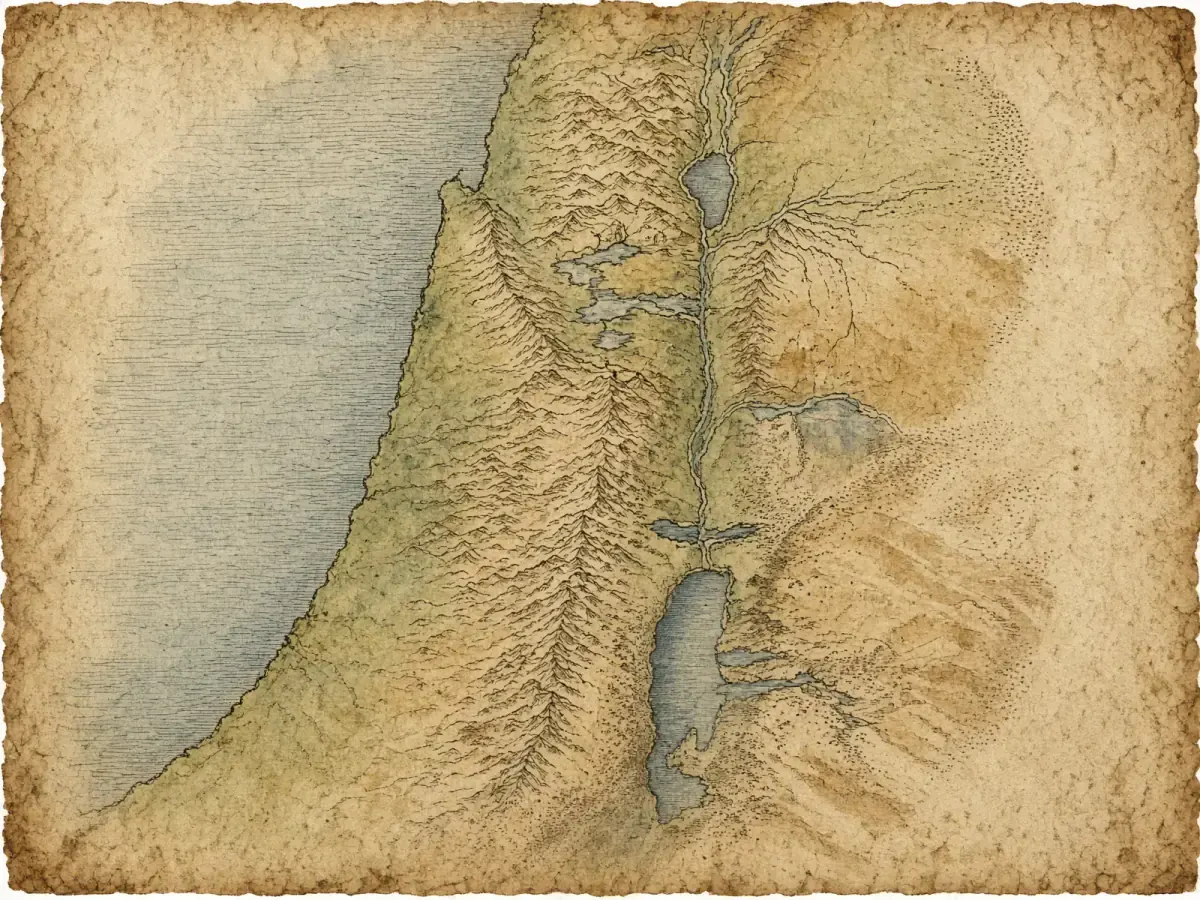
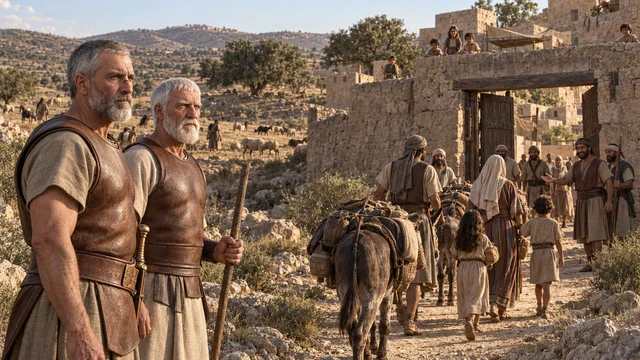
Gershon and Merari spread the Levitical network through a broad cross-section of Israel. Gershon receives cities from eastern Manasseh, Issachar, Asher, and Naphtali; Merari receives from Zebulun, Reuben, and Gad. The river again fails to divide the arrangement into separate systems. Golan, Kedesh, Ramoth, and Bezer reappear among these towns, joining Hebron and Shechem so that the six refuge cities are also embedded within Levitical provision. The phrase "with her suburbs" keeps returning until it almost becomes the rhythm of the section, and that repetition is functional. The gift is not a dot on a map. It is a place to live with enough surrounding land to support ordinary life. By the time Gershon's thirteen and Merari's twelve are counted, the Book of Joshua has distributed a tribe with no contiguous territory throughout the territories of its brethren, making dependence and provision visible in the geography itself.
Deep dive
Gershon's grant draws upon Issachar, Asher, Naphtali, and the half of Manasseh in Bashan. Merari's draws upon Zebulun, Reuben, and Gad. The families are distributed through Israel's different inheritances rather than gathered into a separate Levitical territory beside them.
The cities of refuge reappear within this network: Golan, Kedesh, Ramoth, and Bezer join Shechem and Hebron from the preceding groups. Bezer is listed without repeating its refuge designation, but Joshua 20:8 has already supplied it. The constant return of "with her suburbs" makes the practical provision almost insistent. A place-name alone is not the whole gift. The list records cities with surrounding land, tribe after tribe, until the Levitical families have received the form of inheritance assigned to them.
Words to trace: suburbs, cities, tribe, families, children, city
Verse-by-verse path
- Joshua 21:27
Beesh-terah is a contraction of “Be-ashtarah”, “in Ashtaroth”, and 1 Chronicles 6:71 has Ashtaroth, Og’s royal city (12:4). Golan, the eastern city of refuge, heads the Gershonite list.
- Joshua 21:28
Kishon is the Kishion of Issachar’s list (19:20), and 1 Chronicles 6:72 has Kedesh instead. Dabareh is Daberath, at the foot of Mount Tabor, still echoed in the name of the village Daburiyya.
- Joshua 21:29
This Jarmuth is a northern town, not the Jarmuth of the Shephelah; it is the Remeth of 19:21 and the Ramoth of 1 Chronicles 6:73. En-gannim appears there as Anem.
- Joshua 21:30
Abdon is the Ebron of Asher’s list (19:28). The same name belongs to one of the minor judges, Abdon son of Hillel, who had forty sons and thirty grandsons riding on seventy ass colts (Judges 12:13–14).
- Joshua 21:31
Helkath appears as Hukok in 1 Chronicles 6:75. There were several towns called Rehob, “broad place”; this one lay in Asher, and Levites were placed in a district where, by Judges 1:31, Canaanites still lived.
- Joshua 21:32
Hammoth-dor is the Hammath of 19:35, the hot springs by the lake, and 1 Chronicles 6:76 calls it Hammon; Kartan appears there as Kirjathaim. Kedesh in Galilee, a city of refuge, heads Naphtali’s three.
- Joshua 21:33
Asaph, the chief of David’s singers and the name on the headings of twelve psalms, was a Gershonite (1 Chronicles 6:39–43). The family that once carried the tabernacle’s curtains later supplied its music.
- Joshua 21:34
Merari’s line produced Ethan, one of David’s three chief singers alongside Heman and Asaph (1 Chronicles 6:44; 15:17). 1 Chronicles 6:77 gives Merari’s Zebulun towns as Rimmon and Tabor, not Jokneam and Kartah.
- Joshua 21:35
Dimnah is probably Rimmonah (Rimmon in 1 Chronicles 6:77); in Hebrew script the letters d and r look very alike and were easily confused. Nahalal is one of the towns Zebulun did not clear of Canaanites (Judges 1:30).
- Joshua 21:36
This verse and the next are missing from many Hebrew manuscripts and some printed Hebrew Bibles. The Greek version and 1 Chronicles 6:78–79 include the four Reubenite cities, and without them Merari’s total of twelve cannot be reached.
- Joshua 21:37
Mephaath is identified with Umm er-Rasas in Jordan, where a Byzantine church mosaic labels the town “Kastron Mefaa”. The mosaic confirmed the ancient name of a place that had been only a word in these lists.
- Joshua 21:38
Ramoth-gilead is where one of Elisha’s young prophets anointed Jehu king in an inner room (2 Kings 9:1–6). At Mahanaim, the aged Barzillai brought beds, food and supplies to David in flight from Absalom (2 Samuel 17:27–29).
- Joshua 21:39
The Song of Solomon praises a beloved’s eyes as “the fishpools in Heshbon” (7:4). In David’s fortieth year, “mighty men of valour” among the Levites were found at Jazer of Gilead (1 Chronicles 26:31).
- Joshua 21:40
Merari was Levi’s youngest son (Genesis 46:11), and his families, Mahli and Mushi (Exodus 6:19), receive the last lot. The word “remaining” is used of them as it was of the non priestly Kohathites.
Joshua 21:27-40
King James Version27And unto the children of Gershon, of the families of the Levites, out of the other half tribe of Manasseh they gave Golan in Bashan with her suburbs, to be a city of refuge for the slayer; and Beesh-terah with her suburbs; two cities.
28And out of the tribe of Issachar, Kishon with her suburbs, Dabareh with her suburbs,
29Jarmuth with her suburbs, En-gannim with her suburbs; four cities.
30And out of the tribe of Asher, Mishal with her suburbs, Abdon with her suburbs,
31Helkath with her suburbs, and Rehob with her suburbs; four cities.
32And out of the tribe of Naphtali, Kedesh in Galilee with her suburbs, to be a city of refuge for the slayer; and Hammoth-dor with her suburbs, and Kartan with her suburbs; three cities.
33All the cities of the Gershonites according to their families were thirteen cities with their suburbs.
34And unto the families of the children of Merari, the rest of the Levites, out of the tribe of Zebulun, Jokneam with her suburbs, and Kartah with her suburbs,
35Dimnah with her suburbs, Nahalal with her suburbs; four cities.
36And out of the tribe of Reuben, Bezer with her suburbs, and Jahazah with her suburbs,
37Kedemoth with her suburbs, and Mephaath with her suburbs; four cities.
38And out of the tribe of Gad, Ramoth in Gilead with her suburbs, to be a city of refuge for the slayer; and Mahanaim with her suburbs,
39Heshbon with her suburbs, Jazer with her suburbs; four cities in all.
40So all the cities for the children of Merari by their families, which were remaining of the families of the Levites, were by their lot twelve cities.
Joshua 21:41-45
The Conclusion Measures the Promise, Not Joshua's Reputation
After forty-eight cities have been counted, the chapter stops counting and delivers a verdict. The grammatical subject changes the scale: the LORD gave the land, the LORD gave rest, the LORD delivered the enemies. The Book of Joshua could have used the completed distribution to praise Joshua as an organizer or conqueror. Instead it asks whether the promise made to the fathers held. Its answer is emphatic: "all came to pass." That declaration does not require the book to forget the peoples it has already said remain or the local occupation still unfinished. Joshua 23 will speak of those nations again. Fulfilment here concerns the successful gift, possession, settlement, and rest that the campaigns and allotments have produced. The text is confident enough to preserve unresolved details without letting them cancel the larger claim. The standard is not whether every later task has vanished, but whether the promised inheritance has truly been given.
Deep dive
The repeated subject of the closing statements is the LORD. He gives the land, gives rest, and delivers the enemies. The book could have closed the distribution by counting Joshua's accomplishments; instead it evaluates the outcome against what God swore to the fathers. The final "all came to pass" answers the promises that have governed the account from its opening commission.
This is a comprehensive claim of fulfilment, made by a book that has also openly recorded remaining peoples and unfinished local occupation. The tribes have received land, taken possession, and settled; the campaigns have broken the opposition that prevented that settlement. Those realities are not cancelled by the unresolved notices, nor do these concluding lines erase them. Chapter 23 will again place fulfilled promises beside nations still remaining. The book preserves both rather than changing one claim into the other.
Hebrews 4:8–9 later distinguishes the rest associated with Joshua from a further rest still spoken of in Scripture. The KJV's "Jesus" in Hebrews 4:8 refers to Joshua; the Greek name Iesous is used for both. Hebrews does not have to deny the settlement described here to argue that it was not the final exhaustion of the biblical theme of rest.
Words to trace: cities, LORD, Israel, enemies, fathers, gave
Verse-by-verse path
- Joshua 21:41
Forty eight cities spread across twelve tribal territories gives roughly four to each. Ezekiel’s vision of the restored land takes a different approach: the Levites receive one strip of land together beside the sanctuary (Ezekiel 45:5; 48:13).
- Joshua 21:42
The Greek Old Testament adds a paragraph here: when Joshua finished dividing the land, he took the flint knives used at Gilgal and placed them at Timnath-serah. The Hebrew passes straight from the list to the great summary.
- Joshua 21:43
“Possessed it, and dwelt therein” is the pair of verbs Moses used for the future: “ye shall possess it, and dwell therein” (Deuteronomy 11:31). Promise and fulfilment are written in the same words.
- Joshua 21:44
Deuteronomy 12:10 had made rest “from all your enemies round about” the signal for choosing the place of worship. The phrase returns when David dwells in his house and “the LORD had given him rest round about” (2 Samuel 7:1).
- Joshua 21:45
Solomon uses nearly the same words at the temple’s dedication: “there hath not failed one word of all his good promise” (1 Kings 8:56), and Joshua repeats them in his farewell (23:14). “Failed” is literally “fell”: not one word dropped to the ground.
Joshua 21:41-45
King James Version41All the cities of the Levites within the possession of the children of Israel were forty and eight cities with their suburbs.
42These cities were every one with their suburbs round about them: thus were all these cities.
43And the LORD gave unto Israel all the land which he sware to give unto their fathers; and they possessed it, and dwelt therein.
44And the LORD gave them rest round about, according to all that he sware unto their fathers: and there stood not a man of all their enemies before them; the LORD delivered all their enemies into their hand.
45There failed not ought of any good thing which the LORD had spoken unto the house of Israel; all came to pass.
Questions to keep in mind while reading
- Track who acts, who speaks, who is affected, and what changes.
- Notice repeated promises, failures, rescues, and consequences.
- Do not assume the account approves every action that is reported.
Text first
Where readers differ
The chapter summary begins with what the passage says and how its parts fit together. It does not assume one denomination has already settled every question. Where a conclusion depends on a tradition, literary theory, or historical reconstruction, that dependence is named openly.
The KJV text is presented first. Interpretive conclusions are labeled, and differences are introduced only when they help a reader understand why serious communities do not always reach the same answer.
Comparative interpretive notes for this chapter are in preparation. Until reviewed notes are ready, this page separates the KJV text from summary and application without claiming that serious readers agree on every question.
Questions beneath the surface
- What account of God, human freedom, responsibility, and the good life emerges from Joshua 21?
- Which tension does the chapter refuse to resolve quickly?
- What changes when the chapter is read as part of the whole canon rather than as an isolated moral lesson?
- Where might a sincere reader confuse a familiar tradition with something the text states directly?
Questions for serious personal contemplation
These open-ended questions make room for tension, honest response, prayer, and conclusions that remain accountable to the chapter.
Observe without rushing
What part of Joshua 21 makes you stop, feel unsettled, or feel surprised, and why?
Which detail in the passage would be easiest to overlook? How does that detail change your understanding?
Where do you see tension between what happens and this focus: Joshua 21 develops its own movement around suburbs, cities, tribe, children, families?
What important question does the passage leave open instead of resolving quickly?
Examine your inner life honestly
Which person, response, fear, or desire in the passage feels most like your own life right now?
What assumption about God, other people, or yourself does this text challenge?
Which part would you rather soften, avoid, or explain away too quickly? What might that reaction reveal?
If this Scripture could ask you one direct question, what do you think it would ask?
Respond with wisdom and courage
What do you need to remember, confess, grieve, thank God for, or trust after reading this passage?
How might another faithful person read this situation differently without ignoring the text?
What obedient response would be costly, uncomfortable, or slow, yet still faithful to Scripture?
What question will you carry into prayer this week, and which verses will you keep in front of you?
Music and video connected to the passage
Related media appears when its Scripture reference overlaps this study. Music and video can illuminate a theme while the biblical text remains the foundation.