The big picture
Israel's twelve sons appear briefly before Judah fills most of the chapter, yet the expanded Judah register refuses to become a polished royal pedigree. Er's wickedness remains visible, Tamar remains essential, and Achar is remembered through the trespass that troubled Israel. The line toward David is important, but so are David's sisters and the family ties that explain later military figures. Other branches lead toward Bezaleel, Gilead, childless households, an Egyptian servant who becomes a son-in-law, settlements, and scribal families. Women, marriages, occupations, and towns keep breaking the simple father-to-son rhythm. The result is a genealogy that establishes royal ancestry while showing how much larger Judah is than the throne. The crown comes from one line inside a complicated tribal network, not from a sanitized chain of isolated men.
In this chapter
- A Pedigree That Keeps Its Difficult Names 1 Chronicles 2:1-8
The twelve sons of Israel are named in their familiar family order, but Judah quickly receives the greater share of attention.
- David Arrives with His Relatives 1 Chronicles 2:9-17
The descent through Ram reaches Jesse and David, but David arrives as a son inside a household rather than as a royal beginning that erases everyone before him.
- The Line Toward the Craftsman 1 Chronicles 2:18-24
Caleb's branch leads through Hur and Uri to Bezaleel, which gives this Judah material a destination very different from David.
- A Daughter Carries the Line Forward 1 Chronicles 2:25-41
Jerahmeel's branch shows how misleading a genealogy can become if every line is imagined as an automatic march of fathers and sons.
- Towns, Households, and the People Who Kept Records 1 Chronicles 2:42-55
The closing Caleb material mixes people, places, and occupations so thoroughly that a modern family-tree diagram would lose part of what the passage is preserving.
Scripture beside the summary
1 Chronicles · King James Version · 551 Chronicles 2:1-8
A Pedigree That Keeps Its Difficult Names
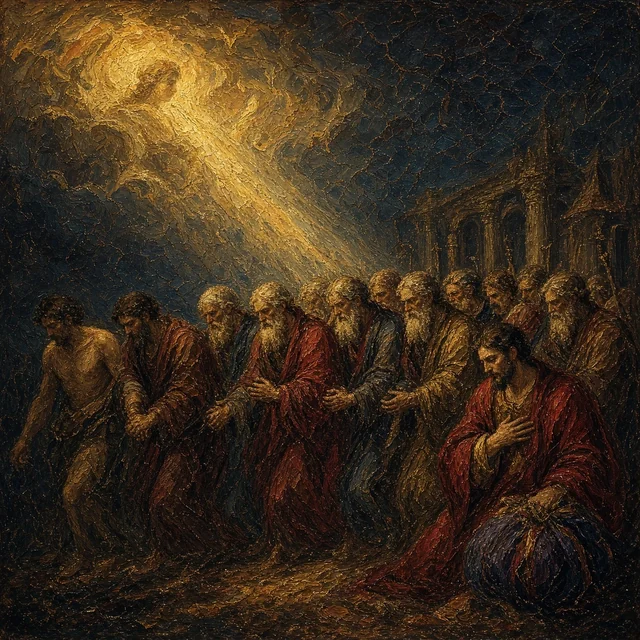
The twelve sons of Israel are named in their familiar family order, but Judah quickly receives the greater share of attention. That change in space is purposeful without rewriting birth order. Judah is not made firstborn simply because the book is moving toward David. More importantly, the genealogy refuses to polish the branch it is about to honor. Er is remembered as evil in the sight of the Lord and as one whom the Lord slew. Tamar remains in the line as the mother of Pharez and Zerah. Achar is identified by the trespass that troubled Israel. Those compressed notices carry the weight of fuller accounts elsewhere, but 1 Chronicles leaves the difficult names exactly where they belong. A place in the line that produces the king is not a certificate of innocence. The genealogy can trace chosen continuity while preserving facts that make the ancestry morally untidy.
Deep dive
Judah is not the first son listed, but his descendants soon occupy the page. The arrangement gives more space to the tribe that will produce David without quietly rewriting the order of Israel's sons. This is a guided genealogy, not an evenly proportioned directory.
Nor is the guidance an exercise in polishing the ancestors. Er's wickedness and death remain in the record, Tamar remains the mother of Pharez and Zerah, and Achar is identified through the trespass that troubled Israel. The fuller accounts in Genesis 38 and Joshua 7 explain the weight carried by these compressed notices. A place in Judah's ancestry is not a certificate of innocence. The book can trace a chosen royal line while leaving deeply uncomfortable entries exactly where they belong.
Words to trace: sons, Judah, daughter, Ethan, five, Israel
Verse-by-verse path
- 1 Chronicles 2:1
The first six names are Leah's sons in birth order, as Genesis 35:23 lists them. Reuben heads the roll even though 5:1–2 will explain that he lost the birthright for defiling his father's bed; the order of birth is kept, the order of honour is argued later.
- 1 Chronicles 2:2
Dan, a son of Rachel's maid Bilhah, is set oddly between Leah's sons and Rachel's own, Joseph and Benjamin, rather than with his full brother Naphtali. No reason is given. Joseph appears as a single name here, though he will be counted later as the two tribes of Ephraim and Manasseh.
- 1 Chronicles 2:3
Judah comes first of all the tribes to be traced, though he was the fourth son. His wife is not named, only “the daughter of Shua”; Genesis 38:2 gives the same. That Er was slain by the LORD is kept from Genesis 38:7, the first death in the chapter.
- 1 Chronicles 2:4
Tamar bore twins by her father-in-law after posing as a veiled woman at the roadside (Genesis 38:13–30). The line to David runs through Pharez, the twin who broke out first. The count of five includes both of Judah's dead sons, Er and Onan.
- 1 Chronicles 2:5
Hezron is the key name for everything that follows: David, Caleb and Jerahmeel all descend from him. Hamul is barely mentioned again, though his family is counted among Judah's clans in Numbers 26:21.
- 1 Chronicles 2:6
Ethan, Heman, Calcol and Dara are the names of the famous wise men whom Solomon surpassed (1 Kings 4:31, where Dara is Darda). Whether these sons of Zerah are the same men is debated; Kings calls them sons of Mahol. Zimri is Zabdi in Joshua 7:1.
- 1 Chronicles 2:7
Achar is Achan of Joshua 7, spelled here to match 'akar, to trouble, which gave the valley of Achor its name (Joshua 7:26). The verb “transgressed”, ma'al, means breach of faith, the Chronicler's favourite word for Israel's unfaithfulness, used again of Saul (10:13).
- 1 Chronicles 2:8
Of Ethan's line only one son is named. Azariah is among the commonest names in the Old Testament, borne by some two dozen men, so nothing links this one to any other Azariah.
1 Chronicles 2:1-8
King James Version1These are the sons of Israel; Reuben, Simeon, Levi, and Judah, Issachar, and Zebulun,
2Dan, Joseph, and Benjamin, Naphtali, Gad, and Asher.
3The sons of Judah; Er, and Onan, and Shelah: which three were born unto him of the daughter of Shua the Canaanitess. And Er, the firstborn of Judah, was evil in the sight of the LORD; and he slew him.
4And Tamar his daughter in law bare him Pharez and Zerah. All the sons of Judah were five.
5The sons of Pharez; Hezron, and Hamul.
6And the sons of Zerah; Zimri, and Ethan, and Heman, and Calcol, and Dara: five of them in all.
7And the sons of Carmi; Achar, the troubler of Israel, who transgressed in the thing accursed.
8And the sons of Ethan; Azariah.
1 Chronicles 2:9-17
David Arrives with His Relatives
The descent through Ram reaches Jesse and David, but David arrives as a son inside a household rather than as a royal beginning that erases everyone before him. His brothers remain named, and then the register does something especially useful by naming his sisters Zeruiah and Abigail. Through them, Joab, Abishai, Asahel, and Amasa enter David's family network. Those men will later appear as military figures, but the genealogy has already made their relationships visible before rank can flatten them into interchangeable officers. Zeruiah's sons are David's nephews, and Amasa belongs through Abigail. A few family notices therefore explain later loyalties, tensions, and proximity to the king without trying to narrate those events here. The royal line is being established, but the book keeps insisting that the king comes with relatives. David's history will be the history of a household as well as a throne.
Deep dive
This line also supplies the closing movement of Ruth 4:18–22, from Pharez toward David. Here the emphasis falls on its place within the larger family of Judah. David emerges from named fathers and brothers rather than appearing as a royal beginning in his own right. The register reaches the king through a household.
Zeruiah and Abigail are especially important. Through them, Joab, Abishai, Asahel, and Amasa belong to David's extended family. Later military names therefore carry relationships as well as ranks. The book does not explain every future alliance or conflict here, but it gives the connections that prevent those figures from becoming interchangeable officers. A few words about sisters do more historical work than a much longer catalogue of titles could accomplish.
Words to trace: begat, Abigail, Amasa, Amminadab, Boaz, Jesse
Verse-by-verse path
- 1 Chronicles 2:9
Chelubai is another form of Caleb (verse 18), and Ram is called Aram in the King James of Matthew 1:3. Jerahmeel is named first as the eldest, but the chapter will trace Ram's line before his, because Ram's leads to David.
- 1 Chronicles 2:10
Nahshon led Judah in the wilderness and brought the first offering at the tabernacle's dedication (Numbers 7:12). His sister Elisheba married Aaron (Exodus 6:23), so the royal line and the priestly line were joined in this generation.
- 1 Chronicles 2:11
Salma is Salmon of Ruth 4:21. Matthew 1:5 names Rahab of Jericho as the mother of Boaz, a detail the Book of 1 Chronicles does not include. The gap between Nahshon in the wilderness and Boaz in the judges' period suggests generations have been skipped.
- 1 Chronicles 2:12
The verse compresses the whole book of Ruth. Ruth herself is not named, though Obed was her son; the line of David is traced here through men, while the next verses will name David's sisters.
- 1 Chronicles 2:13
Eliab was the tall eldest whom Samuel mistook for the LORD's anointed (1 Samuel 16:6–7). Shimma is Shammah of 1 Samuel 16:9, called Shimeah in 2 Samuel 13:3, where his son Jonadab advised Amnon.
- 1 Chronicles 2:14
Nethaneel and Raddai are named only here. Samuel's account of the anointing passes over them as among the sons who were not chosen, so the Book of 1 Chronicles alone preserves their names.
- 1 Chronicles 2:15
David is “the seventh”, while 1 Samuel 16:10–11 and 17:12 imply Jesse had eight sons. Perhaps one died without heirs and was dropped. Seven also places David in the position that in Hebrew thought marks completion.
- 1 Chronicles 2:16
Zeruiah's three sons are always named after their mother, and her husband is never mentioned anywhere in the Bible. Joab became David's commander, Abishai one of his chief warriors, and Asahel was killed by Abner (2 Samuel 2:23).
- 1 Chronicles 2:17
2 Samuel 17:25 calls Amasa's father Ithra an Israelite; here he is Jether the Ishmeelite. The Chronicles reading is probably original, since noting an Israelite would be pointless. Amasa led Absalom's army, and his cousin Joab murdered him (2 Samuel 20:10).
1 Chronicles 2:9-17
King James Version9The sons also of Hezron, that were born unto him; Jerahmeel, and Ram, and Chelubai.
10And Ram begat Amminadab; and Amminadab begat Nahshon, prince of the children of Judah;
11And Nahshon begat Salma, and Salma begat Boaz,
12And Boaz begat Obed, and Obed begat Jesse,
13And Jesse begat his firstborn Eliab, and Abinadab the second, and Shimma the third,
14Nethaneel the fourth, Raddai the fifth,
15Ozem the sixth, David the seventh:
16Whose sisters were Zeruiah, and Abigail. And the sons of Zeruiah; Abishai, and Joab, and Asahel, three.
17And Abigail bare Amasa: and the father of Amasa was Jether the Ishmeelite.
1 Chronicles 2:18-24
The Line Toward the Craftsman
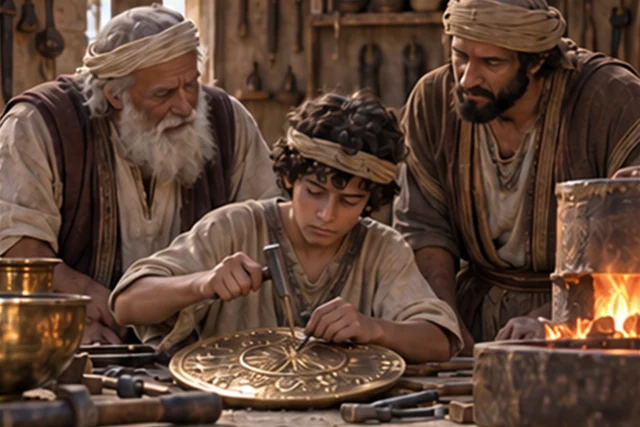
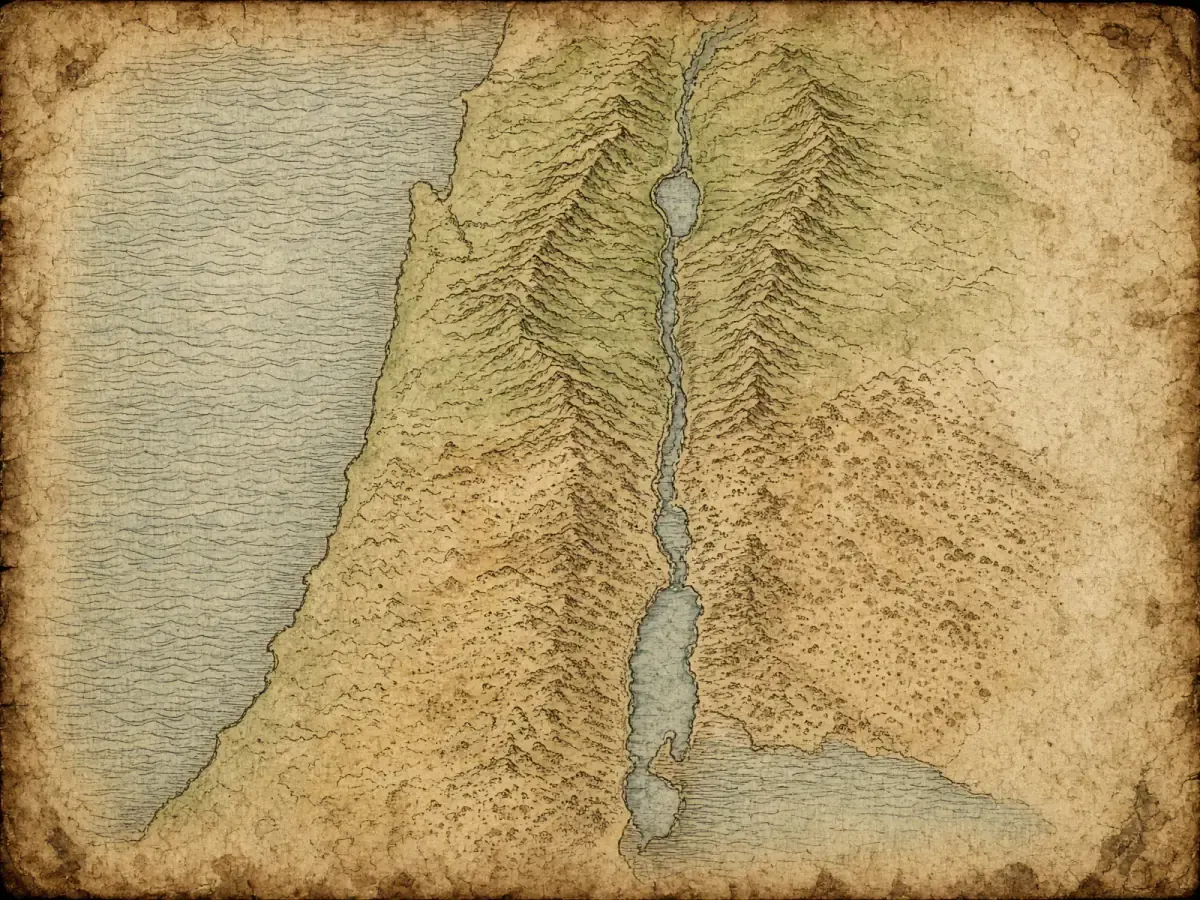
Caleb's branch leads through Hur and Uri to Bezaleel, which gives this Judah material a destination very different from David. Bezaleel is the skilled craftsman associated with the tabernacle, so the tribe that will later supply a king also preserves the ancestry of a man tied to the making of Israel's earlier sanctuary. Royal authority and skilled construction sit inside the same wider tribal register without becoming the same office. The remaining notices expand the geography. Hezron's marriage to a daughter of Machir connects this Judah material with Gilead, and the record begins to combine families with towns and territorial holdings. Several statements are too compressed to reconstruct every movement with confidence, and the passage does not invite an invented map to fill the gaps. Its clearer point is that Judah's households were connected through marriage and settlement well beyond a single neat local line.
Deep dive
David is not the only significant destination in Judah's ancestry. The sequence through Hur and Uri reaches Bezaleel, the craftsman commissioned for the tabernacle in Exodus 31:2. Before the book has described David's preparations for the temple, it has already preserved a family connection to the making of the earlier sanctuary. Royal authority and skilled construction have separate roots in the same tribal register.
The marriages and territorial notices also keep the family tree from remaining neatly inside a single border. Hezron's marriage into Machir's family connects this Judah material with Gilead. Several compressed statements about persons and settlements are difficult to reconstruct in detail, and the passage does not provide a complete sequence of movements. Its clear concern is to preserve those links, not to supply enough information for an exhaustive map of every marriage and town.
Words to trace: begat, bare, Caleb, father, Gilead, Hezron
Verse-by-verse path
- 1 Chronicles 2:18
The Hebrew is tangled: it may mean Caleb had children by Azubah his wife and by Jerioth, or that Azubah bore a daughter Jerioth. “Her sons” then refers to whichever woman is meant. This Caleb, son of Hezron, lived generations before Caleb son of Jephunneh.
- 1 Chronicles 2:19
Ephrath is also the old name of Bethlehem (Genesis 35:19; Micah 5:2, Bethlehem Ephratah). Her son Hur may be the Hur who held up Moses' hands with Aaron (Exodus 17:12), as Jewish tradition supposed.
- 1 Chronicles 2:20
Bezaleel built the tabernacle and its furnishings, and is the first person the Bible describes as filled with the spirit of God (Exodus 31:2–3). Solomon later worshipped at the bronze altar Bezaleel made (2 Chronicles 1:5), a link the Chronicler values.
- 1 Chronicles 2:21
Hezron's late marriage at sixty ties Judah to Manasseh, since Machir was Manasseh's son and Gilead his grandson (Numbers 26:29). “Went in to” is the Hebrew idiom for a man sleeping with a woman.
- 1 Chronicles 2:22
Jair appears in Numbers 32:41 as a son of Manasseh who took villages and called them Havoth-jair, “Jair's tent villages”. Here his father's line is from Judah, and he is counted with Manasseh through his grandmother.
- 1 Chronicles 2:23
The Hebrew subject is more likely Geshur and Aram, who took the towns of Jair and Kenath from Jair's descendants; the King James makes Jair the taker. Deuteronomy 3:4 counts sixty cities in the region of Argob. Kenath had been conquered by Nobah (Numbers 32:42).
- 1 Chronicles 2:24
Caleb-ephratah is a textual puzzle; the Greek reads “Caleb went in to Ephrathah”, meaning Caleb married his father's widow. Ashur, born after Hezron's death, founded Tekoa, the town of the wise woman (2 Samuel 14:2) and of Amos.
1 Chronicles 2:18-24
King James Version18And Caleb the son of Hezron begat children of Azubah his wife, and of Jerioth: her sons are these; Jesher, and Shobab, and Ardon.
19And when Azubah was dead, Caleb took unto him Ephrath, which bare him Hur.
20And Hur begat Uri, and Uri begat Bezaleel.
21And afterward Hezron went in to the daughter of Machir the father of Gilead, whom he married when he was threescore years old; and she bare him Segub.
22And Segub begat Jair, who had three and twenty cities in the land of Gilead.
23And he took Geshur, and Aram, with the towns of Jair, from them, with Kenath, and the towns thereof, even threescore cities. All these belonged to the sons of Machir the father of Gilead.
24And after that Hezron was dead in Caleb-ephratah, then Abiah Hezron’s wife bare him Ashur the father of Tekoa.
1 Chronicles 2:25-41
A Daughter Carries the Line Forward
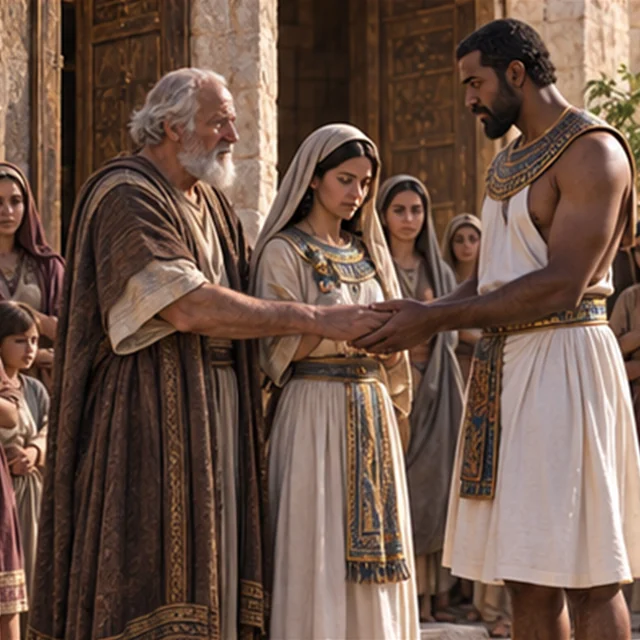
Jerahmeel's branch shows how misleading a genealogy can become if every line is imagined as an automatic march of fathers and sons. Childlessness interrupts several households. Some branches stop. Then Sheshan, who has daughters but no sons, gives a daughter in marriage to Jarha, his Egyptian servant, and the genealogy follows their descendants for generation after generation. The continuation of this Judah household therefore depends on a woman whose name is not supplied here and a man identified both by foreign origin and servant status. The record neither apologizes for that connection nor quietly deletes it. Birth order is equally unable to control literary emphasis, since Jerahmeel is Hezron's firstborn but appears after lines that lead toward David and Bezaleel. Family memory follows the relationships necessary to preserve continuity, even when those relationships do not fit a simple male-only chart or a tidy hierarchy of social standing.
Deep dive
Jerahmeel is Hezron's firstborn, yet his branch appears after the material leading to David and Bezaleel. Birth order and literary priority are not the same thing. Within this branch, notices of childlessness interrupt any impression that descent proceeds automatically. Families expand, stop, and continue by routes that a list of fathers and sons alone would not fully explain.
Sheshan has daughters but no sons, and his daughter marries Jarha, his Egyptian servant. The genealogy then follows their descendants through a long sequence of names. It does not pause to apologize for the Egyptian connection or erase the woman's indispensable place in the line. The continuation of this Judah household depends on a marriage across differences of origin and status. The register is more socially textured than a collection of male names initially suggests.
Words to trace: begat, sons, Sheshan, Jerahmeel, children, firstborn
Verse-by-verse path
- 1 Chronicles 2:25
The Jerahmeelites were a clan in the Negev whom David claimed to raid while he was really fighting Israel's enemies (1 Samuel 27:10), and to whom he later sent spoil (1 Samuel 30:29). This Ram is Jerahmeel's son, not the ancestor of David.
- 1 Chronicles 2:26
The second wife is named, Atarah, meaning crown, while the first wife is not. Onam's line, not the firstborn's, is the one the genealogy follows in detail.
- 1 Chronicles 2:27
Maaz, Jamin and Eker are named nowhere else. Eker means offshoot or root, a fitting name in a list of branching descent.
- 1 Chronicles 2:28
Shammai carries a name that became famous much later through the rabbi Shammai of Hillel's day. Nadab shares his name with Aaron's son who offered strange fire (Leviticus 10:1).
- 1 Chronicles 2:29
Abihail means “my father is might”, a name borne by both women and men; Esther's father had the same name. Wives rarely appear in this register, so her mention may preserve a clan tradition.
- 1 Chronicles 2:30
The first note of a childless death. Seled's line ends where it begins, and the genealogy records the dead end rather than dropping him. Appaim is a dual noun, “nostrils”, a strange personal name.
- 1 Chronicles 2:31
“The children of Sheshan; Ahlai” clashes with verse 34, which says Sheshan had no sons. Ahlai may be the daughter given to Jarha: 11:41 lists a Zabad son of Ahlai among David's warriors, and a Zabad is Jarha's grandson in verse 36.
- 1 Chronicles 2:32
Jether, like Seled two verses earlier, dies childless. Jada, brother of Shammai, therefore continues only through Jonathan.
- 1 Chronicles 2:33
Peleth and Zaza close Jerahmeel's line with a summary, though Sheshan's descendants still follow. Peleth was also the name of a Reubenite whose son On joined Korah's rebellion (Numbers 16:1).
- 1 Chronicles 2:34
Sheshan's problem is Zelophehad's, whose daughters were allowed to inherit so that his name would not vanish (Numbers 27:1–8). Jarha is the only Egyptian named in Judah's genealogy, and a slave.
- 1 Chronicles 2:35
Marrying a daughter to a household slave kept the property and name in the family, a solution Abraham once contemplated in making his servant Eliezer his heir (Genesis 15:2–3). Attai's descendants are counted as Sheshan's.
- 1 Chronicles 2:36
Zabad may be the Zabad son of Ahlai among David's mighty men (11:41). If so, a grandson of an Egyptian slave fought in David's elite guard.
- 1 Chronicles 2:37
Obed, “servant”, repeats the name of David's grandfather in verse 12. Ephlal, perhaps “judge”, is found nowhere else.
- 1 Chronicles 2:38
Jehu and Azariah are also names of a king of Israel and a king of Judah, but these men are private citizens of Sheshan's line. The chain runs on without a single comment.
- 1 Chronicles 2:39
Helez was the name of one of David's thirty mighty men (11:27), and Eleasah may be the same name as Elasah son of Shaphan, Jeremiah's messenger (Jeremiah 29:3). Nothing but the names connects them.
- 1 Chronicles 2:40
Sisamai is a puzzling name, perhaps containing the name of a Phoenician god, Sasam, which would suit a family of mixed origins. Shallum is common, borne by a king of Israel and a king of Judah.
- 1 Chronicles 2:41
Thirteen generations run from Attai to Elishama, the longest unbroken father to son chain in the chapter. Some have suggested this Elishama is the grandfather of Ishmael who killed Gedaliah (2 Kings 25:25), but that is a guess.
1 Chronicles 2:25-41
King James Version25And the sons of Jerahmeel the firstborn of Hezron were, Ram the firstborn, and Bunah, and Oren, and Ozem, and Ahijah.
26Jerahmeel had also another wife, whose name was Atarah; she was the mother of Onam.
27And the sons of Ram the firstborn of Jerahmeel were, Maaz, and Jamin, and Eker.
28And the sons of Onam were, Shammai, and Jada. And the sons of Shammai; Nadab, and Abishur.
29And the name of the wife of Abishur was Abihail, and she bare him Ahban, and Molid.
30And the sons of Nadab; Seled, and Appaim: but Seled died without children.
31And the sons of Appaim; Ishi. And the sons of Ishi; Sheshan. And the children of Sheshan; Ahlai.
32And the sons of Jada the brother of Shammai; Jether, and Jonathan: and Jether died without children.
33And the sons of Jonathan; Peleth, and Zaza. These were the sons of Jerahmeel.
34Now Sheshan had no sons, but daughters. And Sheshan had a servant, an Egyptian, whose name was Jarha.
35And Sheshan gave his daughter to Jarha his servant to wife; and she bare him Attai.
36And Attai begat Nathan, and Nathan begat Zabad,
37And Zabad begat Ephlal, and Ephlal begat Obed,
38And Obed begat Jehu, and Jehu begat Azariah,
39And Azariah begat Helez, and Helez begat Eleasah,
40And Eleasah begat Sisamai, and Sisamai begat Shallum,
41And Shallum begat Jekamiah, and Jekamiah begat Elishama.
1 Chronicles 2:42-55
Towns, Households, and the People Who Kept Records
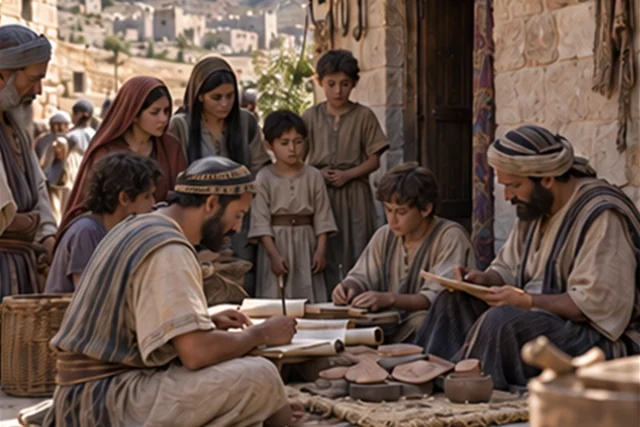
The closing Caleb material mixes people, places, and occupations so thoroughly that a modern family-tree diagram would lose part of what the passage is preserving. Expressions such as the father of a town can identify founders, ancestral groups, or inhabitants rather than immediate biological parenthood. Bethlehem, Kirjath-jearim, Beth-zur, and other settlements therefore belong inside the genealogy because tribal identity includes where households took root. Women such as Achsah and concubines connected with Caleb's branch remain visible as the record expands. The final notice then reaches families of scribes associated with Jabez, the Kenites, and the house of Rechab. That ending is almost perfectly suited to a chapter full of preserved names. Judah contains the line that will wear the crown, but it also contains the communities that inhabit towns, maintain households, and practice the work by which records can survive. Royal ancestry is only one part of the tribal memory.
Deep dive
Expressions such as the father of a town connect people with the founding or ancestry of its inhabitants. They are not all statements about immediate biological parenthood. Place names and personal names can occupy the same sentence because this register preserves both kinship and settlement. A rigid modern family-tree template would flatten information the passage deliberately keeps together.
The final notice identifies families of scribes and connects them with the Kenites and the house of Rechab. After so many preserved names, the appearance of people whose work involved writing is a fitting close. Judah includes not only the line that wears the crown but communities that build, inhabit, and record. The book has room for the people whose names are kept and for some of the people whose work helped names remain available.
Words to trace: father, sons, Beth, bare, begat, Caleb
Verse-by-verse path
- 1 Chronicles 2:42
This Caleb is the Chelubai of verse 9. Ziph is the town where the Ziphites twice betrayed David to Saul (1 Samuel 23:19; 26:1), and Mareshah was a Shephelah town fortified by Rehoboam (2 Chronicles 11:8).
- 1 Chronicles 2:43
Hebron's sons are partly towns: Tappuah, “apple”, was a town of Judah (Joshua 15:34). Korah here is not the Levite rebel, and Rekem shares a name with a Midianite king (Numbers 31:8).
- 1 Chronicles 2:44
Jorkoam may be Jokdeam, a town in Judah's hills (Joshua 15:56). This Shammai is a different man from the Jerahmeelite of verse 28, showing how names repeat across neighbouring clans.
- 1 Chronicles 2:45
Maon was Nabal's town, where David met Abigail (1 Samuel 25:2). Beth-zur, “house of the rock”, commanded the road north of Hebron and was later a Maccabean fortress.
- 1 Chronicles 2:46
Ephah, a woman's name here, is borne by a man in the next verse and by a Midianite in 1:33. Gazez appears as both son and grandson of Ephah, perhaps a boy named after his uncle.
- 1 Chronicles 2:47
Jahdai appears without any link to what comes before, perhaps another concubine or a son of Caleb whose connection has dropped out. Ephah and Shaaph recur in nearby verses as different people.
- 1 Chronicles 2:48
Maachah was a common name; David's wife, Absalom's mother, bore it too (3:2). Sheber and Tirhanah are known only here.
- 1 Chronicles 2:49
Madmannah lay in the Negev (Joshua 15:31). Achsah was the daughter Caleb promised to whoever took Kirjath-sepher, and who asked her father for springs (Joshua 15:16–19); her name here may link the two Calebs or merge their clans.
- 1 Chronicles 2:50
The Hebrew is best read “These were the sons of Caleb. The sons of Hur”, making Shobal a son of Hur, not of Caleb son of Hur. Kirjath-jearim held the ark for twenty years (1 Samuel 7:2) until David brought it up (13:5–6).
- 1 Chronicles 2:51
Salma is named as father, or founder, of Bethlehem, and the name matches Boaz's father in verse 11. Beth-gader may be Geder, whose king Joshua defeated (Joshua 12:13).
- 1 Chronicles 2:52
Haroeh means “the seer”, possibly a garbling of Reaiah in 4:2. The other half of the Manahethites is counted under Salma in verse 54, so the clan straddled two lines.
- 1 Chronicles 2:53
The Zareathites and Eshtaulites came from Zorah and Eshtaol, the towns between which Samson grew up and was buried (Judges 13:25; 16:31). Two of David's heroes, Ira and Gareb, were Ithrites (11:40).
- 1 Chronicles 2:54
Netophah near Bethlehem was the home of two of David's mighty men (11:30) and of an officer who came to Gedaliah (2 Kings 25:23). “Ataroth, the house of Joab” is probably one place name, Atroth-beth-joab, crowns of Joab's house.
- 1 Chronicles 2:55
The Kenites were Jethro's people, non-Israelites attached to Judah since the wilderness (Judges 1:16). The house of Rechab later refused wine and houses in Jeremiah 35. Jabez is a place here, and a man with a famous prayer in 4:9–10.
1 Chronicles 2:42-55
King James Version42Now the sons of Caleb the brother of Jerahmeel were, Mesha his firstborn, which was the father of Ziph; and the sons of Mareshah the father of Hebron.
43And the sons of Hebron; Korah, and Tappuah, and Rekem, and Shema.
44And Shema begat Raham, the father of Jorkoam: and Rekem begat Shammai.
45And the son of Shammai was Maon: and Maon was the father of Beth-zur.
46And Ephah, Caleb’s concubine, bare Haran, and Moza, and Gazez: and Haran begat Gazez.
47And the sons of Jahdai; Regem, and Jotham, and Geshan, and Pelet, and Ephah, and Shaaph.
48Maachah, Caleb’s concubine, bare Sheber, and Tirhanah.
49She bare also Shaaph the father of Madmannah, Sheva the father of Machbenah, and the father of Gibea: and the daughter of Caleb was Achsah.
50These were the sons of Caleb the son of Hur, the firstborn of Ephratah; Shobal the father of Kirjath-jearim,
51Salma the father of Beth-lehem, Hareph the father of Beth-gader.
52And Shobal the father of Kirjath-jearim had sons; Haroeh, and half of the Manahethites.
53And the families of Kirjath-jearim; the Ithrites, and the Puhites, and the Shumathites, and the Mishraites; of them came the Zareathites, and the Eshtaulites.
54The sons of Salma; Beth-lehem, and the Netophathites, Ataroth, the house of Joab, and half of the Manahethites, the Zorites.
55And the families of the scribes which dwelt at Jabez; the Tirathites, the Shimeathites, and Suchathites. These are the Kenites that came of Hemath, the father of the house of Rechab.
Questions to keep in mind while reading
- Track who acts, who speaks, who is affected, and what changes.
- Notice repeated promises, failures, rescues, and consequences.
- Do not assume the account approves every action that is reported.
Text first
Where readers differ
The chapter summary begins with what the passage says and how its parts fit together. It does not assume one denomination has already settled every question. Where a conclusion depends on a tradition, literary theory, or historical reconstruction, that dependence is named openly.
The KJV text is presented first. Interpretive conclusions are labeled, and differences are introduced only when they help a reader understand why serious communities do not always reach the same answer.
Comparative interpretive notes for this chapter are in preparation. Until reviewed notes are ready, this page separates the KJV text from summary and application without claiming that serious readers agree on every question.
Questions beneath the surface
- What account of God, human freedom, responsibility, and the good life emerges from 1 Chronicles 2?
- Which tension does the chapter refuse to resolve quickly?
- What changes when the chapter is read as part of the whole canon rather than as an isolated moral lesson?
- Where might a sincere reader confuse a familiar tradition with something the text states directly?
Questions for serious personal contemplation
These open-ended questions make room for tension, honest response, prayer, and conclusions that remain accountable to the chapter.
Observe without rushing
What part of 1 Chronicles 2 makes you stop, feel unsettled, or feel surprised, and why?
Which detail in the passage would be easiest to overlook? How does that detail change your understanding?
Where do you see tension between what happens and this focus: 1 Chronicles 2 develops its own movement around sons, begat, father, bare, firstborn?
What important question does the passage leave open instead of resolving quickly?
Examine your inner life honestly
Which person, response, fear, or desire in the passage feels most like your own life right now?
What assumption about God, other people, or yourself does this text challenge?
Which part would you rather soften, avoid, or explain away too quickly? What might that reaction reveal?
If this Scripture could ask you one direct question, what do you think it would ask?
Respond with wisdom and courage
What do you need to remember, confess, grieve, thank God for, or trust after reading this passage?
How might another faithful person read this situation differently without ignoring the text?
What obedient response would be costly, uncomfortable, or slow, yet still faithful to Scripture?
What question will you carry into prayer this week, and which verses will you keep in front of you?
Music and video connected to the passage
Related media appears when its Scripture reference overlaps this study. Music and video can illuminate a theme while the biblical text remains the foundation.