The big picture
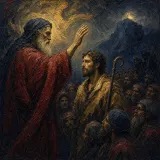
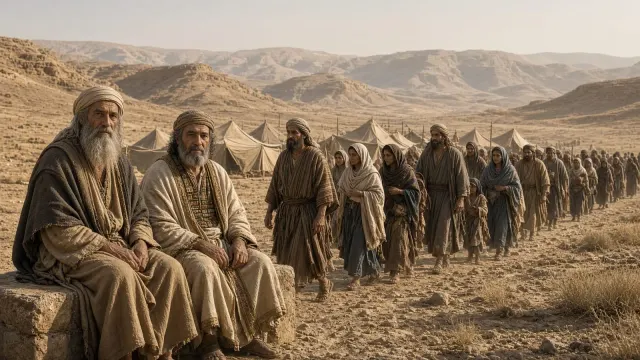
Numbers 26 takes a second military census after the plague and turns a long list of names into evidence that an entire generation has changed. Men twenty years old and upward who are able to go to war are counted by tribal families, while the Levites are counted separately from one month old because their role and inheritance are different. The total of 601,730 is remarkably close to the first census, yet the closing lines forbid a superficial reading of that similarity: apart from Caleb and Joshua, none of the men from the earlier military registration remains. Within the lists, memory keeps interrupting arithmetic. Dathan, Abiram, Korah, Er, Onan, Nadab, and Abihu are recalled, while the survival of Korah's children is expressly preserved. Five daughters of Zelophehad are named in a male military roll because their household will soon raise an inheritance question. The census therefore looks backward to judgment and forward to land, war, succession, and settlement all at once.
In this chapter
- The Count Begins After the Plague Numbers 26:1-11
"After the plague" is the first interpretive marker in the census.
- The Totals Change Unevenly from Tribe to Tribe Numbers 26:12-27
The tribal totals do not rise or fall evenly.
- Five Daughters Interrupt the Military Roll Numbers 26:28-51
The military roll pauses over a household with no sons.
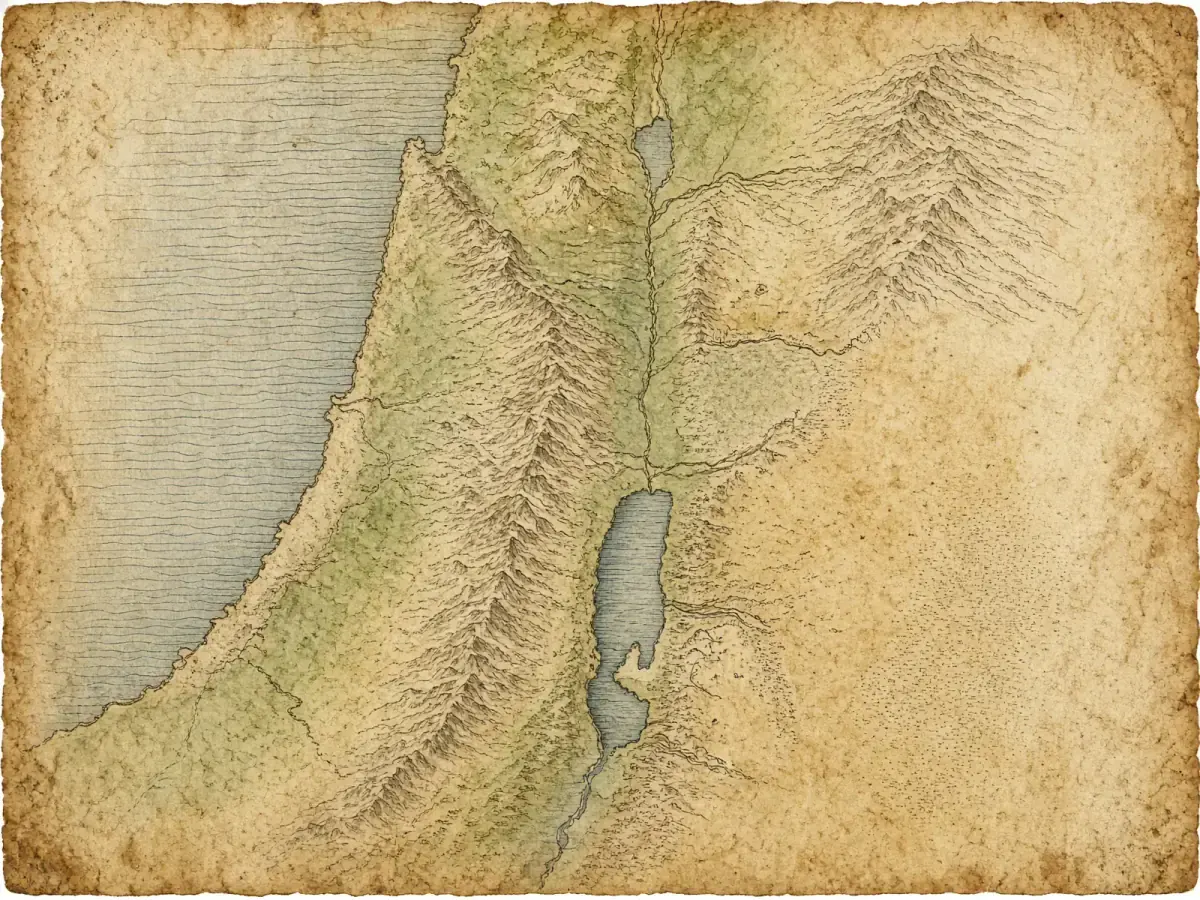
- The Census Becomes a Land-Allocation Instrument Numbers 26:52-56
The reason for counting becomes explicit when the LORD connects the census to land.
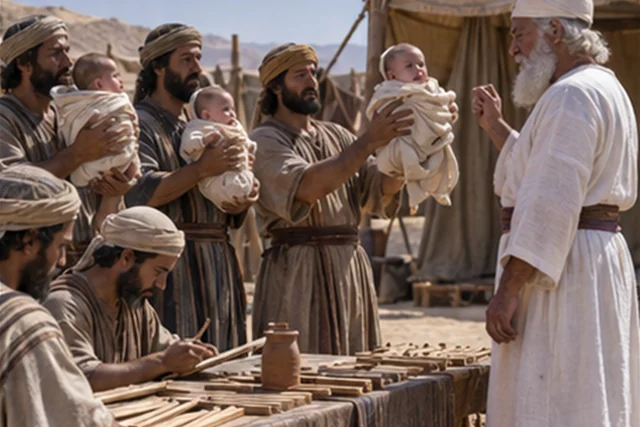
- Levi Is Counted by a Different Rule Numbers 26:57-62
The Levite count uses a different threshold because it is counting a different kind of place in Israel.
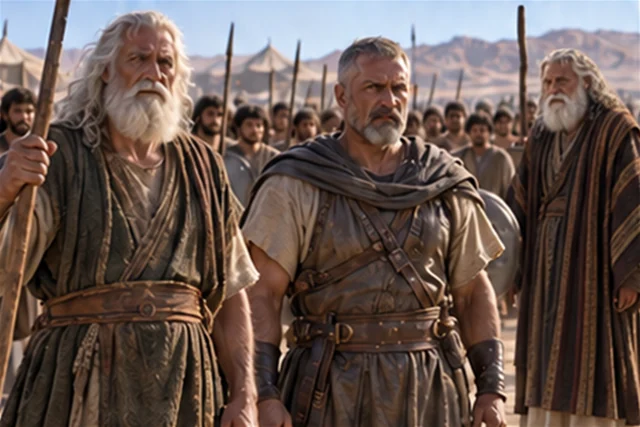
- The First Military Generation Is Absent Numbers 26:63-65
The closing verses explain the entire census in one severe comparison.
Scripture beside the summary
Numbers · King James Version · 65Numbers 26:1-11
The Count Begins After the Plague
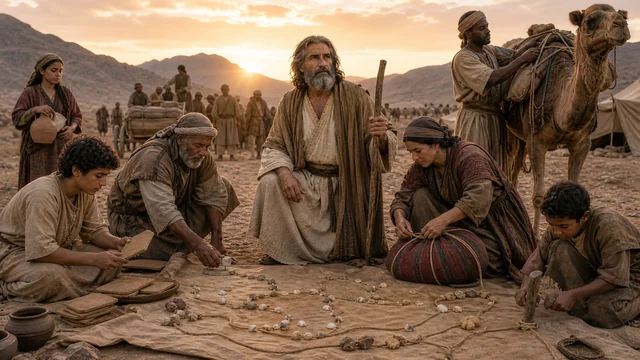
"After the plague" is the first interpretive marker in the census. Israel has just lost thousands, Aaron has already died, and Eleazar now stands beside Moses where Aaron stood during the first registration. The command again counts men twenty years old and upward who are able to go to war, so this number is not a headcount of every Israelite. Reuben's family list then pauses over Dathan and Abiram, recalling their prominence, rebellion, and destruction with Korah's company. The census is doing more than administration; it is carrying remembered judgment inside the genealogy of the people who remain. Then comes a qualification Numbers makes deliberately: "Notwithstanding the children of Korah died not." That line matters because it prevents the sweeping language of chapter 16 from being read as though every descendant of Korah vanished. A census can preserve the distinction with unusual precision. The rebellion was real, the judgment was real, and the survival of Korah's children is equally part of the book's record.
Deep dive
"After the plague" is not a disposable time marker. The new count is taken after another major loss, and Eleazar now stands where Aaron stood in the first census. The men being counted are twenty and upward and able to go to war. This is not a total of every person in Israel. The age, sex, military qualification, and family organization determine what kind of number the chapter will produce.
The list of Reuben's families stops to remember Dathan and Abiram. Their prominence is recalled alongside their rebellion and its judgment. Then comes the careful exception concerning Korah's children. The account does not allow the destruction associated with Korah to become an assumption that every descendant vanished. A census can carry that distinction more precisely than a broad statement about a fallen household. Here names and family continuities are part of the historical argument: judgment occurred, but its reach must be described as Numbers actually describes it.
Words to trace: children, family, Israel, Moses, Korah, LORD
Verse-by-verse path
- Numbers 26:1
Hebrew Bibles end chapter 25 with the words “And it came to pass after the plague”, so the census begins in the middle of a sentence about twenty four thousand dead. It is the first time the LORD addresses Moses and Eleazar together; Aaron died on Mount Hor in 20:28.
- Numbers 26:2
The wording copies the Sinai census of 1:2–3 almost phrase for phrase: the sum, the fathers’ house, twenty and upward, able to go to war. The sameness is deliberate. A second generation is put through exactly the test the first one passed forty years before.
- Numbers 26:3
“The plains of Moab” are the arvot, the flat floor of the Jordan rift on the east bank, facing Jericho across the river. Every remaining law and speech of the Torah is set here; Israel does not move camp again until Joshua 3.
- Numbers 26:4
The Hebrew of the last clause is abrupt, and many translators read it as a heading for the list that follows: “the children of Israel, which went forth out of the land of Egypt” are Reuben, Simeon and the rest. Read that way, the exodus generation’s name is carried by their sons.
- Numbers 26:5
Reuben is still called “the eldest son of Israel” and still stands first, although he lost the birthright for lying with Bilhah (Genesis 35:22; 1 Chronicles 5:1). The four clans are the four sons listed under his name when Jacob went down into Egypt in Genesis 46:9.
- Numbers 26:6
A Hezron heads a Reubenite family here, and another Hezron will head a Judahite family in verse 21. The same name in two tribes is common in these rolls, and the census keeps them apart by the tribe under which each stands.
- Numbers 26:7
Forty three thousand seven hundred and thirty is a fall of 2,770 from Reuben’s 46,500 at Sinai (1:21). Reuben is the only tribe in this roll whose total ends in a figure finer than the hundreds, a small oddity the text leaves unexplained.
- Numbers 26:8
Pallu has a single son recorded, Eliab, and the list narrows to one line so that it can reach the men it wants to name. The Pentateuch never lists Eliab’s descendants for their own sake; he exists here to be the father of the next verse.
- Numbers 26:9
“Famous in the congregation” is qeri’ei ha’edah, “called ones of the congregation”, the title given to the tribal leaders chosen for the first census in 1:16. Dathan and Abiram were men summoned to govern, which is what made their revolt in chapter 16 a revolt from inside.
- Numbers 26:10
“They became a sign” uses nes, a standard or banner raised on a pole. It is the word for the pole that held the brass serpent in 21:8. The swallowed men were hoisted, so to speak, as a warning flag for the congregation to see.
- Numbers 26:11
Five Hebrew words, and a large afterlife. The Korahites became temple singers and doorkeepers; eleven psalms carry the heading “for the sons of Korah” (42, 44–49, 84, 85, 87, 88), and 1 Chronicles 6:33–38 traces the singer Heman and the prophet Samuel back to Korah.
Numbers 26:1-11
King James Version1And it came to pass after the plague, that the LORD spake unto Moses and unto Eleazar the son of Aaron the priest, saying,
2Take the sum of all the congregation of the children of Israel, from twenty years old and upward, throughout their fathers’ house, all that are able to go to war in Israel.
3And Moses and Eleazar the priest spake with them in the plains of Moab by Jordan near Jericho, saying,
4Take the sum of the people, from twenty years old and upward; as the LORD commanded Moses and the children of Israel, which went forth out of the land of Egypt.
5Reuben, the eldest son of Israel: the children of Reuben; Hanoch, of whom cometh the family of the Hanochites: of Pallu, the family of the Palluites:
6Of Hezron, the family of the Hezronites: of Carmi, the family of the Carmites.
7These are the families of the Reubenites: and they that were numbered of them were forty and three thousand and seven hundred and thirty.
8And the sons of Pallu; Eliab.
9And the sons of Eliab; Nemuel, and Dathan, and Abiram. This is that Dathan and Abiram, which were famous in the congregation, who strove against Moses and against Aaron in the company of Korah, when they strove against the LORD:
10And the earth opened her mouth, and swallowed them up together with Korah, when that company died, what time the fire devoured two hundred and fifty men: and they became a sign.
11Notwithstanding the children of Korah died not.
Numbers 26:12-27
The Totals Change Unevenly from Tribe to Tribe
The tribal totals do not rise or fall evenly. Simeon now numbers only 22,200, far below the 59,300 recorded in the first census. The decline is striking, especially after a leading Simeonite has just been named in the Peor crisis, but Numbers gives no tribal breakdown of the plague deaths. The connection may invite attention; it does not justify assigning every missing Simeonite to that one event. Judah, by contrast, remains the largest military contingent at 76,500. Its list pauses over the deaths of Er and Onan in Canaan, reaching back before the descent into Egypt while counting men about to enter Canaan generations later. These interruptions keep the census from sounding like anonymous bookkeeping. Names in Israel's present are carried inside remembered family histories of death and continuity. Yet Numbers resists turning each numerical change into a fully explained demographic report. The totals tell what the tribes now are able to field. They do not supply a cause for every increase and decline between Sinai and Moab.
Deep dive
Simeon's count is now 22,200, compared with 59,300 in Numbers 1:23. The difference is striking, particularly after a Simeonite leader has been named in the Peor crisis. Yet Numbers gives no tribal breakdown of the plague's deaths. Assigning the entire decline to that one event would turn a suggestive connection into an unsupported calculation. The census records the result, not a complete demographic explanation.
Judah remains the largest military contingent in this census, at 76,500. Its family list nevertheless includes the deaths of Er and Onan in Canaan. The roll of those who stand ready to enter the land contains a memory of men who died there before the descent into Egypt. Numbers does not expand their account here because the list's task is lineage, not a second telling of Genesis. These brief notices prevent the names from becoming a completely impersonal inventory, while leaving the inventory free to remain brief.
Words to trace: family, families, sons, numbered, five, Judah
Verse-by-verse path
- Numbers 26:12
Nemuel was already a Reubenite name in verse 9; here it is a Simeonite one. In Genesis 46:10 this son is called Jemuel. Jamin and Jachin keep their Genesis names, and a son called Ohad in Genesis has no family at all in this roll.
- Numbers 26:13
Zerah is the Zohar of Genesis 46:10. Shaul is the son Genesis singles out as “the son of a Canaanitish woman”, a detail this list drops, so that a family descended from a Canaanite mother stands in Israel’s muster without comment.
- Numbers 26:14
The figure is bare, with no “according to those that were numbered of them” formula around it, the barest of the twelve tribal totals. Simeon is the smallest tribe by a wide margin, and in the blessing of Moses in Deuteronomy 33 Simeon is not named at all.
- Numbers 26:15
Zephon is Ziphion in Genesis 46:16. Gad’s clans follow the seven sons listed there almost exactly, and Gad is the tribe that, in chapter 32, will ask to stay on this side of the Jordan, in the grazing land where the count is being taken.
- Numbers 26:16
Ozni stands where Genesis 46:16 has Ezbon, a different name for the fourth son. Lists compiled in different periods often carry a clan under the name it later used, so the mismatch points to a living register, not a copied one.
- Numbers 26:17
Arod is Arodi in Genesis 46:16, the same name with its ending worn away. With Areli the seven Gadite clans are complete: every son of Gad listed in Genesis has a family in this census.
- Numbers 26:18
Forty thousand five hundred is 5,150 below Gad’s Sinai figure of 45,650 (1:25). Gad’s old total was the only one in chapter 1 ending in fifty, and the new one returns to round hundreds like the others.
- Numbers 26:19
Er and Onan left no sons, so they head no family; they are named only to be marked dead. Genesis 38:7 and 38:10 say in each case that the LORD slew him, and the census, reaching its first Judahite line, pauses on two men who have no line.
- Numbers 26:20
Shelah is named first, the son Judah withheld from Tamar in Genesis 38:11. Pharez and Zerah are the twins Tamar bore, whose birth order was disputed at the moment of delivery (Genesis 38:28–30). The Zarhites will later produce Achan (Joshua 7:18).
- Numbers 26:21
Pharez’s two sons, Hezron and Hamul, already appear in Genesis 46:12. The Hezronite family is the one that matters most for later history: Ruth 4:18–22 runs from Pharez through Hezron to David.
- Numbers 26:22
Seventy six thousand five hundred makes Judah the largest tribe again, as at Sinai with 74,600 (1:27). Judah was already given the lead position east of the tabernacle in 2:3, and its size still matches its place.
- Numbers 26:23
Tola is a name Issachar kept: the judge who followed Abimelech was “Tola the son of Puah”, a man of Issachar (Judges 10:1). Father and son in Judges carry the names of the first two clans in this verse. Pua is the Phuvah of Genesis 46:13.
- Numbers 26:24
Jashub is the son called Job in Genesis 46:13, Hebrew Yov. The Samaritan Pentateuch and the Greek read Jashub in Genesis as well, which suggests the shorter form there is a scribal slip.
- Numbers 26:25
Sixty four thousand three hundred is up almost ten thousand from 54,400 at Sinai (1:29), one of the largest rises in the census. Issachar will be allotted part of the fertile Jezreel valley in Joshua 19:17–23.
- Numbers 26:26
Sered, Elon and Jahleel are the three sons of Zebulun in Genesis 46:14, unchanged. Elon too became a judge’s name: “Elon, a Zebulonite, judged Israel” for ten years (Judges 12:11).
- Numbers 26:27
Sixty thousand five hundred, a rise of 3,100 over 57,400 at Sinai (1:31). Zebulun, a tribe with only three families, fields more men than Reuben with four or Gad with seven.
Numbers 26:12-27
King James Version12The sons of Simeon after their families: of Nemuel, the family of the Nemuelites: of Jamin, the family of the Jaminites: of Jachin, the family of the Jachinites:
13Of Zerah, the family of the Zarhites: of Shaul, the family of the Shaulites.
14These are the families of the Simeonites, twenty and two thousand and two hundred.
15The children of Gad after their families: of Zephon, the family of the Zephonites: of Haggi, the family of the Haggites: of Shuni, the family of the Shunites:
16Of Ozni, the family of the Oznites: of Eri, the family of the Erites:
17Of Arod, the family of the Arodites: of Areli, the family of the Arelites.
18These are the families of the children of Gad according to those that were numbered of them, forty thousand and five hundred.
19The sons of Judah were Er and Onan: and Er and Onan died in the land of Canaan.
20And the sons of Judah after their families were; of Shelah, the family of the Shelanites: of Pharez, the family of the Pharzites: of Zerah, the family of the Zarhites.
21And the sons of Pharez were; of Hezron, the family of the Hezronites: of Hamul, the family of the Hamulites.
22These are the families of Judah according to those that were numbered of them, threescore and sixteen thousand and five hundred.
23Of the sons of Issachar after their families: of Tola, the family of the Tolaites: of Pua, the family of the Punites:
24Of Jashub, the family of the Jashubites: of Shimron, the family of the Shimronites.
25These are the families of Issachar according to those that were numbered of them, threescore and four thousand and three hundred.
26Of the sons of Zebulun after their families: of Sered, the family of the Sardites: of Elon, the family of the Elonites: of Jahleel, the family of the Jahleelites.
27These are the families of the Zebulunites according to those that were numbered of them, threescore thousand and five hundred.
Numbers 26:28-51
Five Daughters Interrupt the Military Roll
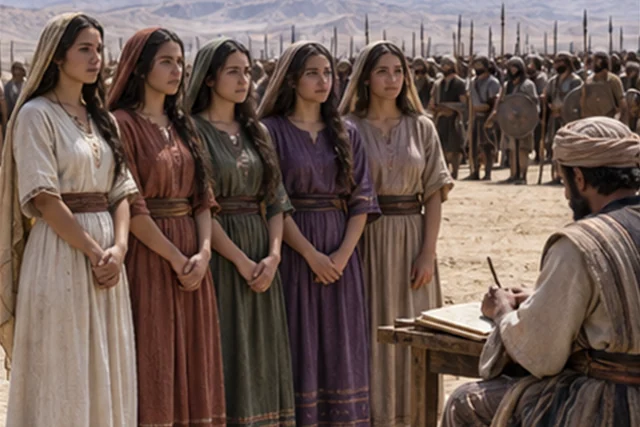
The military roll pauses over a household with no sons. Zelophehad belongs to Manasseh through Hepher, but instead of a male descendant entering the count, Numbers names five daughters: Mahlah, Noah, Hoglah, Milcah, and Tirzah. They do not become soldiers in the census, yet the book refuses to let their family disappear from the record simply because its inheritance problem does not fit the ordinary male line. Their names prepare the legal case of the next chapter before anyone has formally argued it. Asher's daughter Sarah is also named, another reminder that the genealogical material contains more than the bodies contributing to the military total. The final number, 601,730, sits only 1,820 below the 603,550 of the first census. That near match could suggest almost perfect continuity if the chapter ended there. It does not. The names, losses, daughters, and final explanation all insist that comparable national strength can coexist with a complete replacement of the earlier military generation.
Deep dive
Zelophehad's household receives unusual attention. The list says he had no sons and names Mahlah, Noah, Hoglah, Milcah, and Tirzah. They do not enter the military total, but their presence in the genealogy prepares the legal question of the next chapter. The family exists, yet the ordinary male line through which its holding would pass is absent. The census is already looking toward inheritance before the inheritance rules are stated.
Asher's daughter Sarah is also named, a reminder that these family records contain more than a bare roll of current soldiers. The final total, 601,730, is only 1,820 below the 603,550 recorded in Numbers 1:46. That near equality can conceal the chapter's larger point if it is read in isolation. The nation is not simply the old army reduced by a small number. The closing verses will identify a replacement generation. The totals establish substantial continuity in Israel's strength, while the surrounding names and explanations establish a far more profound change in who is present.
Words to trace: family, families, sons, numbered, Asher, Ephraim
Verse-by-verse path
- Numbers 26:28
The order is Manasseh, then Ephraim, the order of their births. At Sinai Ephraim was listed first (1:32–35), following Jacob’s crossed hands in Genesis 48:14–20. Here the elder son comes first again, and the numbers that follow will match it.
- Numbers 26:29
Machir is the grandson Genesis 50:23 says was brought up on Joseph’s knees. Gilead is here a man, the son of Machir, and the name of a whole region east of the Jordan. In chapter 32 Machir’s sons will take the land that shares their father’s son’s name.
- Numbers 26:30
Jeezer is shortened from Abiezer, the form Joshua 17:2 uses. The Abiezrites are Gideon’s clan: Gideon threshed wheat at “Ophrah that pertained unto Joash the Abiezrite” (Judges 6:11), and his first call to arms went out to them.
- Numbers 26:31
Shechem as a clan shares its name with the town where Jacob bought land in Genesis 33:18–19. Asriel and Shechem, along with Helek and Shemida, turn up as district names on the Samaria ostraca, eighth century BC tax dockets, so these clans became places on the map.
- Numbers 26:32
Hepher is the father through whom the inheritance question of the next chapter arises. Shemida is one of the district names on the Samaria ostraca too, evidence that this genealogy records real clans holding real territory in the hills of Manasseh.
- Numbers 26:33
Noah here is a woman’s name, No’ah in Hebrew, unrelated to the Noach of the flood. Tirzah became a city, the royal seat of the northern kings from Jeroboam to Omri (1 Kings 14:17; 16:23). Hoglah and Noah also appear as district names on the Samaria ostraca.
- Numbers 26:34
Fifty two thousand seven hundred is a rise of 20,500 over Manasseh’s 32,200 at Sinai (1:35), the largest gain in the census. Manasseh goes from the smallest tribe at Sinai to the sixth largest.
- Numbers 26:35
Becher heads an Ephraimite clan here, yet in Genesis 46:21 Becher is a son of Benjamin, and he is missing from Benjamin’s list below. Whether a Benjamite clan was absorbed into Ephraim or the names simply coincide, the text does not say.
- Numbers 26:36
Eran is the only grandson in Ephraim’s list to found his own family, which is why Shuthelah gets a second line. 1 Chronicles 7:20–27 traces a descent from Ephraim that ends at “Non his son, Jehoshua his son”, the Joshua of verse 65.
- Numbers 26:37
Ephraim falls by eight thousand, from 40,500 to 32,500, the only one of the Joseph tribes to decline. Together Joseph now numbers 85,200, more than Judah, which is how Joseph can be one son and still hold the double share of Genesis 48:5.
- Numbers 26:38
Benjamin in Genesis 46:21 has ten sons; this verse and the next give five families. Ahiram is probably the Ehi of Genesis, with the full form of a name that was cut short in the earlier list.
- Numbers 26:39
Shupham and Hupham match the Muppim and Huppim of Genesis 46:21, their opening letters differing in the way names often drift between the two lists. 1 Chronicles 7:12 has a third spelling, Shuppim and Huppim.
- Numbers 26:40
Ard and Naaman are sons of Benjamin in Genesis 46:21 but sons of Bela here. The two lists measure different things: Genesis names those who went down to Egypt, while the census names the households that became clans, and grandsons could found clans alongside their uncles.
- Numbers 26:41
Forty five thousand six hundred is up 10,200 from 35,400 at Sinai (1:37). The tribe that will be nearly destroyed in Judges 20, where only six hundred of its men survive at the rock Rimmon, is here at full strength.
- Numbers 26:42
Dan has one family only. Genesis 46:23 gives Dan a single son, Hushim, here Shuham with the same letters rearranged. The formula “families” stands awkwardly over a list of one, and the verse repeats itself as though the list were longer.
- Numbers 26:43
Sixty four thousand four hundred men from a single clan makes Dan the second largest tribe, after Judah, as it was at Sinai with 62,700 (1:39). A single forefather does not mean a small tribe.
- Numbers 26:44
Jimna, Jesui and Beriah are three of Asher’s four sons in Genesis 46:17. The fourth, Ishuah, has no family in this roll. Jesui and Ishuah are so close in Hebrew that the one may have been folded into the other.
- Numbers 26:45
Heber and Malchiel, Beriah’s sons, found families of their own, as they are named in Genesis 46:17. Heber is a common name; the Kenite Heber of Judges 4:11, husband of Jael, is a different man.
- Numbers 26:46
The Hebrew name is Serach, different from Abraham’s wife Sarah, and she is named also in Genesis 46:17. That she appears in both lists, four centuries apart, fed a later Jewish legend that she lived through the whole period; the text says only her name.
- Numbers 26:47
Fifty three thousand four hundred is exactly the figure Naphtali had at Sinai (1:43), and Asher has risen from 41,500 to reach it. The two neighbouring northern tribes seem to have traded places, a coincidence the chapter lets pass.
- Numbers 26:48
Jahzeel and Guni are the first two sons of Naphtali in Genesis 46:24, the same four sons carried over here without a single change of name. Naphtali’s list, unlike Benjamin’s or Simeon’s, matches Genesis exactly.
- Numbers 26:49
Shillem closes the last of the twelve tribal lists. Across the chapter fifty seven clan names have been recorded in the formula “of X, the family of the Xites”, a register of Israel’s households as it stood on the eve of the conquest.
- Numbers 26:50
Forty five thousand four hundred is eight thousand below Naphtali’s 53,400 at Sinai, the same drop as Ephraim’s. After Simeon, the heaviest losses fall on Ephraim and Naphtali, tribes the book names in none of its revolts.
- Numbers 26:51
Six hundred and one thousand seven hundred and thirty. Some scholars, notably George Mendenhall, have argued that elef, “thousand”, can mean a clan unit, which would shrink these totals; the Hebrew text as it stands adds the figures up as thousands.
Numbers 26:28-51
King James Version28The sons of Joseph after their families were Manasseh and Ephraim.
29Of the sons of Manasseh: of Machir, the family of the Machirites: and Machir begat Gilead: of Gilead come the family of the Gileadites.
30These are the sons of Gilead: of Jeezer, the family of the Jeezerites: of Helek, the family of the Helekites:
31And of Asriel, the family of the Asrielites: and of Shechem, the family of the Shechemites:
32And of Shemida, the family of the Shemidaites: and of Hepher, the family of the Hepherites.
33And Zelophehad the son of Hepher had no sons, but daughters: and the names of the daughters of Zelophehad were Mahlah, and Noah, Hoglah, Milcah, and Tirzah.
34These are the families of Manasseh, and those that were numbered of them, fifty and two thousand and seven hundred.
35These are the sons of Ephraim after their families: of Shuthelah, the family of the Shuthalhites: of Becher, the family of the Bachrites: of Tahan, the family of the Tahanites.
36And these are the sons of Shuthelah: of Eran, the family of the Eranites.
37These are the families of the sons of Ephraim according to those that were numbered of them, thirty and two thousand and five hundred. These are the sons of Joseph after their families.
38The sons of Benjamin after their families: of Bela, the family of the Belaites: of Ashbel, the family of the Ashbelites: of Ahiram, the family of the Ahiramites:
39Of Shupham, the family of the Shuphamites: of Hupham, the family of the Huphamites.
40And the sons of Bela were Ard and Naaman: of Ard, the family of the Ardites: and of Naaman, the family of the Naamites.
41These are the sons of Benjamin after their families: and they that were numbered of them were forty and five thousand and six hundred.
42These are the sons of Dan after their families: of Shuham, the family of the Shuhamites. These are the families of Dan after their families.
43All the families of the Shuhamites, according to those that were numbered of them, were threescore and four thousand and four hundred.
44Of the children of Asher after their families: of Jimna, the family of the Jimnites: of Jesui, the family of the Jesuites: of Beriah, the family of the Beriites.
45Of the sons of Beriah: of Heber, the family of the Heberites: of Malchiel, the family of the Malchielites.
46And the name of the daughter of Asher was Sarah.
47These are the families of the sons of Asher according to those that were numbered of them; who were fifty and three thousand and four hundred.
48Of the sons of Naphtali after their families: of Jahzeel, the family of the Jahzeelites: of Guni, the family of the Gunites:
49Of Jezer, the family of the Jezerites: of Shillem, the family of the Shillemites.
50These are the families of Naphtali according to their families: and they that were numbered of them were forty and five thousand and four hundred.
51These were the numbered of the children of Israel, six hundred thousand and a thousand seven hundred and thirty.
Numbers 26:52-56
The Census Becomes a Land-Allocation Instrument
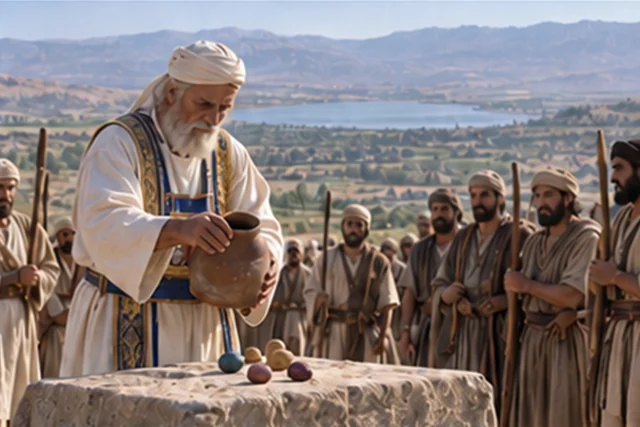
The reason for counting becomes explicit when the LORD connects the census to land. Larger groups are to receive larger inheritances and smaller groups smaller ones, so fairness here does not mean giving every tribe or clan an identical amount of territory. Population affects scale. Yet size alone does not determine placement, because the inheritance is also divided by lot according to the tribal houses. Numbers states both principles together without supplying every administrative step by which they will later be combined on the ground. That combination is the point. The map will not simply reward whichever household is most numerous, most aggressive, or first to occupy a desirable field. Nor will the lot erase the practical difference between many people and few. The census becomes an instrument for a settled future still ahead of the congregation. Men counted for war are simultaneously being counted for the inheritance their households will receive, linking military readiness to an ordered distribution rather than to an unrestricted scramble for conquered land.
Deep dive
The purpose of the count now becomes explicit. These names will be connected to land. A larger population is to receive a larger inheritance and a smaller population a smaller one, so equal treatment does not mean assigning every group an identical area. The military census supplies an administrative basis for a settled community that has not yet taken possession west of Jordan.
The lot is not presented as a replacement for that proportional rule. Numbers states both together: the division follows tribal names and lot, while the size corresponds to those numbered. The chapter does not describe every step by which those principles will be combined on the ground. Their joint effect is nevertheless clear. Neither population size alone nor the unilateral preference of a powerful household is allowed to be the whole procedure. The map ahead will be formed through a distribution that the congregation receives under command, not merely through whichever family reaches a desirable field first.
Words to trace: inheritance, divided, land, names, fathers, inherit
Verse-by-verse path
- Numbers 26:52
The census had a stated purpose in verse 2, war. This new word from the LORD adds a second purpose, and it is land. The men counted for battle are counted in the same breath as heirs.
- Numbers 26:53
“According to the number of names” is literally that: the names are the unit. Each counted man stands for a share of ground, and a name written in this list becomes a claim on the map.
- Numbers 26:54
The Hebrew is vivid: “to the many thou shalt make his inheritance great, and to the few thou shalt make it small.” Size of household governs size of holding, a rule repeated in almost the same words at 33:54.
- Numbers 26:55
The lot, goral, was a marked stone or piece of wood drawn or thrown before the LORD. Joshua 18:6–10 shows it done at Shiloh. The lot fixes where a tribe’s land lies; the census fixes how much of it there is.
- Numbers 26:56
“According to the lot” is al pi hagoral, literally “by the mouth of the lot”. The lot is said to speak. A rabbinic tradition (Bava Batra 122a) imagined it calling out each tribe’s portion aloud, a legend built on the idiom.
Numbers 26:52-56
King James Version52And the LORD spake unto Moses, saying,
53Unto these the land shall be divided for an inheritance according to the number of names.
54To many thou shalt give the more inheritance, and to few thou shalt give the less inheritance: to every one shall his inheritance be given according to those that were numbered of him.
55Notwithstanding the land shall be divided by lot: according to the names of the tribes of their fathers they shall inherit.
56According to the lot shall the possession thereof be divided between many and few.
Numbers 26:57-62
Levi Is Counted by a Different Rule
The Levite count uses a different threshold because it is counting a different kind of place in Israel. Levite males are numbered from one month old, not from age twenty and ability to go to war, which means their total of twenty-three thousand cannot be compared directly with the military strength of another tribe. The reason is stated: they do not receive the same kind of land inheritance among Israel. Their genealogy then carries the sanctuary's recent record inside it. Jochebed, Moses, Aaron, and Miriam are named, followed by Aaron's sons and the deaths of Nadab and Abihu for offering strange fire. Eleazar's present priestly leadership therefore appears in a family line marked by both appointment and loss. The separate count preserves the Levites' continuing identity without pretending that lack of a normal tribal allotment means they have no place to dwell. Later provision of Levitical towns will address residence while leaving the distinction here intact. This census is measuring service structure, not simply population.
Deep dive
The Levite total of twenty-three thousand cannot be compared directly with a tribe's military total. These are males from one month old upward, not men from twenty able to fight. The different threshold corresponds to a different place in the congregation's organization. The reason for the separate count is stated: the Levites will not receive an inheritance among the landholding tribes in the same way.
The genealogy also brings the leading priestly household into view. Jochebed, Aaron, Moses, and Miriam are named, followed by Aaron's sons and the deaths of Nadab and Abihu when they offered strange fire. The family list therefore records both the line that continues and the losses within it. Eleazar's present authority is placed inside that remembered history. Later provision of Levite towns in Numbers 35 will address their dwelling places without undoing the distinction made here between their calling and an ordinary tribal allotment.
Words to trace: family, numbered, Aaron, Abihu, Amram, bare
Verse-by-verse path
- Numbers 26:57
Gershon, Kohath and Merari are the three sons of Levi in Exodus 6:16, and the three divisions that carried the tabernacle in chapters 3–4. The tribe is counted after the other twelve, as it stood apart from them at Sinai (1:47–49).
- Numbers 26:58
Only five Levite families are named here: Libnites, Hebronites, Mahlites, Mushites and Korathites. The Shimeites, Amramites, Izharites and Uzzielites of 3:21–27 are missing, and the Korahites now stand as a clan in their own right.
- Numbers 26:59
Exodus 6:20 says Amram married Jochebed, “his father’s sister”, a marriage Leviticus 18:12 later forbids. The phrase “whom her mother bare to Levi in Egypt” has no named subject in Hebrew; “her mother” is supplied. Miriam is named here with her brothers, placed after them.
- Numbers 26:60
The four sons of Aaron were named together at Sinai in 3:2. Ithamar supervised the Gershonites and Merarites in 4:28 and 4:33, and 1 Chronicles 24:3 traces a later priestly house through him, while Eleazar’s line holds the high priesthood.
- Numbers 26:61
Numbers records their death a second time, having told it already in 3:4, where it adds that they had no children. Leviticus 10:1–2 gives the event itself: fire from the LORD devoured them for offering fire he had not commanded.
- Numbers 26:62
Twenty three thousand is a thousand more than the 22,000 Levites counted at Sinai in 3:39. That older count was used to redeem Israel’s firstborn, one Levite for one son; this one has no such task and only records the tribe that holds no land.
Numbers 26:57-62
King James Version57And these are they that were numbered of the Levites after their families: of Gershon, the family of the Gershonites: of Kohath, the family of the Kohathites: of Merari, the family of the Merarites.
58These are the families of the Levites: the family of the Libnites, the family of the Hebronites, the family of the Mahlites, the family of the Mushites, the family of the Korathites. And Kohath begat Amram.
59And the name of Amram’s wife was Jochebed, the daughter of Levi, whom her mother bare to Levi in Egypt: and she bare unto Amram Aaron and Moses, and Miriam their sister.
60And unto Aaron was born Nadab, and Abihu, Eleazar, and Ithamar.
61And Nadab and Abihu died, when they offered strange fire before the LORD.
62And those that were numbered of them were twenty and three thousand, all males from a month old and upward: for they were not numbered among the children of Israel, because there was no inheritance given them among the children of Israel.
Numbers 26:63-65
The First Military Generation Is Absent
The closing verses explain the entire census in one severe comparison. Among the men Moses and Eleazar have just numbered, not one belongs to the men Moses and Aaron numbered for war in the wilderness of Sinai, except Caleb and Joshua. The sentence pronounced after the refusal to enter the land has reached its stated end. This must not be broadened carelessly into a claim that no adult who left Egypt remained alive, because the verse concerns the earlier military registration, and Numbers itself treats the Levites separately while Moses is obviously still present. Within that defined group, however, the replacement is complete. The near equality of the two national totals can no longer be mistaken for continuity of personnel. Israel has almost the same military size and almost none of the same men. The census therefore becomes numerical testimony to two truths held together throughout Numbers: the people endure, and the judged generation does not. The nation stands ready again, but the wilderness years have not been skipped.
Deep dive
The conclusion tells the reader how to interpret everything just counted. The earlier military generation has died in the wilderness as the LORD said it would. Caleb and Joshua are the exceptions. This is a statement about the men included in that former registration, not a declaration that no one who left Egypt as an adult could still be alive. The separate treatment of Levi, along with Moses' own presence, prevents that careless generalization.
The chapter has carried out two tasks at once. It prepares the new generation for war and inheritance, and it establishes the completion of an earlier judgment. The near match between the two totals cannot erase the intervening deaths. Israel stands ready again, but not because the years of refusal and wandering have been quietly skipped. The count becomes the book's plainest numerical witness that continuity of the people and the loss of a generation are both true.
Words to trace: numbered, children, Israel, Moses, priest, wilderness
Verse-by-verse path
- Numbers 26:63
The summary repeats the place of verse 3 word for word, “the plains of Moab by Jordan near Jericho”, closing the census where it began. The Hebrew phrase is “the Jordan of Jericho”, the stretch of river opposite that city.
- Numbers 26:64
At Sinai the counters were “Moses and Aaron”; here they are “Moses and Eleazar”. The change of name between the two pairs is itself the change of generation the verse describes. Moses is the only man counting in both.
- Numbers 26:65
“They shall surely die” is the doubled Hebrew verb mot yamutu, the same form as “thou shalt surely die” in Genesis 2:17. The sentence was passed in 14:29–30, where Caleb and Joshua were named as the exceptions in this same order.
Numbers 26:63-65
King James Version63These are they that were numbered by Moses and Eleazar the priest, who numbered the children of Israel in the plains of Moab by Jordan near Jericho.
64But among these there was not a man of them whom Moses and Aaron the priest numbered, when they numbered the children of Israel in the wilderness of Sinai.
65For the LORD had said of them, They shall surely die in the wilderness. And there was not left a man of them, save Caleb the son of Jephunneh, and Joshua the son of Nun.
Questions to keep in mind while reading
- Identify the people addressed and the covenant setting.
- Distinguish rescue, worship, holiness, justice, and community responsibility.
- Read commands in their literary and covenant context before making a modern application.
Text first
Where readers differ
The chapter summary begins with what the passage says and how its parts fit together. It does not assume one denomination has already settled every question. Where a conclusion depends on a tradition, literary theory, or historical reconstruction, that dependence is named openly.
The KJV text is presented first. Interpretive conclusions are labeled, and differences are introduced only when they help a reader understand why serious communities do not always reach the same answer.
Comparative interpretive notes for this chapter are in preparation. Until reviewed notes are ready, this page separates the KJV text from summary and application without claiming that serious readers agree on every question.
Questions beneath the surface
- What account of God, human freedom, responsibility, and the good life emerges from Numbers 26?
- Which tension does the chapter refuse to resolve quickly?
- What changes when the chapter is read as part of the whole canon rather than as an isolated moral lesson?
- Where might a sincere reader confuse a familiar tradition with something the text states directly?
Questions for serious personal contemplation
These open-ended questions make room for tension, honest response, prayer, and conclusions that remain accountable to the chapter.
Observe without rushing
What part of Numbers 26 makes you stop, feel unsettled, or feel surprised, and why?
Which detail in the passage would be easiest to overlook? How does that detail change your understanding?
Where do you see tension between what happens and this focus: Numbers 26 develops its own movement around family, families, sons, numbered, children?
What important question does the passage leave open instead of resolving quickly?
Examine your inner life honestly
Which person, response, fear, or desire in the passage feels most like your own life right now?
What assumption about God, other people, or yourself does this text challenge?
Which part would you rather soften, avoid, or explain away too quickly? What might that reaction reveal?
If this Scripture could ask you one direct question, what do you think it would ask?
Respond with wisdom and courage
What do you need to remember, confess, grieve, thank God for, or trust after reading this passage?
How might another faithful person read this situation differently without ignoring the text?
What obedient response would be costly, uncomfortable, or slow, yet still faithful to Scripture?
What question will you carry into prayer this week, and which verses will you keep in front of you?
Music and video connected to the passage
Related media appears when its Scripture reference overlaps this study. Music and video can illuminate a theme while the biblical text remains the foundation.