The big picture
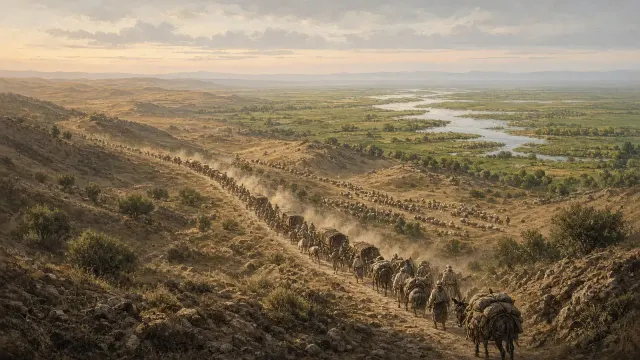
Jacob pauses at Beersheba to worship before leaving the land. God assures him about the move to Egypt and the family's future return. A detailed list names the household, and father and son finally meet.
In this chapter
- Permission for the Journey Genesis 46:1-7
God addresses Jacob in a night vision, tells him not to fear going to Egypt and promises to make a great nation there.
- People Behind the Promise Genesis 46:8-27
The list names sons, grandsons and family branches through Leah, Zilpah, Rachel and Bilhah.
- The Reunion and a Place to Live Genesis 46:28-34
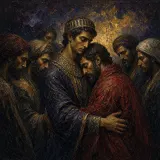
Judah goes ahead, Joseph meets Jacob in Goshen, and they weep together.
Scripture beside the summary
Genesis · King James Version · 34Genesis 46:1-7
Permission for the Journey
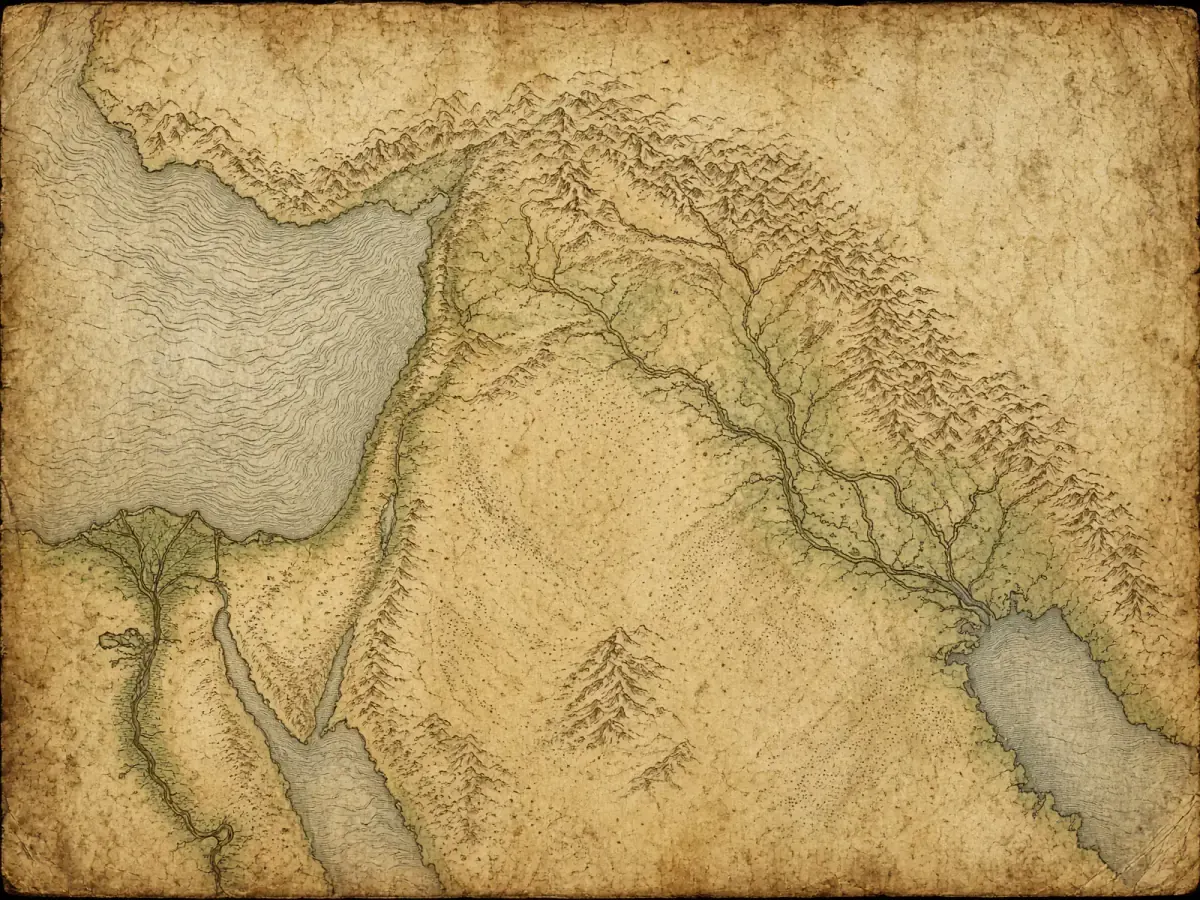
God addresses Jacob in a night vision, tells him not to fear going to Egypt and promises to make a great nation there. Divine presence accompanies departure from Canaan. The promise of being brought up again looks beyond immediate comfort toward the family's continuing account.
Deep dive
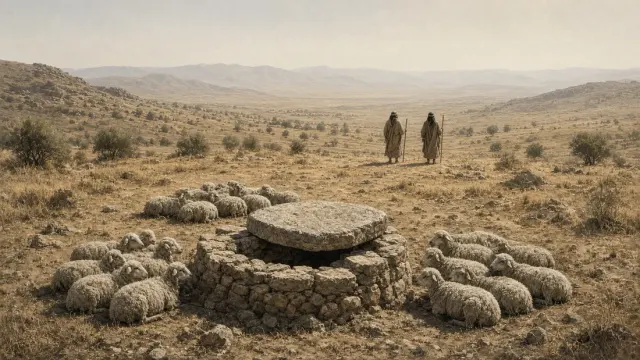
Beersheba interrupts the journey with worship before the border is crossed. Jacob sacrifices to the God of Isaac, and the night vision identifies the speaker through that same relationship. This matters because Isaac was told not to go down to Egypt during the famine in Genesis 26. Jacob's journey is not justified by assuming that every earlier instruction has the same destination for every later generation. He receives an explicit assurance for this departure.
The promise holds descent and return together. God will go down with Jacob, make him a great nation there, and bring him up again. The words move between the individual and the family he embodies: Jacob will be returned for burial, while the nation's departure lies beyond his life. The assurance that Joseph will put his hand upon Jacob's eyes brings that large future to an intimate point. The son once believed dead is to be present at his father's death. Wagons, cattle, possessions, and descendants then carry the household into the country where that promise is to unfold.
Words to trace: Jacob, sons, Egypt, father, Israel, Beer
Verse-by-verse path
- Genesis 46:1
Beersheba is where Isaac built an altar and dug a well (26:23–25), and the town Jacob left when he fled to Haran (28:10). It was the last settlement in the south before the desert road to Egypt. Jacob stops at the edge of the land to sacrifice before he leaves it.
- Genesis 46:2
The doubled name is how God called “Abraham, Abraham” on Moriah (22:11), and will call “Moses, Moses” from the bush (Exodus 3:4). God says “Jacob”, although Genesis calls him Israel in the same verse. This is the last time God speaks in the Book of Genesis.
- Genesis 46:3
“I am God” is ha’el, “the God”. The words echo Bethel, “I am the LORD God of Abraham thy father” (28:13). “A great nation” is the first promise ever given to Abraham (12:2); now God names the place where it will happen, and it is Egypt.
- Genesis 46:4
“Surely bring thee up” doubles the verb in Hebrew. For Jacob himself the promise is kept when his sons carry his body back to Canaan (50:13); for his descendants, at the Exodus. God does not say “send thee”, but “go down with thee”.
- Genesis 46:5
When Jacob fled from Laban he set his wives and sons on camels (31:17). Now the old man is carried himself, in Pharaoh’s carts. The verse names the carts’ purpose again: sent “to carry him”.
- Genesis 46:6
“Goods” is rekush, the word for the substance Abram brought out of Haran into Canaan: “all their substance that they had gathered” (12:5). Abram entered the land with his goods; his grandson leaves it with his.
- Genesis 46:7
Daughters are plural, and granddaughters too, but only two women will be named in the list that follows: Dinah and Serah. The count that follows is a count of names, and the unnamed daughters are left out of it.
Genesis 46:1-7
King James Version1And Israel took his journey with all that he had, and came to Beer-sheba, and offered sacrifices unto the God of his father Isaac.
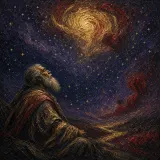
2And God spake unto Israel in the visions of the night, and said, Jacob, Jacob. And he said, Here am I.
3And he said, I am God, the God of thy father: fear not to go down into Egypt; for I will there make of thee a great nation:
4I will go down with thee into Egypt; and I will also surely bring thee up again: and Joseph shall put his hand upon thine eyes.
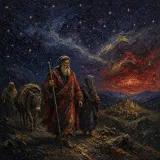
5And Jacob rose up from Beer-sheba: and the sons of Israel carried Jacob their father, and their little ones, and their wives, in the wagons which Pharaoh had sent to carry him.
6And they took their cattle, and their goods, which they had gotten in the land of Canaan, and came into Egypt, Jacob, and all his seed with him:
7His sons, and his sons’ sons with him, his daughters, and his sons’ daughters, and all his seed brought he with him into Egypt.
Genesis 46:8-27
People Behind the Promise
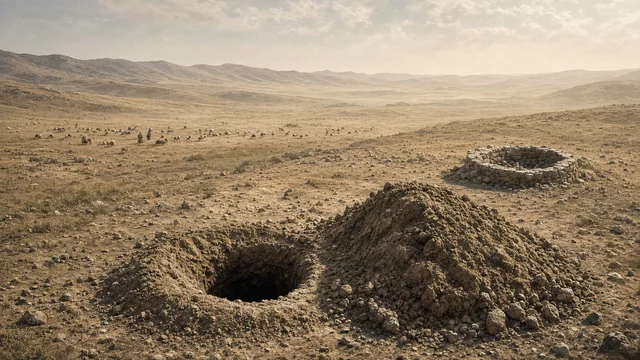
The list names sons, grandsons and family branches through Leah, Zilpah, Rachel and Bilhah. The text distinguishes counts that include or exclude certain relatives. Genealogical lists express household identity and descent, not merely a modern passenger manifest at one instant.
Deep dive
The list does not merely repeat the twelve brothers whose actions have occupied the preceding chapters. It expands the view to their descendants, making visible the family growth behind the promise of a nation. Reuben is still called firstborn, even though later passages will distinguish that birth position from the inheritance and leadership it might suggest. Dinah and Serah are named within groups otherwise largely listed through male descent.
Er and Onan appear with an express reminder that they died in Canaan. Their presence shows that this is a genealogical register, not simply a roll call of people boarding wagons. The account remembers the shape of Judah's family even where death has removed particular members from the migration. The groups are organized through the mothers, Leah and Zilpah here, before proceeding to Rachel and Bilhah. The earlier household divisions remain part of its recorded ancestry without determining which branch is excluded from the move.
Joseph's sons must be named as born in Egypt, since they belong to the family without having made this journey from Canaan. The sixty-six in verse 26 excludes the sons' wives and counts descendants who came with Jacob. Adding Jacob himself, Joseph, and Joseph's two sons gives the household total of seventy in the KJV. The two figures answer different counting questions rather than describing competing numbers of people in the same wagons.
Acts 7:14 gives seventy-five when recalling Joseph's invitation. That number also appears in the ancient Greek version of Genesis 46, whose list includes additional descendants in Joseph's branch. The difference belongs to the textual forms of the family register, not to an unmentioned group that the KJV requires the reader to invent. The present chapter's own totals should be allowed to remain what they are. Its central movement is from the named sons to a substantial household, with both those arriving and those already resident gathered into the family account.
Words to trace: sons, Jacob, bare, Beriah, daughter, Hezron, souls, Egypt, born, Joseph
Verse-by-verse path
- Genesis 46:8
Jacob himself is counted among “the children of Israel”, the father listed in the people called by his name. The list runs by mothers, each wife followed by her own maid: Leah, then Zilpah; Rachel, then Bilhah.
- Genesis 46:9
Hanoch is the same name as Enoch, Chanokh, borne by Cain’s son (4:17) and by the man who walked with God (5:22). Carmi is also the name of the father of Achan, who took the spoil at Jericho (Joshua 7:1). Hezron will turn up again, three verses later, in Judah’s line.
- Genesis 46:10
Simeon has six sons, and the last is marked out by his mother: “the son of a Canaanitish woman”, the only mother named in the list apart from the four wives. Rashi’s midrash identified her with Dinah, which the text does not say. Numbers 26:12–13 drops Ohad from Simeon’s clans.
- Genesis 46:11
Gershon, Kohath and Merari become the three Levite clans who carry the tabernacle in the wilderness (Numbers 3–4). Kohath is the grandfather of Moses and Aaron (Exodus 6:18–20). The priesthood’s whole line goes down to Egypt in these three names.
- Genesis 46:12
Pharez and his sons Hezron and Hamul complete Judah’s five. For Judah to have grandsons by now, the years are very tight; some take Hezron and Hamul as counted here in place of Er and Onan, their dead uncles, which is an inference from the arithmetic.
- Genesis 46:13
Tola means worm, the tiny insect from which crimson dye was made. The same pair of names, “Tola the son of Puah”, returns in Judges 10:1, a judge from the tribe of Issachar. Job is called Jashub in Numbers 26:24.
- Genesis 46:14
Elon is also the name of Esau’s Hittite father-in-law (26:34), and a later judge, “Elon, a Zebulonite”, judged Israel ten years (Judges 12:11). Zebulun’s three sons close Leah’s own line.
- Genesis 46:15
Counting the names gives thirty-two with Dinah, not thirty-three. Ibn Ezra made up the number with Jacob himself; Rashi, with Jochebed, Moses’ mother, whom he held was born as they entered Egypt (compare Numbers 26:59). The list is exact enough that the missing one was noticed.
- Genesis 46:16
Gad has seven sons, a large family for a handmaid’s son. Numbers 26:15–16 spells two of them differently, Zephon for Ziphion and Ozni for Ezbon. Haggi means festive, the root of the name of the prophet Haggai.
- Genesis 46:17
Serah, Asher’s daughter, is named again in the census taken on the plains of Moab (Numbers 26:46). The rabbis made her live through the whole sojourn: the one who first told Jacob, by song, that Joseph lived, and who showed Moses where Joseph’s bones lay. That is legend; the text names her twice.
- Genesis 46:18
Zilpah’s sixteen is exactly half of Leah’s thirty-two, not counting Jacob. Bilhah’s seven in verse 25 will be half of Rachel’s fourteen. Each maid’s line is half the size of her mistress’s, a symmetry that looks designed. “Whom Laban gave” repeats 29:24.
- Genesis 46:19
Only Rachel is called “Jacob’s wife” in the register; Leah is simply Leah. Her line is two names long, and one of those two has not come from Canaan at all.
- Genesis 46:20
The Greek Bible adds to this verse the sons and grandsons of Manasseh and Ephraim, five more names, which is how it reaches seventy-five souls instead of seventy. The Hebrew gives only the two sons and their Egyptian mother.
- Genesis 46:21
Benjamin has ten sons, the largest family in the list. Numbers 26:38–40 makes Naaman and Ard sons of Bela, that is, Benjamin’s grandsons. Gera is a name that stays in the tribe: Ehud “the son of Gera” (Judges 3:15) and Shimei “the son of Gera” (2 Samuel 16:5).
- Genesis 46:22
The fourteen counts Joseph, Manasseh and Ephraim, who were already in Egypt. Only eleven of Rachel’s line, Benjamin and his ten sons, actually made the journey.
- Genesis 46:23
Dan has a single son, and the verse still says “the sons of Dan”. From Hushim, called Shuham in Numbers 26:42, came a clan counted at sixty-four thousand four hundred men in the wilderness census (Numbers 26:43).
- Genesis 46:24
Naphtali’s four sons close the register. Shillem is Shallum in 1 Chronicles 7:13, and Jahzeel is Jahziel there, variant spellings that the two lists keep side by side.
- Genesis 46:25
Bilhah’s household is the smallest, seven souls. Her name comes with its history, “which Laban gave unto Rachel” (29:29); the verse does not mention the other thing the list might have remembered about her (35:22).
- Genesis 46:26
“Out of his loins” is literally “out of his thigh”, yarekh, the thigh the wrestler struck at Peniel (32:25). The man who limped from that night is counted by what came from that same thigh. Wives are excluded, as they were not of his body.
- Genesis 46:27
Seventy is the number of the nations in the table of chapter 10. Deuteronomy 10:22 recalls that “thy fathers went down into Egypt with threescore and ten persons”. Stephen’s speech in Acts 7:14 follows the Greek total, seventy-five.
Genesis 46:8-27
King James Version8And these are the names of the children of Israel, which came into Egypt, Jacob and his sons: Reuben, Jacob’s firstborn.
9And the sons of Reuben; Hanoch, and Phallu, and Hezron, and Carmi.
10And the sons of Simeon; Jemuel, and Jamin, and Ohad, and Jachin, and Zohar, and Shaul the son of a Canaanitish woman.
11And the sons of Levi; Gershon, Kohath, and Merari.
12And the sons of Judah; Er, and Onan, and Shelah, and Pharez, and Zerah: but Er and Onan died in the land of Canaan. And the sons of Pharez were Hezron and Hamul.
13And the sons of Issachar; Tola, and Phuvah, and Job, and Shimron.
14And the sons of Zebulun; Sered, and Elon, and Jahleel.
15These be the sons of Leah, which she bare unto Jacob in Padan-aram, with his daughter Dinah: all the souls of his sons and his daughters were thirty and three.
16And the sons of Gad; Ziphion, and Haggi, Shuni, and Ezbon, Eri, and Arodi, and Areli.
17And the sons of Asher; Jimnah, and Ishuah, and Isui, and Beriah, and Serah their sister: and the sons of Beriah; Heber, and Malchiel.
18These are the sons of Zilpah, whom Laban gave to Leah his daughter, and these she bare unto Jacob, even sixteen souls.
19The sons of Rachel Jacob’s wife; Joseph, and Benjamin.
20And unto Joseph in the land of Egypt were born Manasseh and Ephraim, which Asenath the daughter of Poti-pherah priest of On bare unto him.
21And the sons of Benjamin were Belah, and Becher, and Ashbel, Gera, and Naaman, Ehi, and Rosh, Muppim, and Huppim, and Ard.
22These are the sons of Rachel, which were born to Jacob: all the souls were fourteen.
23And the sons of Dan; Hushim.
24And the sons of Naphtali; Jahzeel, and Guni, and Jezer, and Shillem.
25These are the sons of Bilhah, which Laban gave unto Rachel his daughter, and she bare these unto Jacob: all the souls were seven.
26All the souls that came with Jacob into Egypt, which came out of his loins, besides Jacob’s sons’ wives, all the souls were threescore and six;
27And the sons of Joseph, which were born him in Egypt, were two souls: all the souls of the house of Jacob, which came into Egypt, were threescore and ten.
Genesis 46:28-34
The Reunion and a Place to Live
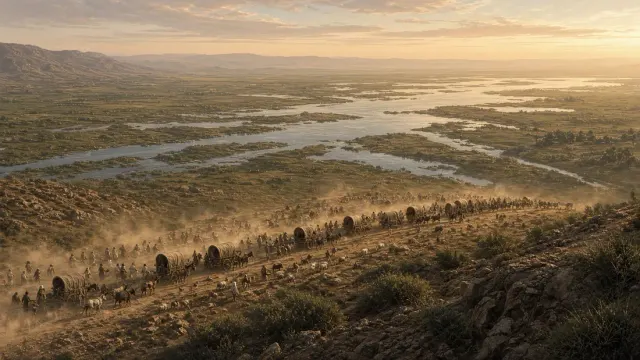
Judah goes ahead, Joseph meets Jacob in Goshen, and they weep together. Joseph prepares the family to explain their work as shepherds to Pharaoh. Settlement will depend on truthful presentation of their livelihood within Egyptian social conditions.
Deep dive
Judah is sent ahead to Joseph to direct the approach to Goshen. His role follows the responsibility he accepted for Benjamin and the speech that preceded Joseph's disclosure. Genesis now places him in advance of the migrating household, helping bring father and son together rather than arranging their separation. Joseph responds by preparing his chariot and going to meet his father.
The account lingers on the duration of the embrace: Joseph weeps on Jacob's neck "a good while." After so many managed encounters and private withdrawals, the reunion is no longer performed behind an official identity. Jacob's words about dying are grounded in having seen Joseph's face alive. They do not announce an immediate death; chapter 47 will give him seventeen years in Egypt. The statement marks what this sight has changed. The father who expected to go to the grave mourning Joseph can now speak of death after meeting, not merely remembering, the son he lost.
Joseph does not advise his brothers to disguise their occupation to sound more impressive at court. They are to identify themselves as keepers of cattle, following the work of their fathers. The account of their flocks and herds also explains why settlement requires suitable land, not merely space in Joseph's residence. Goshen answers a household's continuing way of life as well as its immediate need for food.
The stated Egyptian aversion to shepherds gives separation a practical role in Joseph's plan. It is not evidence that Egyptians owned no livestock or employed no herdsmen; Pharaoh will shortly offer work managing his own cattle. Genesis reports a social distinction relevant to this family's presentation and location. Joseph intends their difference to be acknowledged in a way that secures a place for them. The family is entering Egypt under royal favour, but it is not becoming indistinguishable from Egypt in the process.
Words to trace: Goshen, Joseph, face, Israel, neck, alive, brethren, cattle, father’s, house, land, Pharaoh
Verse-by-verse path
- Genesis 46:28
“To direct his face” is lehorot, to point the way; the verb shares its root with torah, instruction. Rashi read it as setting up a house of study in Goshen ahead of the family. Judah goes first, the brother who argued for the journey.
- Genesis 46:29
“Made ready his chariot” is literally “bound his chariot”; Rashi says Joseph harnessed it with his own hands. “Presented himself” is vayyera, “he appeared”, the verb used when God appears to Abraham (12:7).
- Genesis 46:30
“Now let me die” is literally “this time let me die”. Jacob will in fact live another seventeen years in Egypt (47:28), exactly as many years as he had Joseph with him in Canaan before he lost him (37:2).
- Genesis 46:31
Joseph tells his family what he will say to Pharaoh before telling them what to say themselves. Both scripts are prepared so that the two accounts will match when the king hears them.
- Genesis 46:32
Shepherding was Joseph’s own first work: at seventeen he “was feeding the flock with his brethren” (37:2). He names it before the king as the family trade without apology. “Men of cattle” is the Hebrew phrase.
- Genesis 46:33
Joseph foresees the king’s question word for word. In 47:3 Pharaoh asks exactly this: “What is your occupation?” The man who read Pharaoh’s dreams can read his interviews too.
- Genesis 46:34
“Both we, and also our fathers” reaches back through Isaac and Abraham to Abel, the first keeper of sheep (4:2). Egyptian tomb paintings show herdsmen as lean, unkempt men of the marshes, far below the scribe and the courtier. That low standing is what keeps the family apart.
Genesis 46:28-34
King James Version28And he sent Judah before him unto Joseph, to direct his face unto Goshen; and they came into the land of Goshen.
29And Joseph made ready his chariot, and went up to meet Israel his father, to Goshen, and presented himself unto him; and he fell on his neck, and wept on his neck a good while.
30And Israel said unto Joseph, Now let me die, since I have seen thy face, because thou art yet alive.
31And Joseph said unto his brethren, and unto his father’s house, I will go up, and shew Pharaoh, and say unto him, My brethren, and my father’s house, which were in the land of Canaan, are come unto me;
32And the men are shepherds, for their trade hath been to feed cattle; and they have brought their flocks, and their herds, and all that they have.
33And it shall come to pass, when Pharaoh shall call you, and shall say, What is your occupation?
34That ye shall say, Thy servants’ trade hath been about cattle from our youth even until now, both we, and also our fathers: that ye may dwell in the land of Goshen; for every shepherd is an abomination unto the Egyptians.
Questions to keep in mind while reading
- Track who acts, who speaks, who is affected, and what changes.
- Notice repeated promises, failures, rescues, and consequences.
- Do not assume the account approves every action that is reported.
Text first
Where readers differ
The chapter summary begins with what the passage says and how its parts fit together. It does not assume one denomination has already settled every question. Where a conclusion depends on a tradition, literary theory, or historical reconstruction, that dependence is named openly.
The KJV text is presented first. Interpretive conclusions are labeled, and differences are introduced only when they help a reader understand why serious communities do not always reach the same answer.
Genesis' household totals and the seventy-five in Acts 7:14 reflect a textual counting question discussed in relation to ancient Greek traditions. Do not conceal the difference or invent unnamed travelers as a certain solution.
Questions beneath the surface
- What account of God, human freedom, responsibility, and the good life emerges from Genesis 46?
- Which tension does the chapter refuse to resolve quickly, especially around presence, genealogy, migration?
- What changes when the chapter is read as part of the whole canon rather than as an isolated moral lesson?
- Where might a sincere reader confuse a familiar tradition with something the text states directly?
Questions for serious personal contemplation
These open-ended questions make room for tension, honest response, prayer, and conclusions that remain accountable to the chapter.
Observe without rushing
What part of Genesis 46 makes you stop, feel unsettled, or feel surprised, and why?
Which detail in the passage would be easiest to overlook? How does that detail change your understanding?
Where do you see tension between what happens and this focus: Israel goes down to Egypt?
What important question does the passage leave open instead of resolving quickly?
Examine your inner life honestly
Which person, response, fear, or desire in the passage feels most like your own life right now?
What assumption about God, other people, or yourself does this text challenge?
Which part would you rather soften, avoid, or explain away too quickly? What might that reaction reveal?
If this Scripture could ask you one direct question, what do you think it would ask?
Respond with wisdom and courage
What do you need to remember, confess, grieve, thank God for, or trust after reading this passage?
How might another faithful person read this situation differently without ignoring the text?
What obedient response would be costly, uncomfortable, or slow, yet still faithful to Scripture?
What question will you carry into prayer this week, and which verses will you keep in front of you?
Music and video connected to the passage
Related media appears when its Scripture reference overlaps this study. Music and video can illuminate a theme while the biblical text remains the foundation.