The big picture
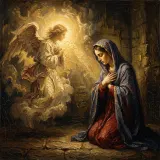
Luke 22 compresses betrayal, covenant, ambition, failure, prayer, violence, and trial into a single night without making Jesus merely reactive to events around him. Judas gives the authorities the quiet opportunity they have been seeking, but the Passover is still prepared under Jesus' direction and interpreted by him before the arrest begins. Bread and cup are joined to his body, blood, remembrance, covenant, suffering, and the kingdom to come. At that same table the disciples manage to debate greatness, and Jesus answers not by abolishing future authority but by redefining it through the one who serves. Peter promises prison and death, then receives a prediction of denial and, before the failure has happened, a word about restoration. On the mount of Olives, Jesus asks for the cup to pass and submits his will to the Father while the disciples sleep from sorrow. A sword is drawn at the arrest, but the final healing before the crucifixion repairs the wound. Peter's denials then fulfill the word he dismissed, and the chapter closes with mockers demanding prophecy from a prisoner whose prediction has just come true.
In this chapter
- The Opening Sought by the Plot Comes from Inside the Twelve Luke 22:1-6
The authorities want Jesus dead, but Luke has already shown why timing matters.
- Preparation Proceeds While Another Plan Is Being Made Luke 22:7-13
While Judas is preparing betrayal, Peter and John are preparing Passover.
- The Passover Is Interpreted Through the One at Its Table Luke 22:14-20
Jesus speaks of intense desire to eat this Passover “before I suffer,” so the meal is not a comfortable interval in which the approaching death disappears.
- At the Table of Self-Giving, the Disciples Debate Rank Luke 22:21-30
The betrayer's hand is on the table, and Jesus says both that the Son of man's course is determined and that woe belongs to the man through whom betrayal comes.
- Peter's Certainty Is Answered Before His Failure Arrives Luke 22:31-38
“Simon, Simon” introduces a warning larger than Peter alone.
- The Prayer Asks for the Cup to Pass Without Abandoning the Father Luke 22:39-46
Jesus goes to the mount of Olives “as he was wont,” so the place of prayer is part of an established rhythm, not a desperate location chosen at random.
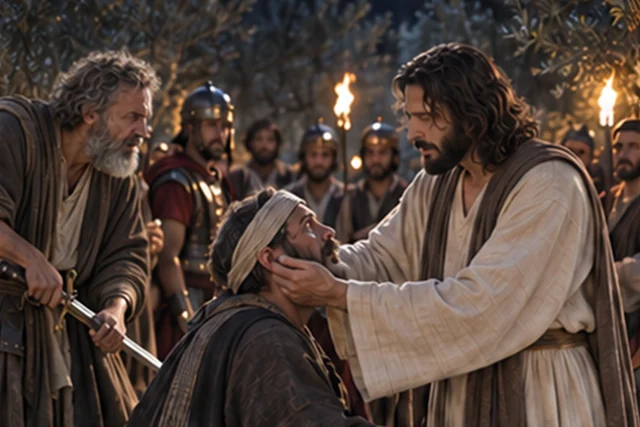
- The Arrest Receives a Healing Rather Than a Battle Luke 22:47-53
Judas comes at the front of the multitude and approaches Jesus with a kiss, turning a gesture of closeness into the instrument of betrayal.
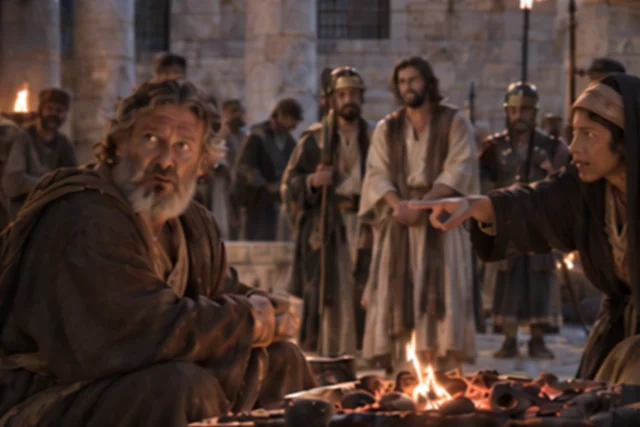
- The Look Reaches Peter Before Any New Speech Does Luke 22:54-62
Peter follows, but now it is “afar off,” and the distance soon becomes verbal as well as physical.
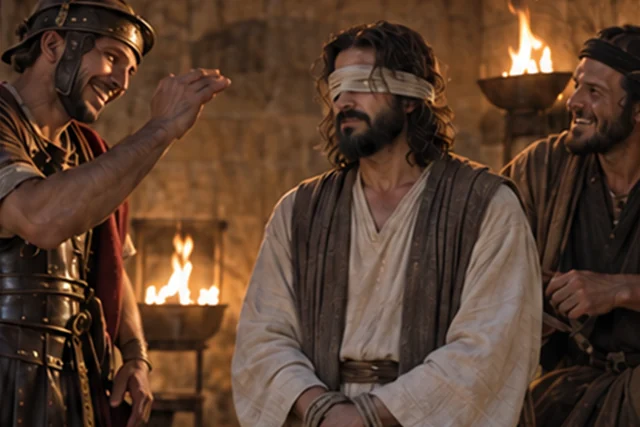
- The Mocked Prophet Has Already Told the Truth Luke 22:63-71
The men holding Jesus mock his prophetic claim by blindfolding, striking, and demanding that he identify the attacker.

Scripture beside the summary
Luke · King James Version · 71Luke 22:1-6
The Opening Sought by the Plot Comes from Inside the Twelve
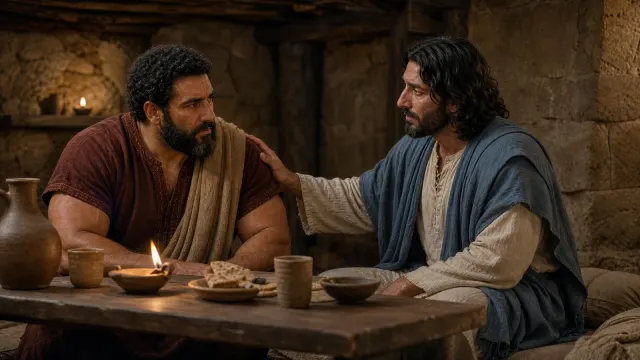
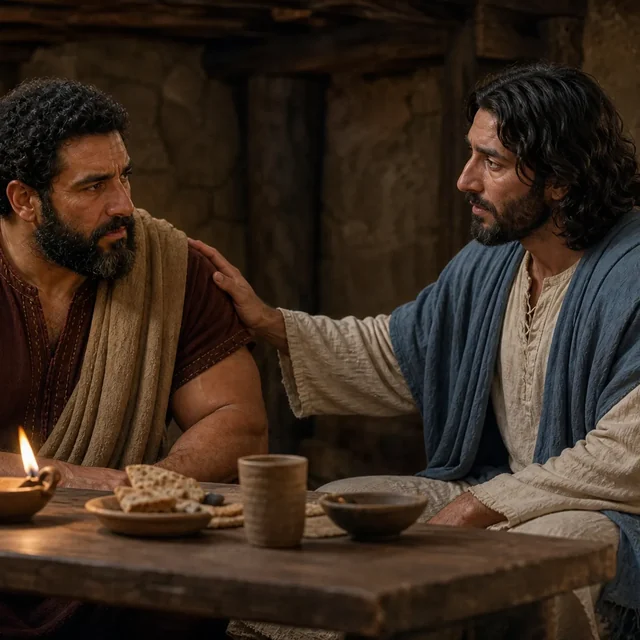
The authorities want Jesus dead, but Luke has already shown why timing matters. He teaches publicly, the people gather early to hear him, and the leaders fear the crowd. Judas supplies the missing opportunity from inside the Twelve. That detail is repeated because betrayal from a close companion solves the practical problem that public opposition could not. Luke says Satan enters Judas, connecting the moment with the larger conflict announced after the wilderness temptation, yet Judas does not become a passive object. He goes to the chief priests and captains, confers with them, agrees to money, and begins seeking the right moment. Spiritual conflict and human action remain in the same sentence. Luke does not give the amount paid or a complete psychological biography of Judas, so details from other Gospel accounts should not be imported as though they were Luke's explanation. The plot now has what it lacked: access to Jesus “in the absence of the multitude,” where public attention will no longer restrain the arrest.
Deep dive
The feast approaches while the chief priests and scribes search for a means to kill Jesus. Their difficulty is not locating a teacher whose public appearances have been secret. Luke has just described the regular pattern of his teaching and the crowds' early arrival. The problem is acting without that crowd's presence becoming an obstacle.
Judas offers precisely that opportunity. His membership in the Twelve is repeated because the access comes from within the group Jesus has commissioned and kept near. The agreement includes money, but Luke gives no amount here and no private manifesto explaining every motive. Details from Matthew about thirty silver pieces should not be inserted as though they were part of Luke's own explanation.
The entrance of Satan identifies a dimension beyond the visible negotiation. It recalls the devil's departure "for a season" after the wilderness temptation in Luke 4:13 and anticipates the coming references to sifting and darkness. Yet Judas remains active throughout the account: he goes, confers, agrees, and seeks an opportunity. The spiritual conflict does not erase human action. Luke will soon place determination and responsibility together again at the table, where Jesus speaks of an appointed course and a woe upon the betrayer.
Words to trace: betray, chief, priests, sought, absence, bread
Verse-by-verse path
- Luke 22:1
Strictly these were two observances: the Passover lamb on the fourteenth of Nisan, and the seven days of unleavened bread that followed (Leviticus 23:5–6). By the first century the names were used for the whole festival; Josephus writes of “the feast of unleavened bread, which we call the Passover” (Antiquities 14.21).
- Luke 22:2
Passover swelled Jerusalem with pilgrims and was the festival most likely to boil over; Josephus records a riot at the feast under the governor Cumanus in which thousands died (Jewish War 2.224–227). A popular teacher arrested in full view of the crowds could start exactly that.
- Luke 22:3
“Iscariot” is most often explained as ish Qeriyyot, “man of Kerioth”, a town in the south of Judah (Joshua 15:25), which would make him the one Judean among Galileans; others connect it with sicarius, a dagger-man. Luke’s list of the Twelve already tagged him “which also was the traitor” (6:16).
- Luke 22:4
The “captains” are strategoi, officers of the temple guard, the Levite police who kept order in the courts. Only Luke mentions them, here, at the arrest (22:52), and in Acts 4:1, where “the captain of the temple” arrests Peter and John. “Betray” is paradidomi, to hand over, the verb of the passion predictions.
- Luke 22:5
“Were glad” is chairo, the verb of Zacchaeus receiving Jesus “joyfully” (19:6); here the priests rejoice. “Covenanted” is syntithemi, to agree terms, used in Acts 23:20 of the men who “agreed” to lure Paul out to be killed. Acts 1:18 says what Judas bought with the money.
- Luke 22:6
“Promised” is exomologeo, a verb that elsewhere means to confess or to give thanks (“I thank thee, O Father”, 10:21); here it means he consented. “In the absence of” renders ater, a preposition that turns up in the New Testament only here and in 22:35, “without purse”.
Luke 22:1-6
King James Version1Now the feast of unleavened bread drew nigh, which is called the Passover.
2And the chief priests and scribes sought how they might kill him; for they feared the people.
3Then entered Satan into Judas surnamed Iscariot, being of the number of the twelve.
4And he went his way, and communed with the chief priests and captains, how he might betray him unto them.
5And they were glad, and covenanted to give him money.
6And he promised, and sought opportunity to betray him unto them in the absence of the multitude.
Luke 22:7-13
Preparation Proceeds While Another Plan Is Being Made
While Judas is preparing betrayal, Peter and John are preparing Passover. Jesus sends them into the city with a sequence precise enough to recognize when it occurs: a man carrying a pitcher of water, the house he enters, the householder, and a large furnished upper room. The disciples go and find matters exactly as he said. Luke does not explain whether every detail was arranged beforehand or known supernaturally, and there is no need to build an elaborate hidden plan beyond the account. The emphasis is control of the preparation. The room is ready because Jesus has directed the path to it. The term translated “guestchamber” is the same Greek word discussed around Luke 2:7, but here there is no shortage of space. More important is the contrast between two preparations moving at once. One group is arranging a meal Jesus intends to share before suffering; another is arranging the betrayal. The hostile plan is real, but it does not cancel the meal or determine its meaning.
Deep dive
Luke names Peter and John as the two sent to prepare. Their question concerns the location, and Jesus answers through a sequence of identifiable encounters: a man carrying water, the house he enters, its householder, and a furnished upper room. The repeated correspondence between instruction and discovery presents the preparations as proceeding under Jesus' knowledge and direction.
The text does not say whether every arrangement had been made privately beforehand or whether the instructions depend entirely on supernatural foreknowledge. Nor does it identify the owner as Mark's family or supply a hidden password beyond the words Jesus gives. Such reconstructions can become more elaborate than the account they are meant to illuminate. Luke's stated emphasis is that the disciples find matters as he has told them.
The room is called a guestchamber, the same Greek term discussed at Jesus' birth in Luke 2:7. Here there is explicitly a prepared place for the meal. More immediately, the preparation stands beside Judas's preparation for betrayal. Two plans advance at once, but the authorities' scheme does not deprive Jesus of the meal he intends to share before suffering. He is not merely reacting from one hostile initiative to the next.
Words to trace: passover, house, prepare, ready, bearing, bread
Verse-by-verse path
- Luke 22:7
The lambs were slaughtered in the temple courts on the afternoon of the fourteenth, “between the two evenings” (Exodus 12:6). Josephus says between the ninth and eleventh hours, and reports a count taken under the governor Cestius that came to more than a quarter of a million lambs in one year (Jewish War 6.422–425).
- Luke 22:8
Only Luke names the two. Peter and John become a pair in Acts: they go up to the temple together at the hour of prayer (Acts 3:1), stand trial together (4:13), and are sent together to Samaria (8:14). Their first joint errand is to buy and prepare a lamb.
- Luke 22:9
The question is practical. Deuteronomy 16:5–7 required the Passover to be eaten “in the place which the LORD thy God shall choose”, which by then meant inside Jerusalem. Jesus has been sleeping outside the city (21:37), so they need a room within the walls.
- Luke 22:10
Carrying water in a jar was usually women’s work, so a man doing it would stand out in a crowded street; that is an inference, but a common one. The instruction resembles the signs Samuel gave Saul, each encounter confirming the word that predicted it (1 Samuel 10:2–7).
- Luke 22:11
“Goodman of the house” is the 1611 English for the householder, oikodespotes, with no moral sense in “good”. The disciples are to say “The Master”, ho didaskalos, the teacher, which implies the owner already knows who that is.
- Luke 22:12
The upper room is anagaion, a room built on the roof or the upper storey. “Furnished” is stronnymi, spread, meaning laid out with cushions or couches for reclining. After the ascension the disciples gather in “an upper room” again, though Acts 1:13 uses a different word for it.
- Luke 22:13
“Made ready the passover” covers a day’s work: taking the lamb to the temple to be slaughtered, roasting it whole over fire as Exodus 12:8–9 required, and setting out the unleavened bread, the bitter herbs and the wine.
Luke 22:7-13
King James Version7Then came the day of unleavened bread, when the passover must be killed.
8And he sent Peter and John, saying, Go and prepare us the passover, that we may eat.
9And they said unto him, Where wilt thou that we prepare?
10And he said unto them, Behold, when ye are entered into the city, there shall a man meet you, bearing a pitcher of water; follow him into the house where he entereth in.
11And ye shall say unto the goodman of the house, The Master saith unto thee, Where is the guestchamber, where I shall eat the passover with my disciples?
12And he shall shew you a large upper room furnished: there make ready.
13And they went, and found as he had said unto them: and they made ready the passover.
Luke 22:14-20
The Passover Is Interpreted Through the One at Its Table
Jesus speaks of intense desire to eat this Passover “before I suffer,” so the meal is not a comfortable interval in which the approaching death disappears. Passover remembrance, present suffering, and future kingdom fulfillment are placed on the same table. Luke records a shared cup before the bread and then another cup after supper, and the sequence should be allowed to remain Luke's rather than compressed into a more familiar arrangement from memory. Bread is taken, thanked for, broken, and given with the words “This is my body which is given for you.” The cup is named as “the new testament in my blood,” covenant language that recalls Jeremiah's promise of renewed relation and forgiveness. Christian traditions later disagree over how Christ is present in the bread and cup, but Luke does not pause to settle those technical formulations. What he does make unmistakable is personal and theological at once: Jesus interprets his coming death as self-giving for those at the table, commands remembrance, and sets the meal within hope for the kingdom still ahead.
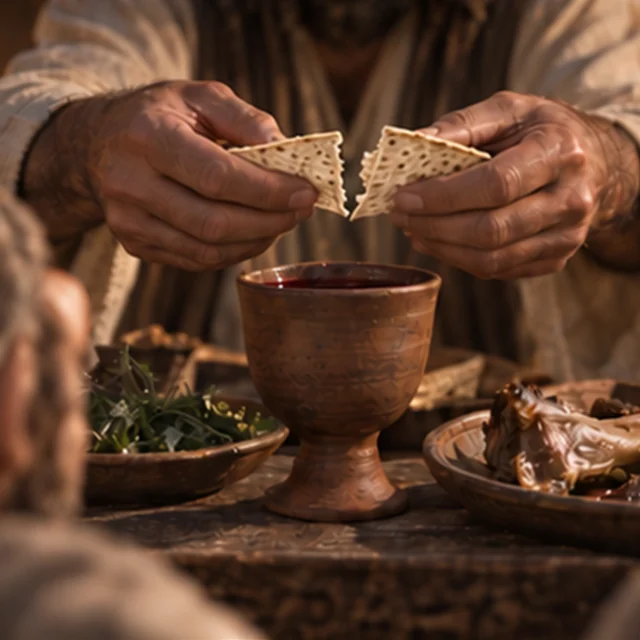
Deep dive
The emphatic desire to eat this Passover belongs to the period "before I suffer." The meal is not a pause in which the coming death can be forgotten. Jesus names both suffering and fulfillment, setting the table between Israel's remembrance of deliverance and the kingdom in which the meal's purpose will reach completion. His refusal to drink again until the kingdom comes gives the farewell a forward horizon.
Luke's KJV account mentions a shared cup before the bread and then the cup after supper. The latter is explicitly interpreted through his blood. The sequence should be read as Luke gives it rather than reduced to a single cup merely because a shorter summary is familiar. The actions of taking, thanking, breaking, and giving now carry words about his body "given for you" and a commanded remembrance. The beneficiaries are addressed personally before they understand the full cost of what is being given.
"New testament" here concerns a new covenant, recalling Jeremiah 31:31–34 and its promise of forgiveness within a renewed relation to God. The language also stands close to the received meal tradition in 1 Corinthians 11:23–26. Christian traditions differ over the mode of Christ's presence in the bread and cup and the precise relation of sign and gift. Luke does not supply a later technical formula settling those disputes. He does unmistakably join the meal to Jesus' self-giving death, covenant relationship, repeated remembrance, and the kingdom still to come.
Words to trace: gave, kingdom, thanks, took, apostles, blood
Verse-by-verse path
- Luke 22:14
Passover was eaten at night (Exodus 12:8), so “the hour” is evening. “Sat down” is anapipto, to recline; the Mishnah says that on Passover night even the poorest in Israel must eat reclining, as free people do (Pesachim 10:1). Luke calls the Twelve “apostles”, a title he uses far more than Matthew or Mark.
- Luke 22:15
“With desire I have desired” copies a Hebrew construction in which a verb is doubled with its own noun for intensity, the kind of phrase the Greek Old Testament is full of: “I have longed and longed”. The Greek is epithymia epethymesa.
- Luke 22:16
“Until it be fulfilled” treats the Passover itself as a promise awaiting fulfilment. On the mount of transfiguration Moses and Elijah spoke “of his decease which he should accomplish at Jerusalem” (9:31), and the Greek word for decease there is exodos.
- Luke 22:17
The Mishnah’s order for Passover night, written down later, has four cups of wine (Pesachim 10:1–7), so Luke’s first cup may be one of them. “Divide it among yourselves” suggests Jesus does not drink from it, which the next verse makes explicit.
- Luke 22:18
“The fruit of the vine” is the wording of the Jewish blessing over wine, “who createst the fruit of the vine” (Mishnah Berakhot 6:1). The vow of abstinence points forward: the next meal Luke describes with Jesus breaking bread is at Emmaus, after the resurrection.
- Luke 22:19
Took, gave thanks, brake, gave: the same four verbs as the feeding of the five thousand (9:16) and the supper at Emmaus, where he “took bread, and blessed it, and brake, and gave to them” (24:30). “Remembrance” recalls Exodus 12:14, where the Passover itself is “a memorial”.
- Luke 22:20
“Shed” is ekchynno, to pour out, the sacrificial word for blood poured at the base of the altar (Leviticus 4:7). The words of verses 19b and 20 are missing from one Greek manuscript, Codex Bezae, and some old Latin copies, but nearly every other witness has them.
Luke 22:14-20
King James Version14And when the hour was come, he sat down, and the twelve apostles with him.
15And he said unto them, With desire I have desired to eat this passover with you before I suffer:
16For I say unto you, I will not any more eat thereof, until it be fulfilled in the kingdom of God.
17And he took the cup, and gave thanks, and said, Take this, and divide it among yourselves:
18For I say unto you, I will not drink of the fruit of the vine, until the kingdom of God shall come.
19And he took bread, and gave thanks, and brake it, and gave unto them, saying, This is my body which is given for you: this do in remembrance of me.
20Likewise also the cup after supper, saying, This cup is the new testament in my blood, which is shed for you.
Luke 22:21-30
At the Table of Self-Giving, the Disciples Debate Rank
The betrayer's hand is on the table, and Jesus says both that the Son of man's course is determined and that woe belongs to the man through whom betrayal comes. Luke refuses to make divine purpose and human responsibility cancel one another. The disciples begin asking who could do such a thing, then almost immediately begin arguing about which of them should be considered greatest. The placement is brutal. A meal interpreted through Jesus' self-giving has not removed their appetite for rank. He contrasts their model with rulers who exercise lordship and enjoy the title of benefactors, then reverses the expected shape of greatness: the greater one should become as the younger, the leader as one who serves. The explanation is not abstract. “I am among you as he that serveth.” Yet Jesus also acknowledges their persistence through his trials and appoints them a kingdom, table, and thrones. Luke does not erase authority. He redefines its character through the serving king whose closest companions are still learning what his greatness looks like.
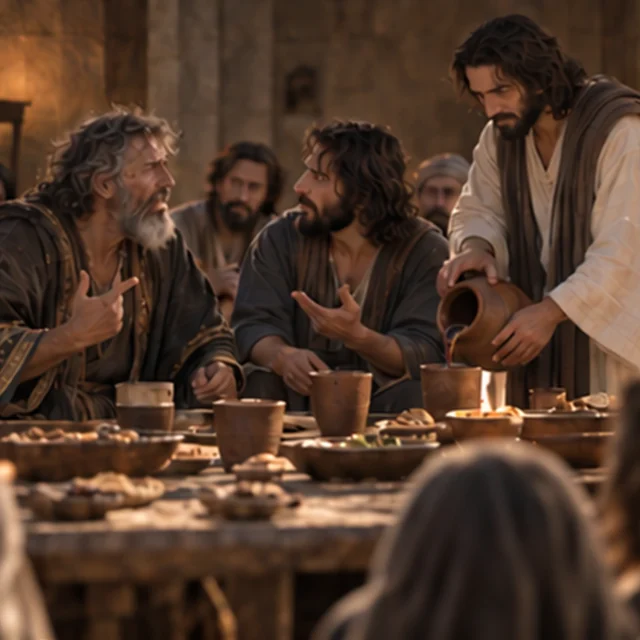
Deep dive
The betrayer's hand is at the table. Luke places treachery within the shared meal rather than safely outside the circle of those receiving it. Jesus' declaration that his course is determined does not turn the betrayer's act into innocence: the same sentence pronounces woe upon the man through whom the betrayal comes. Divine purpose and human responsibility are held together without a speculative explanation of how every act has been caused.
The disciples' inquiry about who could do this is followed by another dispute about who should be accounted greatest. The juxtaposition is stark. A conversation about Jesus' approaching self-giving has not automatically displaced their concern with relative standing. Jesus contrasts their desired ordering with rulers who exercise lordship and carry the title of benefactors, then presents the younger person and the servant as the forms greatness must take among them.
The decisive explanation is not an abstract definition of humility. Jesus identifies himself as the one among them who serves. Yet he also acknowledges that they have continued with him in his trials and promises a place at his kingdom's table and authority concerning Israel's twelve tribes. Their present failure does not make their shared history unreal. The promise of rule is retained, but its character is being redefined by the serving king whose table they currently misunderstand.
Words to trace: exercise, greatest, kingdom, meat, serveth, sitteth
Verse-by-verse path
- Luke 22:21
In Mark and Matthew the betrayer is announced before the bread and cup; Luke puts the announcement after them, so the betrayer has shared both. Psalm 41:9 had said it: “mine own familiar friend… which did eat of my bread, hath lifted up his heel against me.”
- Luke 22:22
“Determined” is horizo, to mark out by a boundary, the root of “horizon”. Luke uses it again in Peter’s Pentecost sermon: Jesus “delivered by the determinate counsel and foreknowledge of God” (Acts 2:23), in the same sentence that holds his killers responsible.
- Luke 22:23
In Mark each disciple asks Jesus, “Is it I?” In Luke they question one another, syzeteo, and the question is never answered at the table: no sop, no name, no departure of Judas into the night. He simply reappears at the head of the arresting party.
- Luke 22:24
“Strife” is philoneikia, love of winning an argument, found only here in the New Testament. It is the second such dispute; at 9:46 “there arose a reasoning among them, which of them should be greatest”, just after Jesus had foretold his betrayal the first time.
- Luke 22:25
“Benefactors”, euergetai, was an official title. Ptolemy III of Egypt was called Euergetes, and cities put it on inscriptions honouring kings and Roman patrons. Jesus names the title rulers gave themselves for the favours they handed down from above.
- Luke 22:26
In a household or community the youngest did the menial work; in Acts 5:6 it is “the young men” who carry out the body of Ananias. “He that is chief” is hegoumenos, leader, the word later used for church leaders in Hebrews 13:17 and for Judas and Silas as “chief men among the brethren” (Acts 15:22).
- Luke 22:27
Jesus has already pictured the reversal in 12:37: the returning master “shall gird himself, and make them to sit down to meat, and will come forth and serve them.” At this table the one reclining at the head is, by his own account, the one waiting on the rest.
- Luke 22:28
“Continued” is diameno, to remain through something. Luke, unlike Mark and Matthew, never says the disciples fled at the arrest (Mark 14:50, “they all forsook him”); at the cross “all his acquaintance… stood afar off” (23:49). The praise is spoken over men about to fail, and Luke softens none of it.
- Luke 22:29
“Appoint” is diatithemai, the verb from which diatheke, the “testament” or covenant of verse 20, is formed. The sentence can be heard as “I covenant to you a kingdom, as my Father covenanted one to me”: the covenant of the cup is extended into a grant of rule.
- Luke 22:30
The table in the kingdom is the banquet foretold in 13:29, where many “shall sit down in the kingdom of God” from east and west. Matthew 19:28 says “twelve thrones”; Luke says only “thrones”, perhaps because one of the twelve is Judas, though that is an inference.
Luke 22:21-30
King James Version21But, behold, the hand of him that betrayeth me is with me on the table.
22And truly the Son of man goeth, as it was determined: but woe unto that man by whom he is betrayed!
23And they began to enquire among themselves, which of them it was that should do this thing.
24And there was also a strife among them, which of them should be accounted the greatest.
25And he said unto them, The kings of the Gentiles exercise lordship over them; and they that exercise authority upon them are called benefactors.
26But ye shall not be so: but he that is greatest among you, let him be as the younger; and he that is chief, as he that doth serve.
27For whether is greater, he that sitteth at meat, or he that serveth? is not he that sitteth at meat? but I am among you as he that serveth.
28Ye are they which have continued with me in my temptations.
29And I appoint unto you a kingdom, as my Father hath appointed unto me;
30That ye may eat and drink at my table in my kingdom, and sit on thrones judging the twelve tribes of Israel.
Luke 22:31-38
Peter's Certainty Is Answered Before His Failure Arrives
“Simon, Simon” introduces a warning larger than Peter alone. In the KJV, Satan's desire to sift “you” is plural, reaching toward the disciples as a group, while Jesus' prayer for “thee” turns specifically to Simon. Peter answers with confidence that prison and death will not move him. Jesus answers with a rooster and three denials before the day is over. Yet restoration is spoken before failure: when Peter turns again, he is to strengthen his brothers. Luke therefore refuses to let the denial become the final definition of the disciple who does not yet know his own weakness. The conversation then shifts to purse, bag, and sword because the conditions of mission are changing as Isaiah's “numbered among the transgressors” approaches fulfillment. The meaning of the two swords remains debated, and “It is enough” can sound like sufficiency or a cutoff to misunderstanding. The arrest scene supplies the necessary boundary. When a sword is actually used, Jesus stops the violence and heals the wounded man. No armed program grows out of these two blades.
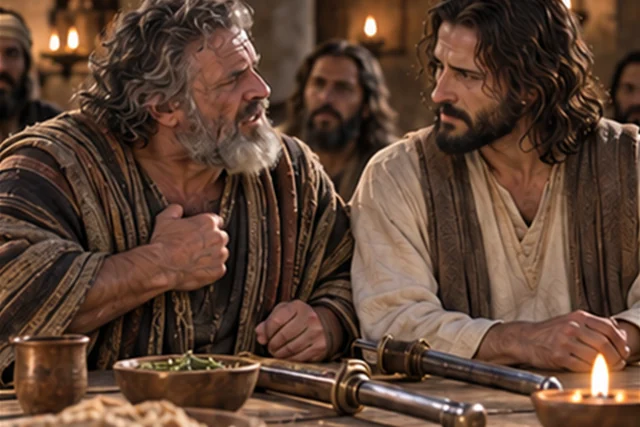

Deep dive
The shift between "you" and "thee" in the KJV preserves a distinction in the Greek. Satan's demand to sift concerns the disciples collectively; Jesus' prayer is addressed particularly to Simon. The image of wheat shaken in a sieve gives the coming testing its force. Peter's confidence about prison and death does not establish that he understands his own exposure.
Jesus' prayer is that Peter's faith not fail, and the commission looks beyond the fall to his turning again and strengthening his brothers. "Converted" here need not mean that Peter has never previously believed. It describes a return after the coming failure. The predicted three denials make the failure specific, while the preceding prayer prevents it from becoming the entire definition of Peter's future. Luke places the possibility of restoration before the disciple knows he will need it.
The instructions about purse, bag, and sword then mark a changed setting from the earlier missions, when nothing was lacking despite deliberately limited provisions. Jesus connects the change with Isaiah 53:12 and being numbered among transgressors. Interpretations of the swords include literal preparation for danger, figurative language for coming hostility, and provision associated with that fulfillment. "It is enough" may acknowledge sufficiency or cut off a misunderstanding. The ambiguity should remain, but the arrest scene gives an important limit: Jesus stops the use of a sword and heals the injured man. The two weapons do not become the foundation of an armed campaign to establish his kingdom.
Words to trace: Lord, purse, scrip, Simon, accomplished, both
Verse-by-verse path
- Luke 22:31
A name spoken twice marks a solemn address: “Martha, Martha” (10:41), and in the Old Testament “Abraham, Abraham” (Genesis 22:11), “Samuel, Samuel” (1 Samuel 3:10). “Desired to have” is exaiteomai, to demand that someone be handed over, as the Adversary asked leave to test Job (Job 1:11–12).
- Luke 22:32
“Fail” is ekleipo, to give out, the word Luke uses when the sun’s light “failed” at the crucifixion (23:45). “Strengthen” is sterizo, the verb of 9:51, where Jesus “stedfastly set his face” toward Jerusalem. Peter is asked to give his brothers the steadiness Jesus showed.
- Luke 22:33
Both halves of the vow come true later. Luke records Peter in prison three times in Acts (4:3; 5:18; 12:4), the last time chained between two soldiers, awaiting execution. John 21:18–19 points to the death, which early tradition places in Rome.
- Luke 22:34
Nowhere else in Luke does Jesus address him by the name Peter, the name he himself gave (6:14); a verse earlier it was “Simon, Simon”. The Jewish day began at sunset, so “this day” means before this same night is over.
- Luke 22:35
The list is the one given to the seventy, “carry neither purse, nor scrip, nor shoes” (10:4), though Jesus is speaking to the Twelve, whose own instructions in 9:3 were slightly different. A scrip is pera, a traveller’s bag for provisions.
- Luke 22:36
The garment is the himation, the outer cloak. The law counted it so necessary that a cloak taken in pledge had to be returned by sundown, since it was a poor man’s blanket (Exodus 22:26–27). To sell it for a sword is to give up the last thing a man would part with.
- Luke 22:37
Isaiah 53 is quoted outright nowhere else in Luke’s Gospel; Acts 8:32–33 quotes verses 7–8 to the Ethiopian. It is fulfilled in plain sight at 23:33: “there they crucified him, and the malefactors.” “Have an end” is telos echei, both “reach their goal” and “are coming to a close”.
- Luke 22:38
Machaira covers anything from a long knife to a short sword; some have suggested the two were knives used for the lamb, which is possible but unprovable. “It is enough” is hikanon estin, close to God’s reply to Moses in the Greek of Deuteronomy 3:26, “Let it suffice thee; speak no more unto me.”
Luke 22:31-38
King James Version31And the Lord said, Simon, Simon, behold, Satan hath desired to have you, that he may sift you as wheat:
32But I have prayed for thee, that thy faith fail not: and when thou art converted, strengthen thy brethren.
33And he said unto him, Lord, I am ready to go with thee, both into prison, and to death.
34And he said, I tell thee, Peter, the cock shall not crow this day, before that thou shalt thrice deny that thou knowest me.
35And he said unto them, When I sent you without purse, and scrip, and shoes, lacked ye any thing? And they said, Nothing.
36Then said he unto them, But now, he that hath a purse, let him take it, and likewise his scrip: and he that hath no sword, let him sell his garment, and buy one.
37For I say unto you, that this that is written must yet be accomplished in me, And he was reckoned among the transgressors: for the things concerning me have an end.
38And they said, Lord, behold, here are two swords. And he said unto them, It is enough.
Luke 22:39-46
The Prayer Asks for the Cup to Pass Without Abandoning the Father
Jesus goes to the mount of Olives “as he was wont,” so the place of prayer is part of an established rhythm, not a desperate location chosen at random. He tells the disciples to pray against entering temptation, withdraws about a stone's cast, kneels, and asks the Father whether the cup might pass. The request is genuine. So is the submission: “nevertheless not my will, but thine, be done.” Luke does not portray obedience as the absence of anguish. In the KJV text, an angel strengthens Jesus and his agony intensifies until his sweat is compared to great drops of blood. Those verses have a significant textual history, but within the received wording used here, the strengthening prepares endurance rather than removing the ordeal. The disciples are sleeping when Jesus returns, and Luke says they sleep “for sorrow.” Their grief is real, yet sorrow is not enough preparation for the approaching test. Jesus wakes them and repeats the command to pray. The time for preparation is already ending as the arresting crowd arrives.
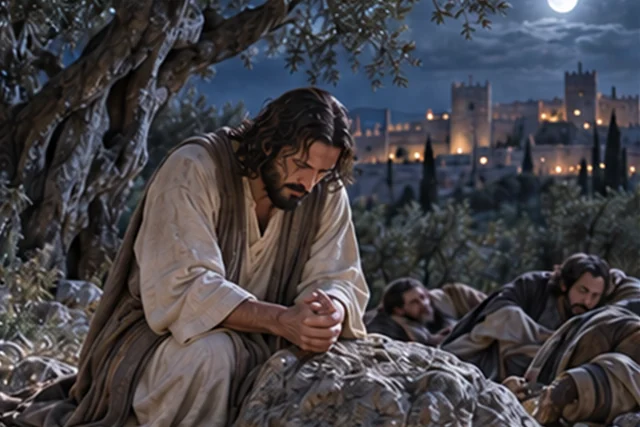
Deep dive
Jesus goes to his accustomed place, and the disciples follow. The instruction to pray against entering temptation frames the scene at both ends. Between those instructions, he withdraws a short distance, kneels, and addresses the Father. His request that the cup be removed is real, just as the submission of his will is real. Luke does not portray obedience as emotional anesthesia or make the request itself an act of rebellion.
The KJV includes an angel strengthening him and the description of sweat "as it were great drops of blood." Verses 43–44 have a disputed textual history because some significant ancient Greek witnesses omit them. In the wording present here, strength is supplied for enduring the ordeal rather than a removal of the ordeal itself. The sweat comparison conveys its bodily intensity. It is often read as actual bloody sweat, but the comparative wording does not require a confident retrospective medical diagnosis.
Luke explicitly attributes the disciples' sleep to sorrow. That explanation neither makes their condition trivial nor treats it as an adequate answer to the coming test. Jesus rises from prayer to find them asleep and renews the instruction. The contrast is between different responses under the same approaching pressure, not between one person who feels anguish and others who feel nothing. The next voice in the scene will belong to an arriving crowd, so the time for this preparation is already closing.
Words to trace: disciples, enter, pray, prayed, temptation, agony
Verse-by-verse path
- Luke 22:39
Luke never names Gethsemane and never mentions a garden; he says only “the mount of Olives” and, in the next verse, “the place”. Nor does he separate Peter, James and John from the rest. All the disciples follow him there together.
- Luke 22:40
The instruction takes up the last petition of the prayer Jesus taught them in Luke, “lead us not into temptation” (11:4). Of that prayer, this is the line he hands back to them on the last night.
- Luke 22:41
“Was withdrawn” is apospao, to tear away or be drawn off, a strong verb. A stone’s cast is near enough to be heard. Kneeling is Luke’s posture of prayer: Stephen (Acts 7:60), Peter (9:40) and Paul (20:36) all kneel, where Jews more usually stood, as the Pharisee and publican did in 18:11–13.
- Luke 22:42
In the prophets the cup is the cup of God’s wrath: “the cup of his fury” (Isaiah 51:17), “the wine cup of this fury” (Jeremiah 25:15). In the oldest manuscripts Luke’s version of the Lord’s prayer lacks “Thy will be done” (11:2); the words appear in Luke here instead, prayed by Jesus himself.
- Luke 22:43
In Mark and Matthew angels minister to Jesus after the temptation in the wilderness; Luke has no angel there (4:13) and one here instead. “Strengthening” is enischyo, which recurs in Acts 9:19, when Saul took food after his blindness and “was strengthened”.
- Luke 22:44
“Agony” is agonia, found only here in the New Testament; in ordinary Greek it was the tension of an athlete before the contest, the agon. “Great drops” is thromboi, clots or thick drops, the word behind the English “thrombosis”. “More earnestly” is ektenesteron, from the word Acts 12:5 uses for the church praying for Peter “without ceasing”.
- Luke 22:45
Mark and Matthew have Jesus return to the sleeping disciples three times; Luke has a single return. The rising from prayer is noted because it is the posture Jesus will ask of them in the next verse.
- Luke 22:46
“Rise” is anistemi, the same verb used of Jesus rising from prayer a verse earlier: he asks them to do what he has just done. Luke omits Mark’s “the spirit truly is ready, but the flesh is weak”, and closes the scene with the same warning about temptation that opened it.
Luke 22:39-46
King James Version39And he came out, and went, as he was wont, to the mount of Olives; and his disciples also followed him.
40And when he was at the place, he said unto them, Pray that ye enter not into temptation.
41And he was withdrawn from them about a stone’s cast, and kneeled down, and prayed,
42Saying, Father, if thou be willing, remove this cup from me: nevertheless not my will, but thine, be done.
43And there appeared an angel unto him from heaven, strengthening him.
44And being in an agony he prayed more earnestly: and his sweat was as it were great drops of blood falling down to the ground.
45And when he rose up from prayer, and was come to his disciples, he found them sleeping for sorrow,
46And said unto them, Why sleep ye? rise and pray, lest ye enter into temptation.
Luke 22:47-53
The Arrest Receives a Healing Rather Than a Battle
Judas comes at the front of the multitude and approaches Jesus with a kiss, turning a gesture of closeness into the instrument of betrayal. Luke again reminds us that he is one of the Twelve. The disciples see what is happening and ask whether they should strike, but one of them acts before any permission is recorded and cuts off the right ear of the high priest's servant. Luke does not name the attacker or the servant; those identifications belong to another Gospel. Here the emphasis falls on Jesus' response. He stops the escalation, touches the wounded man, and heals him. The last healing before the crucifixion repairs damage inflicted by someone on Jesus' own side upon someone who arrived with his captors. Then Jesus exposes the chosen setting. He had been with them daily in the temple, yet they did not seize him there. Swords, staves, darkness, and the absence of the listening crowd reveal the character of this hour. Hostile power is real, but Jesus names it as an hour, not as ownership of the future.
Deep dive
Judas leads the group and approaches to kiss Jesus. The question addressed to him names the contradiction between the familiar gesture and its use in betrayal. Luke again identifies him as one of the Twelve, making the scene a misuse of closeness rather than an encounter between strangers who have never known one another.
The disciples ask about striking, but one acts before any authorization is recorded. The high priest's servant loses his right ear, and Jesus touches and heals it. Luke does not identify the attacker as Peter or the servant as Malchus; those names occur in John 18:10. The distinction keeps Luke's focus clear. The final healing before the crucifixion repairs damage done by someone on Jesus' own side to someone accompanying his captors.
Jesus' address contrasts their weapons and nighttime action with his daily presence in the temple. They have chosen a setting without the attentive crowds that previously restrained them. Calling it their hour and the power of darkness acknowledges a real period of hostile action without granting that action ultimate ownership of the future. He neither treats the arrest as a misunderstanding easily corrected nor answers it by allowing the disciples' violence to determine the manner of his mission.
Words to trace: Jesus, Judas, kiss, temple, betrayest, captains
Verse-by-verse path
- Luke 22:47
Luke says Judas “drew near unto Jesus to kiss him”, but he never says the kiss was given: Jesus speaks first. “He that was called Judas” keeps a certain distance, as though the name were now a label. He is described as “one of the twelve” in the same breath.
- Luke 22:48
In no other place in the Gospels does Jesus address Judas by name. He calls himself “the Son of man”, the title of the predictions: “the Son of man shall be delivered into the hands of men” (9:44). The word “betrayest” is the same verb of handing over.
- Luke 22:49
Only Luke has the disciples ask permission before anyone strikes. “What would follow” is to esomenon, “what was about to be”. The two swords of verse 38 are now in their hands, and the question tests what Jesus meant by them.
- Luke 22:50
Only Luke and John specify the right ear. A mutilated ear could be a deliberate insult: Josephus tells how Antigonus cut off the ears of his uncle Hyrcanus to disqualify him from ever being high priest again (Antiquities 14.366). Whether anything so pointed was meant here, Luke does not say.
- Luke 22:51
“Suffer ye thus far” can be addressed to the disciples, “no more of this”, or to the arresting party, “let them go this far”, and it has been read both ways. Luke alone records that Jesus touched the ear and healed it.
- Luke 22:52
Only Luke puts the chief priests themselves at the arrest, alongside the temple captains and elders. “A thief” is lestes, a bandit or insurgent, the word for the robbers of the Jericho road (10:30). Staves are xyla, wooden clubs, the weapons of a posse rather than soldiers.
- Luke 22:53
“Stretched forth no hands” picks up 20:19, where they “sought to lay hands on him” and did not dare. “The power of darkness” is the exact phrase of Colossians 1:13, God “hath delivered us from the power of darkness”, and the darkness returns at the sixth hour of the crucifixion (23:44).
Luke 22:47-53
King James Version47And while he yet spake, behold a multitude, and he that was called Judas, one of the twelve, went before them, and drew near unto Jesus to kiss him.
48But Jesus said unto him, Judas, betrayest thou the Son of man with a kiss?
49When they which were about him saw what would follow, they said unto him, Lord, shall we smite with the sword?
50And one of them smote the servant of the high priest, and cut off his right ear.
51And Jesus answered and said, Suffer ye thus far. And he touched his ear, and healed him.
52Then Jesus said unto the chief priests, and captains of the temple, and the elders, which were come to him, Be ye come out, as against a thief, with swords and staves?
53When I was daily with you in the temple, ye stretched forth no hands against me: but this is your hour, and the power of darkness.
Luke 22:54-62
The Look Reaches Peter Before Any New Speech Does
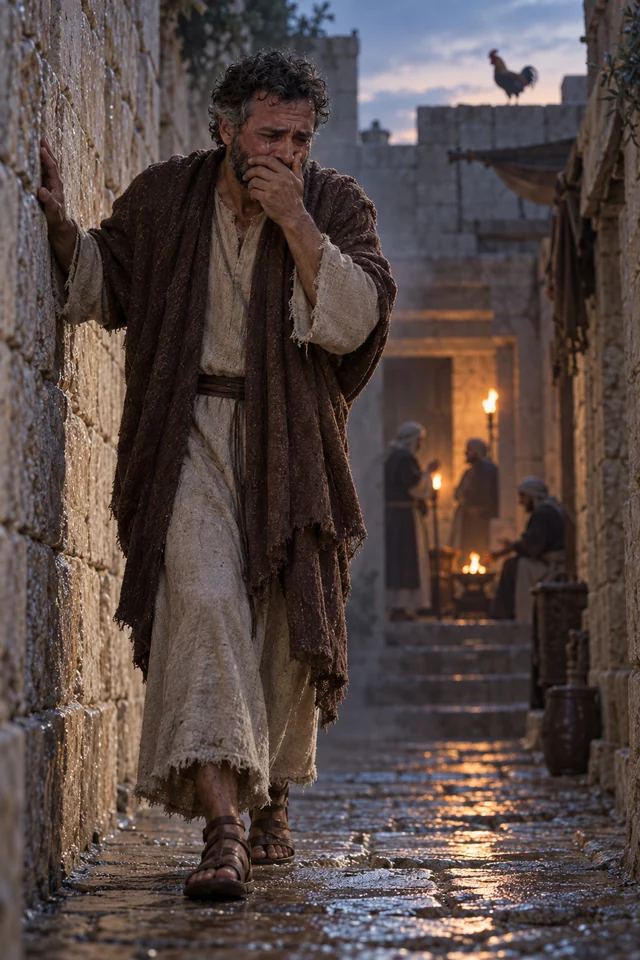
Peter follows, but now it is “afar off,” and the distance soon becomes verbal as well as physical. Around the courtyard fire a servant woman identifies him as having been with Jesus. Peter says he does not know him. Another says he belongs to the group. Peter says he does not. About an hour later a third person confidently points to his Galilean identity, and Peter again denies the connection. Luke gives the failure time to breathe. This is not one startled sentence blurted out before he understands what is happening. The final denial is still being spoken when the cock crows. Jesus turns and looks at Peter, but Luke does not tell us whether the face is angry, wounded, tender, or anything else. The remembered word interprets the look. Peter recalls the prediction he had answered with confidence and goes out to weep bitterly. Earlier in the chapter, Jesus had already prayed for his faith and spoken of his return. Restoration is promised, but it has not yet been experienced.
Deep dive
Peter follows at a distance and sits among those gathered by the fire. The first identification comes from a servant woman who looks closely at him. The progression concerns his connection with Jesus and the group, culminating in a confident identification of him as a Galilean. These are not yet the prison and death he had declared himself ready to face, which makes the difference between his promise and his responses particularly sharp.
Luke gives time room to pass. The denials are not presented as one confused sentence uttered in a single instant; roughly an hour separates the second from the final challenge. When the cock crows, Peter is still speaking. The sound therefore interrupts his denial with the fulfillment of the warning he had dismissed.
Jesus turns and looks at him, and Peter remembers. Luke supplies the look's effect without describing its expression as angry, disappointed, or tender. The remembered word, not an invented reading of Jesus' face, interprets the moment. Peter goes out and weeps bitterly. The prayer and future commission of verses 31–32 remain part of the chapter, so the tears occur within an account that has already spoken beyond them, though restoration has not yet been narrated.
Words to trace: Peter, cock, fire, know, looked, Lord
Verse-by-verse path
- Luke 22:54
Luke named Annas and Caiaphas as high priests at 3:2 but names neither here. “Afar off” is makrothen, the position of the publican who stood “afar off” (18:13), and of Jesus’ acquaintance at the cross (23:49).
- Luke 22:55
“Hall” is aule, the open courtyard of a large house, not an indoor hall; the fire is lit in the open air. Jerusalem stands about 2,500 feet up, and nights at Passover can be cold, which John states and Luke leaves to be inferred from the fire.
- Luke 22:56
“By the fire” is literally “toward the light”, pros to phos: the firelight is on his face. The maid is a paidiske, a slave girl. “Earnestly looked” is atenizo, to fix one’s gaze, Luke’s word for the synagogue at Nazareth, whose eyes “were fastened on him” (4:20).
- Luke 22:57
The first denial follows the wording Jesus foretold in verse 34 almost exactly: “that thou knowest me” becomes “I know him not.” Jesus had said in 12:9 that “he that denieth me before men shall be denied before the angels of God”.
- Luke 22:58
In Mark the same maid speaks again; in Luke the second accuser is a man, heteros in the masculine. Peter answers “I am not”, ouk eimi. Before the council, Jesus will answer “I am” (verse 70).
- Luke 22:59
“Confidently affirmed” is diischyrizomai, to keep insisting, used in the New Testament only here and in Acts 12:15, where the servant girl Rhoda insists that Peter really is at the door. Galilean Aramaic was known for slurring its guttural consonants, and the Talmud preserves jokes about it (Eruvin 53b).
- Luke 22:60
The third denial is the vaguest, a pretence of not understanding the question at all. “While he yet spake” is the phrase used when the crowd arrived with Judas in verse 47: in both, events overtake a man in mid-sentence.
- Luke 22:61
In Luke the council does not meet until daybreak (verse 66), so Jesus is held in the courtyard through the night, within sight of the fire. The narration calls him “the Lord” twice in one verse, once for the look and once for the word Peter remembers.
- Luke 22:62
“Went out” reverses verse 55, where he “sat down among them”. The words “wept bitterly” are identical to Matthew 26:75, and several Old Latin manuscripts leave this verse out of Luke; the Greek manuscripts all have it.
Luke 22:54-62
King James Version54Then took they him, and led him, and brought him into the high priest’s house. And Peter followed afar off.
55And when they had kindled a fire in the midst of the hall, and were set down together, Peter sat down among them.
56But a certain maid beheld him as he sat by the fire, and earnestly looked upon him, and said, This man was also with him.
57And he denied him, saying, Woman, I know him not.
58And after a little while another saw him, and said, Thou art also of them. And Peter said, Man, I am not.
59And about the space of one hour after another confidently affirmed, saying, Of a truth this fellow also was with him: for he is a Galilæan.
60And Peter said, Man, I know not what thou sayest. And immediately, while he yet spake, the cock crew.
61And the Lord turned, and looked upon Peter. And Peter remembered the word of the Lord, how he had said unto him, Before the cock crow, thou shalt deny me thrice.
62And Peter went out, and wept bitterly.
Luke 22:63-71
The Mocked Prophet Has Already Told the Truth
The men holding Jesus mock his prophetic claim by blindfolding, striking, and demanding that he identify the attacker. Luke places the scene immediately after Peter's third denial has fulfilled Jesus' prediction exactly. The irony is almost severe enough to need no comment: the mocked prophet has just been shown to have told the truth while his guards stage a game intended to discredit prophetic knowledge. At daylight the council asks whether he is the Christ. Jesus answers that their questioning is not an open inquiry; they will neither believe nor release him. Then he speaks of the Son of man seated at the right hand of God's power, drawing together Psalm 110 and the exalted figure of Daniel 7. The prisoner claims a future position that reverses the visible hierarchy of the room. Asked whether he is the Son of God, he answers “Ye say that I am,” a form the council treats as sufficient testimony. Luke ends with them declaring that no further witness is needed, even though the chapter has repeatedly shown how selectively they hear.
Deep dive
The men holding Jesus strike and blindfold him, then demand that he identify the attacker. Their game assumes that prophetic authority can be disproved by humiliating its bearer. Luke has just shown the exact fulfillment of Jesus' prediction about Peter, so the sequence creates a sharp contrast between their mock test and a prophetic word already demonstrated as true. He does not need to enter their performance for the claim to remain intact.
The council gathering occurs when day comes. The question about being the Christ meets an answer about their unwillingness to believe or respond fairly. Jesus then speaks of the Son of man seated at God's right hand, returning to Psalm 110:1 and the exalted human figure associated with Daniel 7. The prisoner before the council claims a future position that reverses the apparent finality of its authority over him.
The reply concerning the Son of God, "Ye say that I am," is not a simple denial, though its form does not merely repeat their wording without qualification. The council treats it as sufficient testimony from his own mouth. Luke ends with their declaration that further witness is unnecessary, while the preceding account has shown how much of Jesus' identity their proceedings refuse to hear. The next chapter will translate these contested claims into accusations suited to a Roman hearing.
Words to trace: smote, tell, answer, asked, believe, blasphemously
Verse-by-verse path
- Luke 22:63
“Mocked” is empaizo, the verb of the third passion prediction, “he shall be mocked” (18:32), now fulfilled to the letter. “Smote” is dero, originally to flay or skin, and in common use to beat.
- Luke 22:64
The Greek writer Pollux describes a game in which a blindfolded player must guess who struck him (Onomasticon 9.129); the guards may be playing something like it. The demand “Prophesy” comes minutes after Jesus’ prophecy about Peter has been fulfilled in the same courtyard.
- Luke 22:65
“Blasphemously spake” is blasphemeo. In Mark the council condemns Jesus for blasphemy (Mark 14:64); Luke has no blasphemy charge, and uses the word instead for what his guards say against him.
- Luke 22:66
Luke has a single hearing at daybreak, where Mark has a night trial followed by a morning consultation. The later Mishnah required capital cases to be tried by day (Sanhedrin 4:1). “The elders of the people” is presbyterion, the council of elders, the word Paul uses of this same body in Acts 22:5.
- Luke 22:67
The answer echoes Jeremiah before King Zedekiah, who demanded a straight word from him: “If I declare it unto thee, wilt thou not surely put me to death? and if I give thee counsel, wilt thou not hearken unto me?” (Jeremiah 38:15).
- Luke 22:68
They have already done exactly this. When Jesus asked about John’s baptism, “they answered, that they could not tell” (20:7). The words “nor let me go” are missing from the oldest manuscripts.
- Luke 22:69
“Hereafter” is apo tou nyn, “from now on”. Luke drops Mark’s “coming in the clouds of heaven” and keeps only the session at God’s right hand, beginning now. Stephen will see it from his own trial: “the Son of man standing on the right hand of God” (Acts 7:56).
- Luke 22:70
Only Luke divides the question in two, Christ in verse 67 and Son of God here. “Art thou then the Son of God?” sounds like the devil’s “If thou be the Son of God” (4:3). Luke’s reader has heard the title from Gabriel (1:35) and the voice at the baptism.
- Luke 22:71
Luke has called no witnesses at all; he omits the false witnesses of Mark 14:55–59. So “any further witness” is ironic. “Of his own mouth” echoes the nobleman’s verdict in the parable of the pounds: “Out of thine own mouth will I judge thee” (19:22).
Luke 22:63-71
King James Version63And the men that held Jesus mocked him, and smote him.
64And when they had blindfolded him, they struck him on the face, and asked him, saying, Prophesy, who is it that smote thee?
65And many other things blasphemously spake they against him.
66And as soon as it was day, the elders of the people and the chief priests and the scribes came together, and led him into their council, saying,
67Art thou the Christ? tell us. And he said unto them, If I tell you, ye will not believe:
68And if I also ask you, ye will not answer me, nor let me go.
69Hereafter shall the Son of man sit on the right hand of the power of God.
70Then said they all, Art thou then the Son of God? And he said unto them, Ye say that I am.
71And they said, What need we any further witness? for we ourselves have heard of his own mouth.
Questions to keep in mind while reading
- Watch what Jesus says and does, and how people respond.
- Trace kingdom, discipleship, opposition, cross, and resurrection in the evangelist’s own sequence.
- Let later doctrine clarify the scene without erasing its immediate setting.
Text first
Where readers differ
The chapter summary begins with what the passage says and how its parts fit together. It does not assume one denomination has already settled every question. Where a conclusion depends on a tradition, literary theory, or historical reconstruction, that dependence is named openly.
The KJV text is presented first. Interpretive conclusions are labeled, and differences are introduced only when they help a reader understand why serious communities do not always reach the same answer.
The angel and the sweat like drops of blood
Luke 22:43-44. The KJV includes the angel strengthening Jesus and his sweat becoming like great drops of blood. These verses are ancient, but they are absent from the oldest papyrus witnesses to Luke and from manuscripts across several regions. Other early witnesses include them.
Because the early evidence is divided, many modern Bibles retain the verses with brackets or a note. Readers differ over whether they belonged to Luke’s original text or entered the Gospel very early from remembered tradition.
The comparison is “as it were great drops of blood.” The wording conveys the severity of Jesus’ agony, but it should not be exaggerated into a medical diagnosis that the text itself does not make.
View source: United States Conference of Catholic Bishops, Luke 22 and the note on verses 43-44 ↗
Questions beneath the surface
- What account of God, human freedom, responsibility, and the good life emerges from Luke 22?
- Which tension does the chapter refuse to resolve quickly?
- What changes when the chapter is read as part of the whole canon rather than as an isolated moral lesson?
- Where might a sincere reader confuse a familiar tradition with something the text states directly?
Questions for serious personal contemplation
These open-ended questions make room for tension, honest response, prayer, and conclusions that remain accountable to the chapter.
Observe without rushing
What part of Luke 22 makes you stop, feel unsettled, or feel surprised, and why?
Which detail in the passage would be easiest to overlook? How does that detail change your understanding?
Where do you see tension between what happens and this focus: The Passover meal, dispute about greatness, prayer on the Mount of Olives, arrest, and Peter’s denial?
What important question does the passage leave open instead of resolving quickly?
Examine your inner life honestly
Which person, response, fear, or desire in the passage feels most like your own life right now?
What assumption about God, other people, or yourself does this text challenge?
Which part would you rather soften, avoid, or explain away too quickly? What might that reaction reveal?
If this Scripture could ask you one direct question, what do you think it would ask?
Respond with wisdom and courage
What do you need to remember, confess, grieve, thank God for, or trust after reading this passage?
How might another faithful person read this situation differently without ignoring the text?
What obedient response would be costly, uncomfortable, or slow, yet still faithful to Scripture?
What question will you carry into prayer this week, and which verses will you keep in front of you?
Music and video connected to the passage
Related media appears when its Scripture reference overlaps this study. Music and video can illuminate a theme while the biblical text remains the foundation.