The big picture
Levi's descendants are arranged around responsibilities as much as ancestry. The chapter opens with Aaron's priestly line and carries it all the way to Jehozadak's deportation, placing priesthood inside the same national history that ends in exile. It then broadens to Gershom, Kohath, and Merari before locating Heman, Asaph, and Ethan within a carefully ordered musical service. Aaron's sons remain distinct in sacrificial duties, while the wider Levite body supports the sanctuary through other work. Finally, long lists of cities show how those households were distributed across Israel on both sides of Jordan. The result is a family record that becomes an institutional map: lineage identifies people, offices distinguish their work, and towns provide the practical network that allows sanctuary service to continue.
In this chapter
- A Priestly Line That Reaches Babylon 1 Chronicles 6:1-15
Levi's line quickly narrows from the tribe's three principal sons to Aaron's priestly descendants.
- More Than Aaron's Branch 1 Chronicles 6:16-30
The chapter returns to Gershom, Kohath, and Merari because Levi is larger than Aaron's priestly branch.
- A Choir with a Family Tree 1 Chronicles 6:31-48
David's singers arrive with remarkably long family trees.
- Shared Ancestry, Distinct Responsibilities 1 Chronicles 6:49-53
After the long musical genealogies, the chapter returns to Aaron and states plainly what distinguishes the priestly line.
- Cities and the Land Around Them 1 Chronicles 6:54-65
The chapter's attention now shifts from offices to addresses.
- A Sanctuary Served from Across Israel 1 Chronicles 6:66-81
The remaining city lists spread Kohathite, Gershomite, and Merarite families across the land, from Ephraim and Manasseh to Issachar, Asher, Naphtali, Zebulun, Reuben, and Gad.

Scripture beside the summary
1 Chronicles · King James Version · 811 Chronicles 6:1-15
A Priestly Line That Reaches Babylon
Levi's line quickly narrows from the tribe's three principal sons to Aaron's priestly descendants. Moses and Miriam are named, but the extended sequence follows the family connected with the priestly office. That focus matters because later sanctuary responsibilities depend on distinctions within Levi rather than on the vague claim that every Levite performed the same work. A brief notice about Azariah ties the genealogy directly to the temple Solomon built, giving one point in the list a clear institutional setting. Then the line reaches Jehozadak, who goes into captivity when Judah and Jerusalem are carried away by Nebuchadnezzar. The office does not lift its holders outside the nation's fate. The genealogy that preserves priestly continuity also preserves the historical rupture that interrupts service in the land. That ending gives the chapter's later attention to sanctuary order unusual weight: the book is remembering a system that displacement had severely disrupted.
Deep dive
Moses and Miriam are named, but the line followed at length is Aaron's. Prominence in Israel's origins does not make every branch of Levi interchangeable. The book identifies the ancestry of the priestly office with precision because later responsibilities depend on distinctions within the tribe, not merely on belonging to Levi.
The notice about Azariah serving in the temple Solomon built briefly attaches the genealogy to the sanctuary itself. At the other end, Jehozadak is carried away when the Lord brings Judah and Jerusalem into captivity. The sacred office does not lift its holders outside the nation's historical fate. The list that preserves the continuity of priesthood also preserves the interruption of service in the land. Its ending makes the later attention to sanctuary work more substantial than institutional nostalgia.
Words to trace: begat, Azariah, Ahitub, Amariah, Zadok, sons
Verse-by-verse path
- 1 Chronicles 6:1
Hebrew Bibles number this verse 5:27, and their chapter 6 begins at the King James verse 16, so references to this chapter differ by fifteen verses between editions. Levi’s three sons stand as in Genesis 46:11, but the line followed first is the middle son’s, Kohath’s, because the priests come from him.
- 1 Chronicles 6:2
The four sons of Kohath repeat Exodus 6:18. Izhar is the father of Korah, who led the revolt against Aaron in Numbers 16. Hebron here is a man, sharing his name with the town that will be the first priestly city on the list at verse 55.
- 1 Chronicles 6:3
“Children” is the Hebrew for sons, stretched to take in a daughter, Miriam. Aaron stands before Moses because he was the elder by three years (Exodus 7:7). Nadab and Abihu died offering strange fire (Leviticus 10:1–2), and 24:2 adds that they had no children, which is why the line runs through Eleazar.
- 1 Chronicles 6:4
Eleazar took Aaron’s garments on Mount Hor (Numbers 20:28). Phinehas is an Egyptian name, generally explained as “the Nubian”, and his zeal at Baal-peor won “the covenant of an everlasting priesthood” (Numbers 25:13). Abishua is known only from lists like this one.
- 1 Chronicles 6:5
Ezra 7:1–5 gives this same run of names upward, from Ezra back to Aaron, to prove the scribe’s priestly descent. Bukki and Uzzi have nothing recorded about them but their place in the line. The same list served centuries later as a credential.
- 1 Chronicles 6:6
The years between Phinehas and Zadok are the whole period of the judges, and they are covered by five names. Eli, the priest at Shiloh, and his house are missing entirely. Josephus says the high priesthood passed for a time to Ithamar’s line with Eli, so this list is following descent from Eleazar, not the office.
- 1 Chronicles 6:7
Ahitub is also the name of Eli’s grandson (1 Samuel 14:3), and 2 Samuel 8:17 calls Zadok “the son of Ahitub”. Amariah and Ahitub both come round again in verse 11, and names repeating two generations apart were usual in priestly families, where a grandson often carried his grandfather’s name.
- 1 Chronicles 6:8
Zadok served beside Abiathar under David and anointed Solomon at Gihon (1 Kings 1:39); Abiathar backed Adonijah and was banished. Ahimaaz is the runner who outran the Cushite to bring David news of the battle against Absalom (2 Samuel 18:19–29), carrying the news without telling him Absalom was dead.
- 1 Chronicles 6:9
1 Kings 4:2 lists “Azariah the son of Zadok the priest” first among Solomon’s officers, so “son” there means grandson. Counting from Eleazar, this Azariah is the twelfth generation, and twelve generations of forty years give the 480 years of 1 Kings 6:1; some scholars think the list was shaped with that in mind, an inference.
- 1 Chronicles 6:10
The parenthesis sits oddly. This Azariah is two generations after Solomon, and many think the note belongs to the Azariah of verse 9, Solomon’s own priest, displaced in copying. Others connect it with the Azariah who stood against King Uzziah in the temple (2 Chronicles 26:17–18), though he is not placed in this line.
- 1 Chronicles 6:11
Amariah was chief priest “in all matters of the LORD” under Jehoshaphat (2 Chronicles 19:11), probably the man named here. The pair Amariah and Ahitub is the same pair as in verse 7, repeated in the same order, whether as family naming or as a doubling in the copying.
- 1 Chronicles 6:12
Shallum appears as Meshullam in 9:11 and Nehemiah 11:11. Jehoiada, the priest who crowned Joash and ran the kingdom for him (2 Chronicles 23), and Urijah, who built Ahaz a copy of the Damascus altar (2 Kings 16:10–16), are both missing here. The line records descent and passes over some of the best-known holders of the office.
- 1 Chronicles 6:13
Hilkiah is the high priest who found “the book of the law” while the temple was being repaired under Josiah (2 Kings 22:8; 2 Chronicles 34:14). The reform that followed was the last great one before the fall. His grandson will be the one killed by Babylon.
- 1 Chronicles 6:14
Seraiah was the chief priest taken to Riblah after Jerusalem fell and put to death there by Nebuchadnezzar (2 Kings 25:18–21). Ezra 7:1 names Ezra as “the son of Seraiah”, meaning his descendant. Jehozadak means the LORD is righteous, a name borne by the man who went into exile.
- 1 Chronicles 6:15
“The LORD carried away”: Nebuchadnezzar is only the hand. Jehozadak’s son Joshua, or Jeshua, came back as high priest with Zerubbabel (Ezra 3:2; Haggai 1:1), and Zechariah 3 shows him standing in filthy garments that are taken away. The line broken off here resumes in those books.
1 Chronicles 6:1-15
King James Version1The sons of Levi; Gershon, Kohath, and Merari.
2And the sons of Kohath; Amram, Izhar, and Hebron, and Uzziel.
3And the children of Amram; Aaron, and Moses, and Miriam. The sons also of Aaron; Nadab, and Abihu, Eleazar, and Ithamar.
4Eleazar begat Phinehas, Phinehas begat Abishua,
5And Abishua begat Bukki, and Bukki begat Uzzi,
6And Uzzi begat Zerahiah, and Zerahiah begat Meraioth,
7Meraioth begat Amariah, and Amariah begat Ahitub,
8And Ahitub begat Zadok, and Zadok begat Ahimaaz,
9And Ahimaaz begat Azariah, and Azariah begat Johanan,
10And Johanan begat Azariah, (he it is that executed the priest’s office in the temple that Solomon built in Jerusalem:)
11And Azariah begat Amariah, and Amariah begat Ahitub,
12And Ahitub begat Zadok, and Zadok begat Shallum,
13And Shallum begat Hilkiah, and Hilkiah begat Azariah,
14And Azariah begat Seraiah, and Seraiah begat Jehozadak,
15And Jehozadak went into captivity, when the LORD carried away Judah and Jerusalem by the hand of Nebuchadnezzar.
1 Chronicles 6:16-30
More Than Aaron's Branch
The chapter returns to Gershom, Kohath, and Merari because Levi is larger than Aaron's priestly branch. Repeated ancestors are not wasted repetition. They allow the register to follow different lines for different purposes before those lines are connected with particular forms of service. Samuel appears within the Kohathite material, but even here the compressed genealogy contains a textual difficulty. The KJV gives Vashni among Samuel's sons in one place, while the line that later reaches Heman names Joel as Samuel's son. The chapter does not stop to explain how those forms relate. That uncertainty should remain specific rather than being used to dissolve the recognizable structure of the register. Multiple Levite branches are being assembled, and their ancestry matters because the next section will place musicians within those same family lines. The genealogy is preparing an organization of service, not merely extending a list for its own sake.
Deep dive
The return to Gershom, Kohath, and Merari broadens a genealogy that has concentrated on Aaron. The tribe's identity is larger than the priesthood, and the book is preparing to locate other forms of service within it. Repeated ancestors allow the account to follow different branches rather than requiring the same list to do every job at once.
Some details resist a perfectly clean chart. The KJV names Vashni among Samuel's sons in verse 28, while the line leading to Heman in verse 33 names Joel as Samuel's son. The relationship between those forms is not explained here. The differing names leave a specific uncertainty inside an otherwise recognizable family arrangement. Its structural point is clear: multiple Levite lines are being assembled before the singers are placed within those lines.
Words to trace: sons, Elkanah, Gershom, Kohath, Libni, Merari
Verse-by-verse path
- 1 Chronicles 6:16
Levi’s sons are named a second time, now with the spelling Gershom, the name Moses gave his own son in Midian, “a stranger there” (Exodus 2:22). Having followed the priests to Babylon, the chapter starts over to follow the rest of the tribe, and Hebrew Bibles begin their chapter 6 here.
- 1 Chronicles 6:17
Libni and Shimei are the two sons in Exodus 6:17 and Numbers 3:18, heads of the Libnite and Shimite families. Libni means white. These two names will turn up again within Merari’s line in verse 29, the same names in a different family.
- 1 Chronicles 6:18
This repeats verse 2 almost to the letter. The difference is where it leads: verse 2 went on to Amram and the priests, and this time the line that follows runs through Izhar and Korah, toward the singers.
- 1 Chronicles 6:19
Mahli and Mushi, as in Exodus 6:19. Some scholars connect the Mushites with the name Moses, a suggestion from the sound of the name, not a claim the text makes. “Families of the Levites according to their fathers” is the grouping by father’s house that Numbers 3 uses to assign each family its load.
- 1 Chronicles 6:20
The Gershonite line descends one son at a time. Asaph’s pedigree in verses 42–43 runs through the same men in reverse, but there Shimei stands between Jahath and Zimmah, and here Jahath follows Libni. Two records of one family, not quite agreeing, are kept side by side without comment.
- 1 Chronicles 6:21
Under Hezekiah, 2 Chronicles 29:12 names “Joah the son of Zimmah” among the Gershonite Levites who cleansed the temple, the same pair of names as here, father and son, centuries later. Families reused their ancestors’ names, which is part of why these lines are so hard to separate.
- 1 Chronicles 6:22
Amminadab stands where Izhar should be, since verse 38 and Exodus 6:21 make Korah the son of Izhar. Korah is the rebel the earth swallowed, but Numbers 26:11 adds, “the children of Korah died not”. The rebel’s line survived to become the family of singers.
- 1 Chronicles 6:23
Exodus 6:24 names Assir, Elkanah and Abiasaph as the three sons of Korah, brothers. Here they appear as successive generations. Either the list has turned brothers into a line, or later men bore the same three names; the text does not settle it.
- 1 Chronicles 6:24
Uriel means God is my light, and a Uriel leads the Kohathites when the ark is brought up (15:5 and 11). The names from Tahath down differ from Heman’s pedigree in verses 36–37, which has Zephaniah, Azariah and Joel where this has Uriel, Uzziah and Shaul. Shaul is the Levite form of the king’s name, Saul.
- 1 Chronicles 6:25
Ahimoth looks like Mahath of verse 35 with its letters rearranged, and Amasai recurs there too. This is the point where the line narrows toward Samuel’s family. The two brothers mark a branch, and the next verse follows it.
- 1 Chronicles 6:26
The Hebrew here is broken, and the King James’s “As for Elkanah” papers over a gap. Zophai is the Zuph of verse 35, the ancestor after whom Samuel’s home district was named, “the land of Zuph” where Saul went looking for his father’s asses and found Samuel instead (1 Samuel 9:5–6).
- 1 Chronicles 6:27
This Elkanah is Hannah’s husband, Samuel’s father (1 Samuel 1:1–2). His father Jeroham’s father appears in three spellings: Eliab here, Eliel in verse 34, Elihu in 1 Samuel. The Hebrew never names Samuel in this verse; the King James leaves him out too, and he appears only through his sons in verse 28.
- 1 Chronicles 6:28
1 Samuel 8:2 names Samuel’s firstborn Joel and his second Abiah. “Vashni” is almost certainly the Hebrew for “and the second”, read as a name after Joel dropped out: “the firstborn Joel, and the second Abiah”. 1 Samuel 1:1 calls Elkanah an Ephrathite of Mount Ephraim, and Chronicles shows his line as Levites living there.
- 1 Chronicles 6:29
Merari’s line begins with Mahli and then gives him sons named Libni and Shimei, the names of Gershom’s two sons in verse 17. Uzza shares his name with the man struck dead for touching the ark (13:10), which in this list is only a coincidence of names.
- 1 Chronicles 6:30
Haggiah means feast of the LORD, perhaps a child born at a festival. Asaiah may be the Merarite chief who brought two hundred and twenty of his brethren to carry the ark up to Jerusalem (15:6). The descending line stops with him, the man in office in David’s time.
1 Chronicles 6:16-30
King James Version16The sons of Levi; Gershom, Kohath, and Merari.
17And these be the names of the sons of Gershom; Libni, and Shimei.
18And the sons of Kohath were, Amram, and Izhar, and Hebron, and Uzziel.
19The sons of Merari; Mahli, and Mushi. And these are the families of the Levites according to their fathers.
20Of Gershom; Libni his son, Jahath his son, Zimmah his son,
21Joah his son, Iddo his son, Zerah his son, Jeaterai his son.
22The sons of Kohath; Amminadab his son, Korah his son, Assir his son,
23Elkanah his son, and Ebiasaph his son, and Assir his son,
24Tahath his son, Uriel his son, Uzziah his son, and Shaul his son.
25And the sons of Elkanah; Amasai, and Ahimoth.
26As for Elkanah: the sons of Elkanah; Zophai his son, and Nahath his son,
27Eliab his son, Jeroham his son, Elkanah his son.
28And the sons of Samuel; the firstborn Vashni, and Abiah.
29The sons of Merari; Mahli, Libni his son, Shimei his son, Uzza his son,
30Shimea his son, Haggiah his son, Asaiah his son.
1 Chronicles 6:31-48
A Choir with a Family Tree
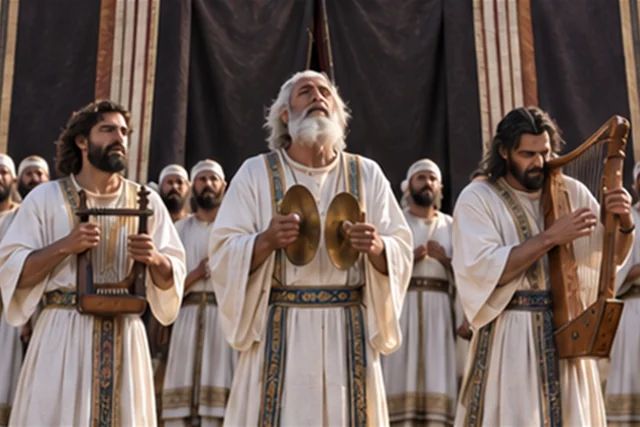
David's singers arrive with remarkably long family trees. Heman is traced through Kohath, Asaph through Gershom, and Ethan through Merari, so the three major Levite families are represented in musical service. Their positions beside one another turn ancestry into an ordered arrangement. The chapter has almost written a family tree that also tells the musicians where they stand. The historical frame stretches from service before the tabernacle to the time when Solomon builds the temple, making music part of continuity between the mobile sanctuary and the permanent house. It is not treated as late decoration added after more serious work was complete. At the same time, the singers do not absorb every Levite responsibility. Their brethren remain appointed to other service of the tabernacle. Music receives substantial dignity without making storage, guarding, carrying, and all the rest disappear. Distinct work can be equally necessary to the same ordered worship.
Deep dive
This is an unusually detailed introduction to a musical ensemble. Heman's ancestry runs through Kohath, Asaph's through Gershom, and Ethan's through Merari. Their positions beside one another turn genealogical relationships into an ordered arrangement for service. The book has, in effect, written a family tree that also tells the musicians where to stand.
The singers serve before the tabernacle until Solomon builds the temple. Music therefore belongs to the continuity between the mobile sanctuary and the permanent house, not to a late embellishment added once the important work was finished. Their fellow Levites attend to the other service of the tabernacle. Neither group is made unnecessary by the other. The passage gives music its own substantial place while preserving the larger body of work that allows worship to continue.
Words to trace: Elkanah, house, Levi, Asaph, brethren, Ethan
Verse-by-verse path
- 1 Chronicles 6:31
“The service of song” is literally “the hands of song”, the singers as the instruments of it. “The ark had rest” picks up Psalm 132:8, “Arise, O LORD, into thy rest; thou, and the ark of thy strength”, the words Solomon prays in 2 Chronicles 6:41. The ark’s wanderings ended in David’s tent.
- 1 Chronicles 6:32
In David’s time the sanctuary was split. The ark sat in the tent in Jerusalem while the old tabernacle and altar stood at Gibeon (16:37–42), and singers were posted at both. “According to their order” is mishpat, their appointed custom, a set rota, not a free arrangement.
- 1 Chronicles 6:33
Shemuel is Samuel, so Heman the singer is Samuel’s grandson, the prophet’s line turned to music. 25:5 calls Heman “the king’s seer” and gives him fourteen sons and three daughters, all trained to sing. The Kohathite stands at the centre, with Asaph on his right and Ethan on his left.
- 1 Chronicles 6:34
The same line that ran downward in verses 22–28 now runs upward, son to father, so the two versions can be laid side by side. Eliel and Toah here are Eliab and Nahath there; the different spellings show up because the list is given twice.
- 1 Chronicles 6:35
Zuph appears in the upward list where Zophai stood in verse 26. Mahath and Amasai both reappear under Hezekiah, among the Kohathite Levites who cleansed the temple (2 Chronicles 29:12), again showing old names handed down in the same family.
- 1 Chronicles 6:36
Where verse 24 has Uriel, Uzziah and Shaul, this has Zephaniah, Azariah and Joel. Azariah and Uzziah are known to be two names for one man, since King Uzziah is Azariah throughout 2 Kings 15, so at least one of the differences may be a single man under two names.
- 1 Chronicles 6:37
This is the line the psalm titles call “the sons of Korah”, credited with Psalms 42–49, 84–85 and 87–88. Heman is named in the title of Psalm 88. The leading singer of David’s choir descends from the man who rose against Aaron and was swallowed by the earth.
- 1 Chronicles 6:38
Heman’s pedigree is the only one of the three that runs past Levi to “Israel”, twenty two generations above him, the longest in the chapter. Izhar and Kohath close it as they stood in Exodus 6. The singer at the centre of the arrangement has the longest pedigree.
- 1 Chronicles 6:39
“His brother” means fellow Levite, since Asaph belongs to Gershom’s family. The right hand was the place of honour. Twelve psalms bear Asaph’s name, 50 and 73–83, and 2 Chronicles 29:30 speaks of praising “with the words of David, and of Asaph the seer”.
- 1 Chronicles 6:40
Michael, Baaseiah and Malchiah: two of the three carry the divine name, and Malchiah means my king is Yah. Baaseiah occurs nowhere else. The pedigree moves up through men known only by their place in the line, with no deed attached to any of them.
- 1 Chronicles 6:41
Set against verse 21, Ethni and Jeaterai look like two forms of one name, and Adaiah and Iddo like two forms of another. Zerah is spelled the same in both. The Gershonite line appears twice, in different forms, and neither form is corrected to match the other.
- 1 Chronicles 6:42
This Ethan is a Gershonite ancestor of Asaph, not the Merarite singer Ethan of verse 44. Here Zimmah is the son of Shimei and grandson of Jahath, whereas verse 20 made Zimmah the son of Jahath. The two records of the family disagree by one generation.
- 1 Chronicles 6:43
Asaph’s line reaches Levi in fifteen names, against Heman’s twenty three, although the two men sang together in one generation. Pedigrees of such different length for contemporaries show the lines are selective, keeping the names that mattered and skipping others, an inference from the numbers.
- 1 Chronicles 6:44
Ethan appears to be the singer called Jeduthun elsewhere (16:41; 25:1), and Jeduthun stands in the titles of Psalms 39, 62 and 77. Kishi is the Kushaiah of 15:17. The left hand completes the arrangement, with the three Levite families standing together in one line of singers.
- 1 Chronicles 6:45
Hashabiah, “the LORD has taken account”, is one of the commonest Levite names in Chronicles, Ezra and Nehemiah. Hilkiah is the high priest’s name from verse 13, but this Hilkiah is a Merarite. Amaziah shares a name with a king of Judah. All three names carry Yah.
- 1 Chronicles 6:46
Numbers 4:31–32 gave the Merarites the heaviest load in the wilderness, the tabernacle’s boards, bars, pillars and sockets. Their descendant now carries a tune. Bani means built, and Shamer means keeper or guard.
- 1 Chronicles 6:47
Exodus 6:19 and verse 19 above make Mahli and Mushi brothers, sons of Merari. Here Mahli is Mushi’s son, so either a nephew carried his uncle’s name or the list has telescoped. Ethan’s pedigree reaches Levi in fourteen names.
- 1 Chronicles 6:48
“Appointed” is netunim, “given”, the word of Numbers 3:9: the Levites “are wholly given unto him” out of Israel. In the wilderness that service meant carrying: the Gershonites the curtains, the Kohathites the holy vessels, the Merarites the frame. The singers were drawn from the same body.
1 Chronicles 6:31-48
King James Version31And these are they whom David set over the service of song in the house of the LORD, after that the ark had rest.
32And they ministered before the dwelling place of the tabernacle of the congregation with singing, until Solomon had built the house of the LORD in Jerusalem: and then they waited on their office according to their order.
33And these are they that waited with their children. Of the sons of the Kohathites: Heman a singer, the son of Joel, the son of Shemuel,
34The son of Elkanah, the son of Jeroham, the son of Eliel, the son of Toah,
35The son of Zuph, the son of Elkanah, the son of Mahath, the son of Amasai,
36The son of Elkanah, the son of Joel, the son of Azariah, the son of Zephaniah,
37The son of Tahath, the son of Assir, the son of Ebiasaph, the son of Korah,
38The son of Izhar, the son of Kohath, the son of Levi, the son of Israel.
39And his brother Asaph, who stood on his right hand, even Asaph the son of Berachiah, the son of Shimea,
40The son of Michael, the son of Baaseiah, the son of Malchiah,
41The son of Ethni, the son of Zerah, the son of Adaiah,
42The son of Ethan, the son of Zimmah, the son of Shimei,
43The son of Jahath, the son of Gershom, the son of Levi.
44And their brethren the sons of Merari stood on the left hand: Ethan the son of Kishi, the son of Abdi, the son of Malluch,
45The son of Hashabiah, the son of Amaziah, the son of Hilkiah,
46The son of Amzi, the son of Bani, the son of Shamer,
47The son of Mahli, the son of Mushi, the son of Merari, the son of Levi.
48Their brethren also the Levites were appointed unto all manner of service of the tabernacle of the house of God.
1 Chronicles 6:49-53
Shared Ancestry, Distinct Responsibilities
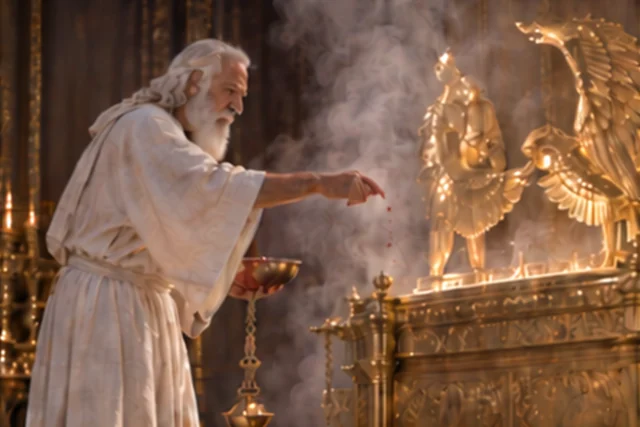
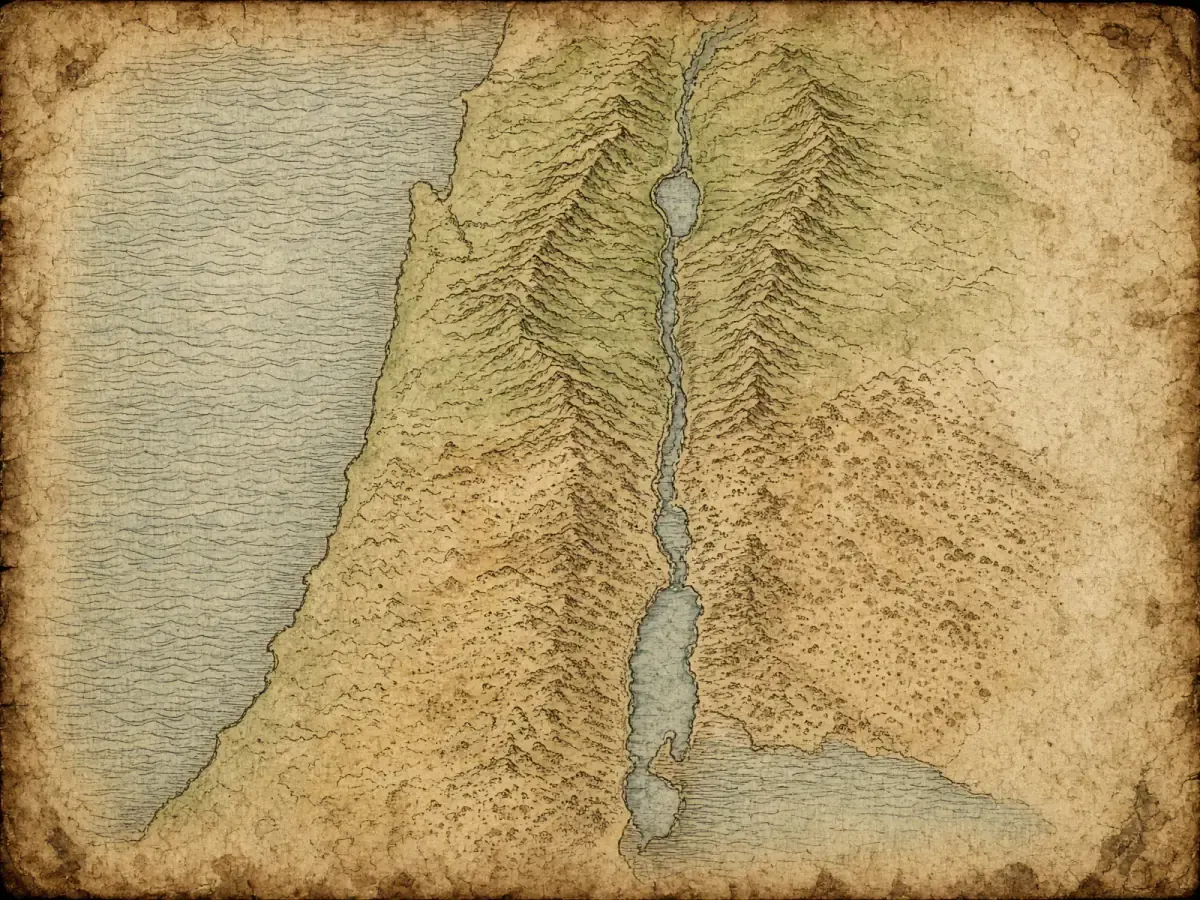
After the long musical genealogies, the chapter returns to Aaron and states plainly what distinguishes the priestly line. Aaron and his sons offer at the altars, perform the work of the most holy place, and make atonement for Israel. That assignment prevents the larger category of Levite service from becoming a blur in which every singer or gatekeeper is automatically an officiating priest. Shared ancestry does not erase distinct office. The passage then grounds priestly responsibility in what Moses commanded, connecting the sanctuary's later organization with earlier instruction. David will eventually make extensive arrangements, but the book does not present him as free to invent holy service from nothing. Continuity runs through Moses, Aaron, David, and Solomon while their functions remain distinguishable. The repeated genealogical names therefore do more than honor prominent families. They identify who bears responsibility for specific work and why those boundaries matter.
Deep dive
After the extended musical genealogies, the book returns to Aaron's line and states what is distinctive about it. Offering on the altars and making atonement belong to the priestly responsibility described here. Being a Levite singer does not automatically make someone an officiating priest, however distinguished that singer's ancestry or skill.
The reference to Moses supplies the governing frame. David's later arrangements will be extensive, but they do not appear as permission to invent sanctuary service without reference to the earlier command. The book is building continuity between Moses, Aaron, David, and Solomon while keeping their functions distinct. Its lists are not simply multiplying honored names; they are identifying who is responsible for which part of the work.
Words to trace: Aaron, altar, sons, Abishua, Ahimaaz, Ahitub
Verse-by-verse path
- 1 Chronicles 6:49
The altar of burnt offering stood in the court, open to the sky; the altar of incense stood inside before the veil. When King Uzziah took a censer to burn incense himself, the priests withstood him and leprosy rose on his forehead (2 Chronicles 26:16–19). “Moses the servant of God” is a title Chronicles gives him repeatedly.
- 1 Chronicles 6:50
The priestly line is given again, now in the “his son” pattern rather than the “begat” pattern of verses 4–8. It adds nothing new in names. The same men who began the chapter are listed again after the singers, next to the priests’ duties.
- 1 Chronicles 6:51
These priests served through the period of the Book of Judges, while the tabernacle stood at Shiloh, yet Judges names none of them. It mentions only Phinehas, at the war with Benjamin (Judges 20:28). Zerahiah means the LORD has shone forth.
- 1 Chronicles 6:52
Nehemiah 11:11 and 1 Chronicles 9:11 give “Meraioth, the son of Ahitub”, reversing the order of this verse, where Ahitub descends from Meraioth. The difference stands between the records, with no attempt to reconcile it.
- 1 Chronicles 6:53
The second list stops at Ahimaaz, David’s contemporary. The first ran to the exile. The priests named beside David’s arrangements are the priests of David’s own day, as if the list were cut off at the moment the organisation was set up.
1 Chronicles 6:49-53
King James Version49But Aaron and his sons offered upon the altar of the burnt offering, and on the altar of incense, and were appointed for all the work of the place most holy, and to make an atonement for Israel, according to all that Moses the servant of God had commanded.
50And these are the sons of Aaron; Eleazar his son, Phinehas his son, Abishua his son,
51Bukki his son, Uzzi his son, Zerahiah his son,
52Meraioth his son, Amariah his son, Ahitub his son,
53Zadok his son, Ahimaaz his son.
1 Chronicles 6:54-65
Cities and the Land Around Them
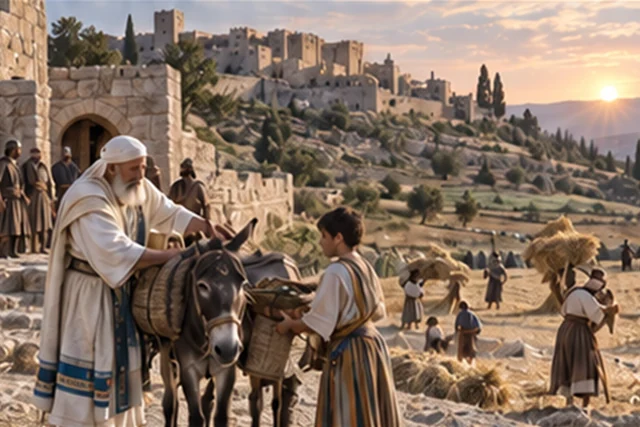
The chapter's attention now shifts from offices to addresses. Aaron's descendants and other Levite families receive cities drawn from Israel's tribal territories, together with the surrounding lands the KJV calls “suburbs.” That word refers to open land associated with the cities, not a modern belt of houses outside an urban center. Hebron shows why the distinction matters. The city and its associated provision belong to Aaron's line, while the fields and villages of the district remain connected with Caleb. Different rights and uses can occupy the same named region without contradiction. More broadly, the Levites do not receive one self-contained block of tribal land. Their support is distributed among other tribes through assigned towns. Genealogy identifies the people, but the city lists identify how those people actually live within Israel's land. Sacred responsibility still requires homes, pasture, food, and local communities from which daily service can be sustained.
Deep dive
The KJV's "suburbs" means the land surrounding the cities, particularly the open ground used with them. It does not picture a ring of modern residential developments. The distinction becomes important at Hebron, where the city and its surrounding provision are associated with Aaron's descendants, while the fields and villages belong to Caleb. Different uses and allocations can occupy the same named district.
The allotments also show that Levi's support is distributed through the other tribes. The service centered on the sanctuary is sustained by households living in assigned towns rather than by a separate, self-contained tribal territory. Genealogy identifies the recipients; the city lists identify the practical means by which those recipients belong within Israel's land. Sacred responsibility still requires somewhere to live and ground on which animals can graze.
Words to trace: tribe, suburbs, cities, gave, sons, children
Verse-by-verse path
- 1 Chronicles 6:54
“Castles” is tirot, walled encampments, the word Genesis 25:16 uses for the camps of Ishmael’s sons, and “coasts” means borders. “Theirs was the lot”: Joshua 21:10 says the first lot came up for Aaron’s sons, so the priests chose first.
- 1 Chronicles 6:55
Hebron was the city where David was anointed king over Judah and reigned seven and a half years (2 Samuel 2:1–4 and 5:5). Near it was the cave of Machpelah, where Abraham, Isaac and Jacob were buried. The first priestly city on the list was also David’s first royal city.
- 1 Chronicles 6:56
Caleb had asked for this hill country at eighty five, while the Anakim still held it: “give me this mountain” (Joshua 14:10–12). Joshua 21:11–12 records the same division, the town to the priests and the land around it to Caleb.
- 1 Chronicles 6:57
The Hebrew has “the cities of refuge”, plural, though only Hebron follows, and the other lists name several; a line may have been lost. Libnah later revolted from Judah under Jehoram (2 Kings 8:22). Jattir and Eshtemoa are both on the list of towns to which David sent spoil from Ziklag (1 Samuel 30:27–28).
- 1 Chronicles 6:58
Hilen is Holon in Joshua 21:15. Debir had once been called Kirjath-sepher, “city of the book” (Joshua 15:15). Debir is also the word for the inner room of Solomon’s temple, which the King James calls “the oracle” (1 Kings 6:5).
- 1 Chronicles 6:59
At Beth-shemesh the ark came back from the Philistines on a new cart pulled by two milch kine, and the Levites lifted it down (1 Samuel 6:13–15). Men of the town then looked into it and were struck. Joshua 21:16 also lists Juttah among these priestly towns, a name missing here.
- 1 Chronicles 6:60
Joshua 21:17 names four towns of Benjamin, beginning with Gibeon; Chronicles lists three but still totals thirteen, which needs Gibeon. Gibeon is where the tabernacle stood in David’s day (16:39). Anathoth is where Solomon sent Abiathar (1 Kings 2:26) and where the prophet Jeremiah was born into a priestly family (Jeremiah 1:1).
- 1 Chronicles 6:61
Joshua 21:5 gives these ten cities out of Ephraim, Dan and the half tribe of Manasseh. Here Ephraim and Dan have dropped out, and the King James’s “namely” is filling the gap. The Kohathites “left” are the ones who were not priests.
- 1 Chronicles 6:62
All of the Gershonites’ thirteen towns lie in the north, from Issachar’s valley to the Galilee hills and Bashan beyond the Jordan. This is the family descended from Libni and Shimei, living on the northern edge of the land.
- 1 Chronicles 6:63
Merari’s twelve towns are divided by the Jordan: Reuben and Gad to the east, Zebulun to the west in lower Galilee. The family that had carried the tabernacle’s frame now lived on both sides of the river.
- 1 Chronicles 6:64
“Gave” matters here: the cities came out of the other tribes’ land, and Numbers 35:8 required each tribe to give in proportion to what it had. The total there is forty eight cities (Numbers 35:7). Levi had no territory of its own.
- 1 Chronicles 6:65
“These cities, which are called by their names” points back to the list in verses 57–60. In Joshua 21:9 this sentence introduces the list; here it follows it, because Chronicles has moved the priests’ towns to the front, directly after the priests.
1 Chronicles 6:54-65
King James Version54Now these are their dwelling places throughout their castles in their coasts, of the sons of Aaron, of the families of the Kohathites: for theirs was the lot.
55And they gave them Hebron in the land of Judah, and the suburbs thereof round about it.
56But the fields of the city, and the villages thereof, they gave to Caleb the son of Jephunneh.
57And to the sons of Aaron they gave the cities of Judah, namely, Hebron, the city of refuge, and Libnah with her suburbs, and Jattir, and Eshtemoa, with their suburbs,
58And Hilen with her suburbs, Debir with her suburbs,
59And Ashan with her suburbs, and Beth-shemesh with her suburbs:
60And out of the tribe of Benjamin; Geba with her suburbs, and Alemeth with her suburbs, and Anathoth with her suburbs. All their cities throughout their families were thirteen cities.
61And unto the sons of Kohath, which were left of the family of that tribe, were cities given out of the half tribe, namely, out of the half tribe of Manasseh, by lot, ten cities.
62And to the sons of Gershom throughout their families out of the tribe of Issachar, and out of the tribe of Asher, and out of the tribe of Naphtali, and out of the tribe of Manasseh in Bashan, thirteen cities.
63Unto the sons of Merari were given by lot, throughout their families, out of the tribe of Reuben, and out of the tribe of Gad, and out of the tribe of Zebulun, twelve cities.
64And the children of Israel gave to the Levites these cities with their suburbs.
65And they gave by lot out of the tribe of the children of Judah, and out of the tribe of the children of Simeon, and out of the tribe of the children of Benjamin, these cities, which are called by their names.
1 Chronicles 6:66-81
A Sanctuary Served from Across Israel
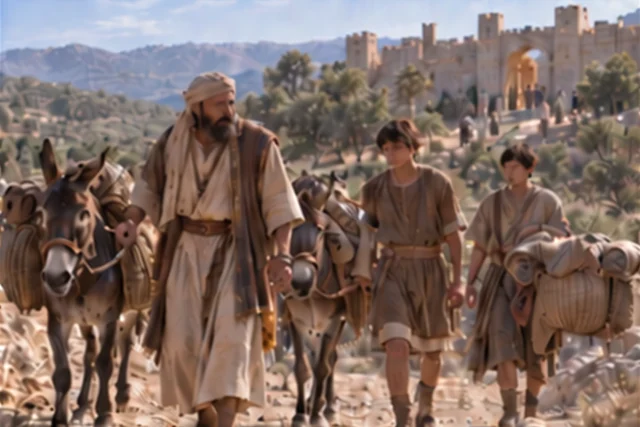
The remaining city lists spread Kohathite, Gershomite, and Merarite families across the land, from Ephraim and Manasseh to Issachar, Asher, Naphtali, Zebulun, Reuben, and Gad. Towns west of Jordan stand beside towns in the eastern territories, creating a geographical network that mirrors the family structure already established in the chapter. Levi is woven through Israel rather than concentrated only near the sanctuary. That wide distribution helps explain how one central place of worship can depend on many households living far from it. The exile named near the chapter's beginning makes the precision of these allocations especially meaningful. 1 Chronicles can still name families, offices, cities, and surrounding lands after displacement has interrupted the old arrangement. It does not turn every town into an anecdote. The preservation of the network is itself the point. Sanctuary service belonged to identifiable people whose ordinary lives stretched across the country.
Deep dive
The movement from family to family and tribe to tribe creates a geographical counterpart to the chapter's musical arrangement. Kohath, Gershom, and Merari each have an assigned place within the larger whole. Towns west of Jordan stand alongside provision in the eastern regions. The Levite presence is woven through Israel rather than confined to the immediate surroundings of the sanctuary.
The exile named near the chapter's beginning gives these allocations a particular weight. The book can still specify families, offices, and places after displacement has disturbed the old arrangement. It does not turn every city into a separate anecdote or insist that every name needs a lengthy explanation. The careful preservation of the network is itself the point: the sanctuary's service belonged to identifiable people whose life extended across the land.
Words to trace: suburbs, tribe, sons, cities, Ephraim, family
Verse-by-verse path
- 1 Chronicles 6:66
“The residue” of Kohath means the Kohathites who were not priests, Moses’ own family among them. Their towns lie in Ephraim, in the central hill country, the heart of what became the northern kingdom.
- 1 Chronicles 6:67
The plural “cities of refuge” appears again with a single name, Shechem, where Joshua renewed the covenant and Joseph’s bones were buried (Joshua 24:1 and 32). Gezer stayed Canaanite until a Pharaoh burned it and gave it as a dowry to his daughter, Solomon’s wife (1 Kings 9:16).
- 1 Chronicles 6:68
Joshua 21:22 has Kibzaim where this has Jokmeam. Beth-horon is the pass where Joshua chased the Amorite kings while hailstones fell on them (Joshua 10:10–11). Solomon later fortified both the upper and nether towns (2 Chronicles 8:5).
- 1 Chronicles 6:69
Aijalon is the valley of Joshua 10:12: “Moon, in the valley of Ajalon.” Joshua 21:23–24 counts Aijalon and Gath-rimmon among Dan’s towns, not Ephraim’s. Dan is never named in this chapter, and its genealogy is missing from these chapters as well.
- 1 Chronicles 6:70
Joshua 21:25 names Tanach and Gath-rimmon here. Bileam is Ibleam, near which Jehu’s men shot King Ahaziah of Judah as he fled (2 Kings 9:27). The towns of the western half of Manasseh close the Kohathite list.
- 1 Chronicles 6:71
Golan in Bashan was one of the three refuge cities Moses set apart east of the Jordan (Deuteronomy 4:43), and it gives its name to the Golan. Ashtaroth, named for the goddess Ashtoreth, was a royal city of Og, king of Bashan (Deuteronomy 1:4).
- 1 Chronicles 6:72
Kedesh means holy place, a common town name; Joshua 21:28 has Kishon here. Daberath lay at the foot of Mount Tabor on the border of Zebulun and Issachar. Issachar’s territory held the rich valley of Jezreel.
- 1 Chronicles 6:73
This Ramoth is not Ramoth-gilead, which comes in verse 80; Joshua 21:29 calls it Jarmuth. Anem is En-gannim there, “spring of gardens”. Two lists of the same towns, with the names worn differently.
- 1 Chronicles 6:74
Asher held the coastal plain north of Carmel toward Tyre. Mashal is the Mishal of Joshua 21:30. This Abdon is a town, not the judge Abdon, who was an Ephraimite from Pirathon (Judges 12:13–15).
- 1 Chronicles 6:75
Hukok is Helkath in Joshua 21:31. Rehob is one of the towns whose inhabitants Asher never drove out (Judges 1:31), so a Levite town on the list may not have been fully in Israelite hands at every period.
- 1 Chronicles 6:76
Kedesh in Galilee was a city of refuge (Joshua 20:7) and the home of Barak, whom Deborah summoned to fight Sisera (Judges 4:6). Galilee is ha-galil, “the circuit” or district. Kirjathaim means double town, and Joshua 21:32 has Kartan here.
- 1 Chronicles 6:77
Joshua 21:34–35 gives Merari four towns in Zebulun, and none of the four names matches these two. Tabor is the mountain where Barak gathered ten thousand men before coming down against Sisera (Judges 4:6 and 14). Rimmon means pomegranate.
- 1 Chronicles 6:78
“On the other side Jordan by Jericho” is the phrase Numbers uses for the plains of Moab where Israel camped before crossing (Numbers 22:1). Bezer in the wilderness was a city of refuge (Deuteronomy 4:43). Jahzah is Jahaz, where Israel fought and defeated Sihon, king of the Amorites (Numbers 21:23–24).
- 1 Chronicles 6:79
From the wilderness of Kedemoth, “eastern places”, Moses sent messengers to Sihon asking for passage (Deuteronomy 2:26). Jeremiah 48:21 lists Mephaath among the towns of Moab under judgment, so this Levite town in Reuben’s land was later Moabite.
- 1 Chronicles 6:80
Ramoth-gilead was a refuge city (Deuteronomy 4:43), the town where Ahab was killed by an arrow shot at a venture (2 Chronicles 18:33) and where Jehu was anointed. Mahanaim, “two camps”, is where Jacob met the angels (Genesis 32:2) and where David fled from Absalom (2 Samuel 17:24).
- 1 Chronicles 6:81
Heshbon was Sihon’s capital (Numbers 21:26). Jazer reappears in 26:31, where in David’s fortieth year “mighty men of valour” of Hebron’s family were found there. Counted up, the chapter names forty two Levite towns against the forty eight of Numbers 35:7, a list that has lost some names in copying.
1 Chronicles 6:66-81
King James Version66And the residue of the families of the sons of Kohath had cities of their coasts out of the tribe of Ephraim.
67And they gave unto them, of the cities of refuge, Shechem in mount Ephraim with her suburbs; they gave also Gezer with her suburbs,
68And Jokmeam with her suburbs, and Beth-horon with her suburbs,
69And Aijalon with her suburbs, and Gath-rimmon with her suburbs:
70And out of the half tribe of Manasseh; Aner with her suburbs, and Bileam with her suburbs, for the family of the remnant of the sons of Kohath.
71Unto the sons of Gershom were given out of the family of the half tribe of Manasseh, Golan in Bashan with her suburbs, and Ashtaroth with her suburbs:
72And out of the tribe of Issachar; Kedesh with her suburbs, Daberath with her suburbs,
73And Ramoth with her suburbs, and Anem with her suburbs:
74And out of the tribe of Asher; Mashal with her suburbs, and Abdon with her suburbs,
75And Hukok with her suburbs, and Rehob with her suburbs:
76And out of the tribe of Naphtali; Kedesh in Galilee with her suburbs, and Hammon with her suburbs, and Kirjathaim with her suburbs.
77Unto the rest of the children of Merari were given out of the tribe of Zebulun, Rimmon with her suburbs, Tabor with her suburbs:
78And on the other side Jordan by Jericho, on the east side of Jordan, were given them out of the tribe of Reuben, Bezer in the wilderness with her suburbs, and Jahzah with her suburbs,
79Kedemoth also with her suburbs, and Mephaath with her suburbs:
80And out of the tribe of Gad; Ramoth in Gilead with her suburbs, and Mahanaim with her suburbs,
81And Heshbon with her suburbs, and Jazer with her suburbs.
Questions to keep in mind while reading
- Track who acts, who speaks, who is affected, and what changes.
- Notice repeated promises, failures, rescues, and consequences.
- Do not assume the account approves every action that is reported.
Text first
Where readers differ
The chapter summary begins with what the passage says and how its parts fit together. It does not assume one denomination has already settled every question. Where a conclusion depends on a tradition, literary theory, or historical reconstruction, that dependence is named openly.
The KJV text is presented first. Interpretive conclusions are labeled, and differences are introduced only when they help a reader understand why serious communities do not always reach the same answer.
Comparative interpretive notes for this chapter are in preparation. Until reviewed notes are ready, this page separates the KJV text from summary and application without claiming that serious readers agree on every question.
Questions beneath the surface
- What account of God, human freedom, responsibility, and the good life emerges from 1 Chronicles 6?
- Which tension does the chapter refuse to resolve quickly?
- What changes when the chapter is read as part of the whole canon rather than as an isolated moral lesson?
- Where might a sincere reader confuse a familiar tradition with something the text states directly?
Questions for serious personal contemplation
These open-ended questions make room for tension, honest response, prayer, and conclusions that remain accountable to the chapter.
Observe without rushing
What part of 1 Chronicles 6 makes you stop, feel unsettled, or feel surprised, and why?
Which detail in the passage would be easiest to overlook? How does that detail change your understanding?
Where do you see tension between what happens and this focus: 1 Chronicles 6 develops its own movement around suburbs, sons, tribe, begat, cities?
What important question does the passage leave open instead of resolving quickly?
Examine your inner life honestly
Which person, response, fear, or desire in the passage feels most like your own life right now?
What assumption about God, other people, or yourself does this text challenge?
Which part would you rather soften, avoid, or explain away too quickly? What might that reaction reveal?
If this Scripture could ask you one direct question, what do you think it would ask?
Respond with wisdom and courage
What do you need to remember, confess, grieve, thank God for, or trust after reading this passage?
How might another faithful person read this situation differently without ignoring the text?
What obedient response would be costly, uncomfortable, or slow, yet still faithful to Scripture?
What question will you carry into prayer this week, and which verses will you keep in front of you?
Music and video connected to the passage
Related media appears when its Scripture reference overlaps this study. Music and video can illuminate a theme while the biblical text remains the foundation.