The big picture
The Book of John opens farther back than Bethlehem, placing the Word before creation and on the creator’s side of everything that came into being. That immense claim then moves steadily into human scale. The Word becomes flesh, John the Baptist refuses titles that would distract from his witness, and disciples begin following through invitations as ordinary as “Come and see.” Recognition grows, but never all at once. Jesus is called Lamb of God, Messiah, Son of God, King of Israel, and Son of man, yet each title opens more than it closes. The chapter’s rhythm is therefore one of disclosure without exhaustion. The one through whom all things were made can be encountered beside a river, during an afternoon visit, and in a conversation about Nazareth. Heaven and earth meet in a person people are only beginning to know.
In this chapter
- Already There at the Beginning John 1:1-5
Before anyone can ask where Jesus came from, the opening has already ruled out the answer that he began as part of creation.
- A Witness Is Not the Light John 1:6-13
The first named human being in the book arrives with a remarkably narrow job description.
- Glory Takes Flesh John 1:14-18
“The Word was made flesh” prevents the opening from drifting into abstraction.
- The Man Who Refuses the Larger Title John 1:19-28
The delegation wants a title it can carry back to Jerusalem, but John keeps refusing the impressive ones.
- Recognition Given, Not Manufactured John 1:29-34
The title “Lamb of God” brings death and sacrifice into the book long before an arrest or cross appears.
- An Afternoon Becomes a Beginning John 1:35-42
A cosmic opening suddenly narrows to an afternoon.
- Nazareth Is Not the Final Explanation John 1:43-51
Nathanael thinks Nazareth settles the question before he meets the man.


Scripture beside the summary
John · King James Version · 51John 1:1-5
Already There at the Beginning
Before anyone can ask where Jesus came from, the opening has already ruled out the answer that he began as part of creation. The Word is there at the beginning, with God and identified as God, while everything that comes into existence comes through him. The Book of John therefore starts by placing a clean line between the maker and everything made. Then it gives that claim human consequences: life is in the Word, and that life becomes light for men. Darkness enters only after the light is already shining, so it never appears as an equal source competing for the world. Even the KJV word “comprehended” carries the tension that will govern the chapters ahead. People may fail to recognize the light, resist it, or try to overcome it, but darkness does not get the first word.
Deep dive
Genesis begins with God creating; John begins with the Word already there. That difference in the verbs matters. The Word does not arrive as the first item on creation's inventory. Everything made belongs on one side of the sentence, and the one through whom it was made belongs on the other. The phrase "with God" preserves relationship and distinction, while "was God" prevents that distinction from turning the Word into a lesser created assistant. John places both claims together rather than trimming either to make the opening easier.
Life becomes light, and the description immediately introduces conflict. Darkness is not a second creator or an equal power standing opposite God. It confronts a light already shining. The KJV's "comprehended" can sound like a problem of understanding alone; the line has also been understood as darkness failing to overcome the light. Recognition and resistance will both occupy the chapters ahead. Before any witness speaks or any opponent objects, John has identified the source of the life over which the arguments will turn.
Words to trace: Word, beginning, darkness, life, light, comprehended
Verse-by-verse path
- John 1:1
“In the beginning” is en arche, the opening words of Genesis in the Greek Old Testament. Logos, “Word”, meant the reason ordering the world to Greek philosophers, while Aramaic paraphrases of Scripture spoke of the Memra, the Word of the LORD, acting for God. In “the Word was God” the Greek article marks the Word as subject, so the sentence cannot be turned round.
- John 1:2
“Was” is the imperfect en, continuing existence, used four times in two verses. The next verse switches to egeneto, “came into being”, for everything made, and verse 6 uses egeneto again for John. The whole prologue keeps the two verbs apart: the Word was; everything else came to be.
- John 1:3
Ancient writers and many modern editions put the full stop earlier, after “not any thing made”, and begin the next sentence “That which was made in him was life.” The King James follows the other division, which makes the verse a double statement: all things through him, nothing without him.
- John 1:4
“Life” is zoe, a word the Book of John uses more than any other book of the New Testament. Light was the first thing spoken into being in Genesis 1:3, and Psalm 36:9 joins the two: “with thee is the fountain of life: in thy light shall we see light.”
- John 1:5
“Shineth” is present tense, set among past verbs: the light is still shining. The verb behind “comprehended” is katalambano, which reappears at 12:35, “lest darkness come upon you”, where it plainly means overtake. That later use gives weight to the reading “the darkness has not overcome it.”
John 1:1-5
King James Version1In the beginning was the Word, and the Word was with God, and the Word was God.
2The same was in the beginning with God.
3All things were made by him; and without him was not any thing made that was made.
4In him was life; and the life was the light of men.
5And the light shineth in darkness; and the darkness comprehended it not.
John 1:6-13
A Witness Is Not the Light
The first named human being in the book arrives with a remarkably narrow job description. John is sent from God, but the text immediately insists that he is not the Light. His importance lies in pointing beyond himself, which means losing followers to Jesus will eventually count as success rather than failure. Around that witness, the opening sharpens its great contradiction. The world is made through the Word, yet the world does not know him. He comes to his own, yet his own do not receive him. Rejection, however, is not the last category available. Those who receive him are given a standing ordinary ancestry cannot manufacture. Bloodline, human desire, and another person’s decision are all excluded as the source of this birth. The Book of John has moved from creation to belonging, and it has made belonging depend on receiving the Light rather than inheriting the right pedigree.
Deep dive
The sudden introduction of a named man after the opening's immense scale is deliberate. John is "sent from God," but he is not the light. The distinction is stated twice because witness can easily attract attention that belongs to its subject. His significance lies in directing belief elsewhere. Later, when his own disciples begin following Jesus, that departure will fulfill his work rather than spoil it.
The rejection sharpens in stages: the world was made through the Word, the Word entered it, and the world did not recognize him. Coming to "his own" makes the refusal more intimate still. Yet rejection is not the final category. Those who receive him are given a new standing as God's children. John rules out bloodline, human desire, and another person's decision as the source of this birth. The opening does not disparage ordinary birth; it announces a life that ordinary descent cannot confer. Nicodemus will shortly discover how disruptive that distinction is to someone with excellent religious credentials.
Words to trace: Light, world, witness, bear, believe, name
Verse-by-verse path
- John 1:6
“There was” is egeneto again, “there came to be”, the verb of created things, not the “was” of the Word. The Book of John never calls him “the Baptist”; in this Gospel he is simply John, and the only other John is the father of Simon (verse 42 in the best manuscripts).
- John 1:7
Witness is this Book’s great word: the verb and noun together occur about forty-seven times in John, against a handful in Matthew. “That all men through him might believe” states for John the same purpose the Book gives for itself at the end: “that ye might believe” (20:31).
- John 1:8
The denial is emphatic, and it may have been needed. Acts 19:1–7 finds disciples at Ephesus who knew only John’s baptism, and a later Christian text reports followers of John who claimed he was the Christ (Pseudo-Clementine Recognitions 1.60). That is one explanation of why the Book of John insists so often.
- John 1:9
“True” is alethinos, real or genuine as against a copy or shadow, the adjective of the true bread (6:32), the true vine (15:1) and the true worshippers (4:23). “That cometh into the world” may describe every man, as the King James takes it, or the light itself, which “was coming into the world”.
- John 1:10
“World”, kosmos, occurs about seventy-eight times in John, more than in Matthew, Mark and Luke combined. Here it carries three senses in one verse: the place he was in, the creation made through him, and the people who did not know him.
- John 1:11
The Greek changes gender between the two halves. He came to ta idia, neuter, “his own things” or his own home; and hoi idioi, masculine, “his own people”, did not receive him. The neuter phrase returns at 19:27, when the disciple takes Jesus’ mother “unto his own home”.
- John 1:12
“Power” is exousia, right or authority, not strength. “Sons” is tekna, children: the Book of John keeps huios, son, for Jesus alone. It never uses the noun “faith” at all, but uses the verb “believe” about ninety-eight times, often as here with eis, believing into.
- John 1:13
“Blood” is plural in Greek, “bloods”, reflecting the ancient idea that a child was formed from the mingled blood of the parents; the Wisdom of Solomon (7:2) speaks of being “compacted in blood”. A few early Latin writers read “who was born” in the singular and took the verse as a reference to Jesus’ own birth.
John 1:6-13
King James Version6There was a man sent from God, whose name was John.
7The same came for a witness, to bear witness of the Light, that all men through him might believe.
8He was not that Light, but was sent to bear witness of that Light.
9That was the true Light, which lighteth every man that cometh into the world.
10He was in the world, and the world was made by him, and the world knew him not.
11He came unto his own, and his own received him not.
12But as many as received him, to them gave he power to become the sons of God, even to them that believe on his name:
13Which were born, not of blood, nor of the will of the flesh, nor of the will of man, but of God.
John 1:14-18
Glory Takes Flesh
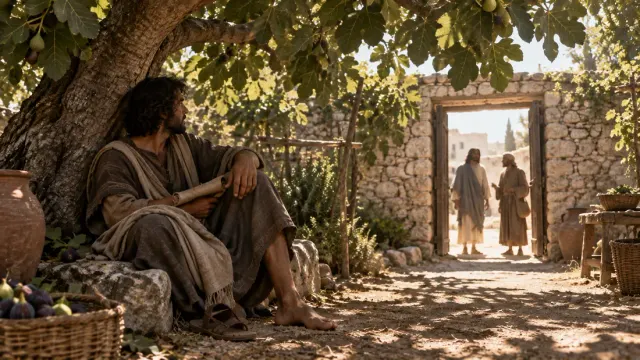
“The Word was made flesh” prevents the opening from drifting into abstraction. The one through whom all things were made enters the ordinary conditions of human life, and flesh is not treated as a disguise that must be discarded before glory can appear. The language of dwelling carries the resonance of a tabernacle, where divine glory had once been associated with a sacred tent. Here that disclosure is located in a human life. Moses remains honored as the giver of the law, but Jesus Christ is presented as the climactic disclosure of grace and truth. John the Baptist’s claim that the one coming after him was before him keeps public chronology and eternal priority together in one sentence. The unseen God is not made known by a description of divine appearance. He is declared through the Son, whose nearness to the Father makes his human presence the place where God is known.
Deep dive
"Made flesh" is the opening's decisive descent into the ordinary conditions of human existence. John does not say that the Word merely wore a convincing disguise. The Greek verb skenoo, rendered "dwelt," means to dwell or pitch a tent, giving the sentence a tabernacle resonance (Strong's Greek 4637). Exodus 40:34 locates divine glory at the tabernacle; John now locates its disclosure in this human life. The claim is not that flesh obstructs glory until it can be discarded. Glory is encountered here, in the Word made flesh.
The comparison with Moses concerns the climactic disclosure of God, not a discovery that Israel's Scriptures had been a mistake. Moses truly gave the law; Jesus Christ brings the fullness of grace and truth that this opening celebrates. The Baptist's insistence that someone arriving after him existed before him holds together public sequence and eternal priority. Finally, the unseen God is made known by the Son's unique nearness to the Father. John has not solved divine invisibility by offering a sketch of God's appearance. He has identified the person whose words and actions disclose him.
Words to trace: grace, begotten, Father, glory, truth, bare
Verse-by-verse path
- John 1:14
“Only begotten” is monogenes, one of a kind, unique: Hebrews 11:17 uses it of Isaac, though Abraham had another son, and Luke of a widow’s only son (Luke 7:12). “Full of grace and truth” echoes God’s self-description to Moses in Exodus 34:6, “abundant in goodness and truth”, hesed and emet in Hebrew.
- John 1:15
“Cried” is kekragen, a perfect tense, “has cried out”, as if the shout were still ringing. John’s voice breaks into the prologue here as his name did in verse 6. The Book of Luke makes John about six months older than Jesus (Luke 1:36), which sharpens “he was before me”.
- John 1:16
“Fulness” is pleroma, the word Paul uses of all the fulness of God dwelling in Christ (Colossians 1:19; 2:9). “Grace for grace” is charin anti charitos; anti means “in place of”, so it may be one grace replacing another, which the next verse explains, or grace heaped on grace like waves.
- John 1:17
After sixteen verses of “the Word”, “the Light” and “he”, the Book names him for the first time: Jesus Christ. The full double name occurs in the Gospel only here and at 17:3, in Jesus’ own prayer.
- John 1:18
Exodus 33:20 had said “there shall no man see me, and live.” The oldest manuscripts read “the only begotten God”, not “Son”. “Declared” is exegeomai, to lead out, explain, narrate, the root of “exegesis”. “In the bosom” is the position of the disciple “leaning on Jesus’ bosom” at the supper (13:23).
John 1:14-18
King James Version14And the Word was made flesh, and dwelt among us, (and we beheld his glory, the glory as of the only begotten of the Father,) full of grace and truth.
15John bare witness of him, and cried, saying, This was he of whom I spake, He that cometh after me is preferred before me: for he was before me.
16And of his fulness have all we received, and grace for grace.
17For the law was given by Moses, but grace and truth came by Jesus Christ.
18No man hath seen God at any time; the only begotten Son, which is in the bosom of the Father, he hath declared him.
John 1:19-28
The Man Who Refuses the Larger Title
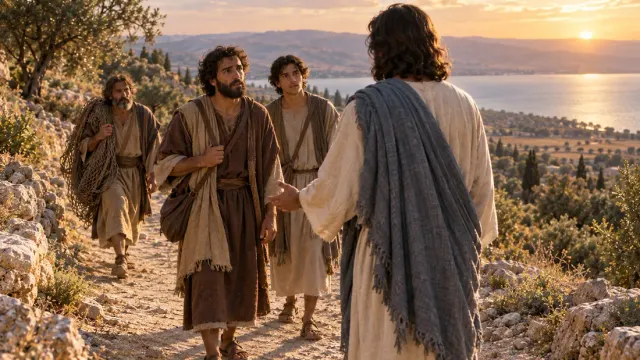
The delegation wants a title it can carry back to Jerusalem, but John keeps refusing the impressive ones. He is not the Christ, not Elijah in the identity being proposed, and not “that prophet.” When pressed to say what he is, he calls himself a voice. That answer makes his entire importance functional: a voice matters because of what it announces, not because it becomes the subject of the announcement. The questioning then shifts from identity to authority. If John will not claim the expected offices, why is he baptizing? His reply places the real problem directly among his questioners. Someone stands in their midst whom they do not know. The Book of John therefore turns the interrogation around. The alarming ignorance is not John’s failure to produce a grand title, but the delegation’s failure to recognize the one John considers himself unworthy even to serve at the level of a sandal.
Deep dive
The interrogation begins with titles and receives a succession of refusals. John is not the Christ, not Elijah in the identity the delegation proposes, and not "that prophet." He eventually identifies himself as a voice, using Isaiah 40:3. A voice has work to do, but it does not need to become the subject of its own announcement. The delegation has arrived to obtain a name worth taking back to Jerusalem; John gives them a commission and redirects their investigation.
His baptism then becomes the point of challenge. If he does not occupy the expected office, his interrogators want to know what authorizes the activity. John's answer places the decisive issue among them: someone stands there whom they do not know. Their lack of recognition, rather than his lack of an impressive title, is the chapter's larger problem. The sandal reference lowers John's claimed status sharply. It also anticipates the reversal of chapter 13, where the one whose sandal John considers himself unworthy to untie will take up a towel and wash his disciples' feet.
Words to trace: John, prophet, asked, Christ, confessed, Elias
Verse-by-verse path
- John 1:19
“The Jews” occurs about seventy times in the Book of John, often of the Jerusalem authorities rather than the people as a whole; here the delegation is sent “from Jerusalem”, and John, Jesus and every disciple in the scene are Jews. Priests and Levites were the right officials to investigate a new rite of washing.
- John 1:20
“Confessed, and denied not; but confessed” says one thing three ways, as Hebrew poetry does. His first words in the Book are ego ouk eimi, “I am not”, with an emphatic “I”, in a Gospel where Jesus will say ego eimi, “I am”, again and again.
- John 1:21
Malachi 4:5 promised Elijah before the day of the LORD; “that prophet” is the prophet like Moses of Deuteronomy 18:15–18. The Qumran Community Rule awaits “the prophet and the Messiahs of Aaron and Israel” (1QS 9:11), the same three figures this delegation asks about. Each of John’s answers is shorter than the last.
- John 1:22
The delegates are envoys who must report back. “What sayest thou of thyself?” raises a question the Book of John will press hard, the worth of self-testimony: “If I bear witness of myself, my witness is not true” (5:31), and the Pharisees’ objection at 8:13.
- John 1:23
In Mark and Matthew the Gospel writer applies Isaiah 40:3 to John; here John applies it to himself. Isaiah’s two verbs, “prepare” and “make straight”, are folded into one. The Qumran community cited the same verse as the reason it withdrew into the desert to prepare the way (1QS 8:13–14).
- John 1:24
The Greek can mean that the men sent were Pharisees, or that some had been sent by the Pharisees, a second group. Either way, the Pharisees, with their close attention to purity and washing, had an interest in a man immersing Jews in the river.
- John 1:25
Jewish ritual washings were done by oneself and repeated; John administered his, once. The question assumes a new baptism belongs to one of the expected figures, and prophets had promised cleansing water in the last days: “Then will I sprinkle clean water upon you” (Ezekiel 36:25).
- John 1:26
“Standeth” is a perfect of histemi: one has taken his stand among you. There was an expectation that the Messiah would live unknown until revealed; in Justin Martyr’s Dialogue with Trypho (8.4) the Jewish speaker says Christ, if he has come, is unknown until Elijah anoints him. The Book of John echoes it in 7:27.
- John 1:27
The latchet is the sandal strap, and untying it was a slave’s work. A later rabbinic saying holds that a disciple should do for his teacher everything a slave does, except loosen his sandal (Ketubot 96a). John ranks himself below even a disciple.
- John 1:28
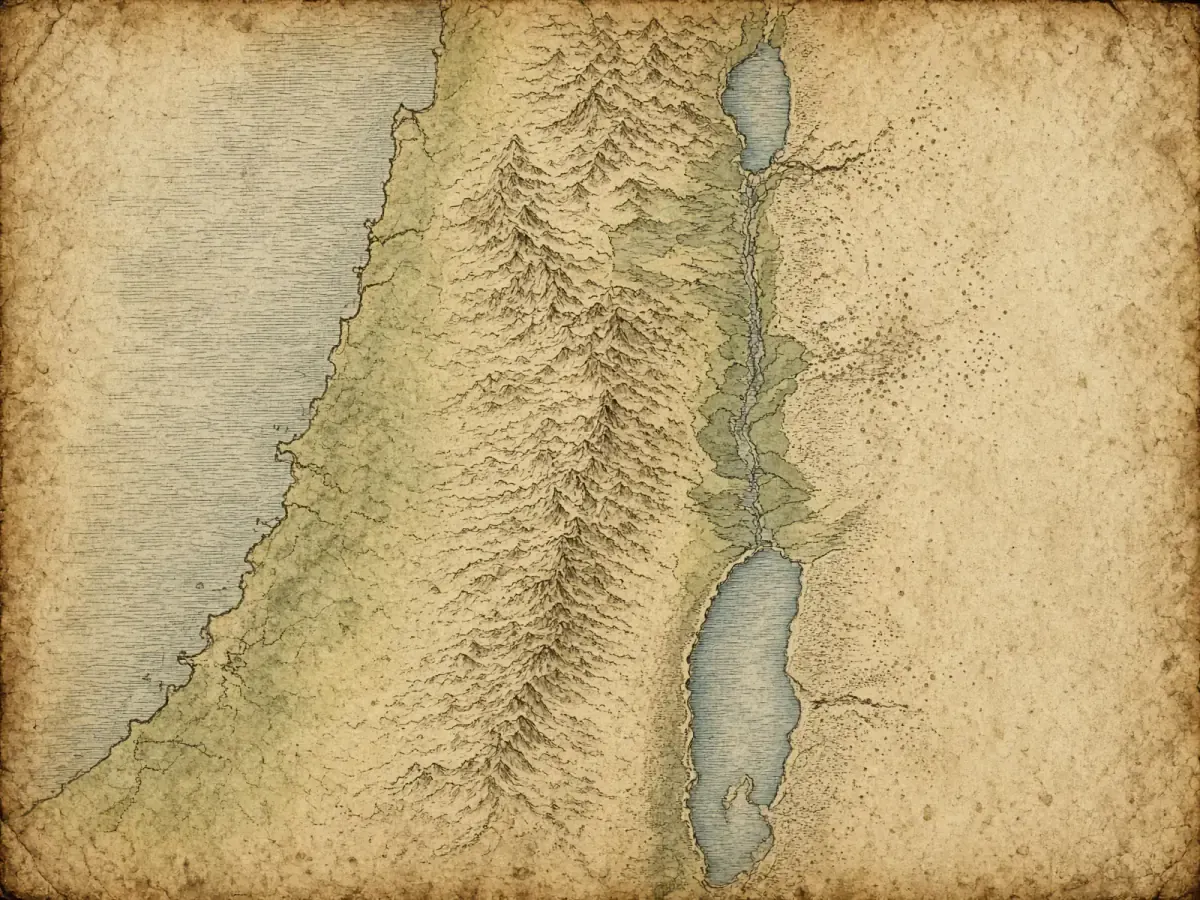
Most early manuscripts read “Bethany beyond Jordan”, not the Bethany near Jerusalem of chapter 11. Origen could not find a Bethany on the river and preferred Bethabara, “house of the crossing”, the reading the King James follows. The site east of the Jordan is still disputed.
John 1:19-28
King James Version19And this is the record of John, when the Jews sent priests and Levites from Jerusalem to ask him, Who art thou?
20And he confessed, and denied not; but confessed, I am not the Christ.
21And they asked him, What then? Art thou Elias? And he saith, I am not. Art thou that prophet? And he answered, No.
22Then said they unto him, Who art thou? that we may give an answer to them that sent us. What sayest thou of thyself?
23He said, I am the voice of one crying in the wilderness, Make straight the way of the Lord, as said the prophet Esaias.
24And they which were sent were of the Pharisees.
25And they asked him, and said unto him, Why baptizest thou then, if thou be not that Christ, nor Elias, neither that prophet?
26John answered them, saying, I baptize with water: but there standeth one among you, whom ye know not;
27He it is, who coming after me is preferred before me, whose shoe’s latchet I am not worthy to unloose.
28These things were done in Bethabara beyond Jordan, where John was baptizing.
John 1:29-34
Recognition Given, Not Manufactured
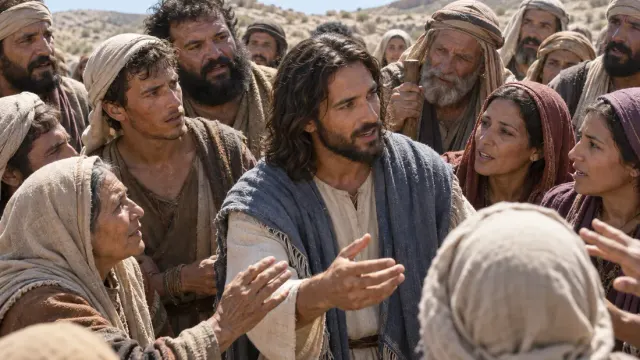
The title “Lamb of God” brings death and sacrifice into the book long before an arrest or cross appears. Its possible echoes are wide enough to touch Passover and Isaiah’s lamb imagery, but the sentence itself puts the emphasis on scope: the sin being addressed is “the sin of the world.” The same world that failed to recognize the Word is also the world toward which God’s provision reaches. John the Baptist then makes his own recognition unusually dependent. Twice he says he did not know Jesus in the sense required by his commission. He was given a sign, the Spirit descending and remaining. The abiding matters as much as the descent. This is not a momentary spectacle that happens to identify a promising man. Water baptism serves the unveiling of the one who baptizes with the Holy Ghost, and John’s witness rests on what he was shown rather than on private deduction or family familiarity.
Deep dive
The title "Lamb of God" brings sacrifice into view before any arrest or trial appears. It can resonate with the Passover lamb and with the lamb imagery of Isaiah 53:7, but John does not attach a label restricting it to one background here. The striking point is the scope: the sin in question is that of the world. The opening's rejected world is also the world toward which God's provision is directed.
John twice says that he did not know Jesus in the recognition his commission required. The testimony is therefore not presented as a clever deduction from family information or public popularity. The identifying sign was the Spirit descending and remaining. That last word matters: the account emphasizes an abiding relation, not a passing spectacle. Water baptism serves the disclosure of the one who baptizes with the Holy Ghost. John's task is then expressed in the language of seeing and bearing record. The chapter has moved from the opening's claims about the Word to a public witness who identifies this particular man as God's Son.
Words to trace: bare, descending, John, knew, record, Spirit
Verse-by-verse path
- John 1:29
“The next day” begins a count of days (verses 29, 35, 43, then “the third day” in 2:1) that makes the opening of the Book a week. “Taketh away” is airo, to lift and carry off, in the present tense. “Sin” is singular, the world’s sin treated as one load.
- John 1:30
“After me cometh” uses the language of following a teacher, opiso mou, “behind me”, the phrase of Mark 1:17, “Come ye after me”. Jesus could look like one of John’s followers; John says the one behind him ranks ahead of him. “A man” is aner, a grown man.
- John 1:31
“Made manifest” is phaneroo, a favourite verb of this Book and of 1 John, used for Jesus showing himself: at Cana he “manifested forth his glory” (2:11). John gives his own baptizing a single purpose: to bring this man into view for Israel.
- John 1:32
Nowhere does the Book of John narrate the baptism of Jesus; John reports only what he saw. The dove may recall the Spirit “moving upon the face of the waters” in Genesis 1:2, which a rabbinic saying compared to a dove hovering over its young (Hagigah 15a), or Noah’s dove over the flood waters.
- John 1:33
Isaiah 11:2 promised that “the spirit of the LORD shall rest upon him”, the resting that John was told to watch for. The promise of baptizing with the Holy Ghost is kept at the end of the Book, when Jesus breathes on the disciples and says “Receive ye the Holy Ghost” (20:22).
- John 1:34
Some ancient witnesses, including the first hand of Codex Sinaiticus, read “the chosen of God” instead of “the Son of God”, echoing Isaiah 42:1, “mine elect… I have put my spirit upon him.” “I saw, and bare record” are perfects: I have seen, and I have testified, and the testimony stands.
John 1:29-34
King James Version29The next day John seeth Jesus coming unto him, and saith, Behold the Lamb of God, which taketh away the sin of the world.
30This is he of whom I said, After me cometh a man which is preferred before me: for he was before me.
31And I knew him not: but that he should be made manifest to Israel, therefore am I come baptizing with water.
32And John bare record, saying, I saw the Spirit descending from heaven like a dove, and it abode upon him.
33And I knew him not: but he that sent me to baptize with water, the same said unto me, Upon whom thou shalt see the Spirit descending, and remaining on him, the same is he which baptizeth with the Holy Ghost.
34And I saw, and bare record that this is the Son of God.
John 1:35-42
An Afternoon Becomes a Beginning
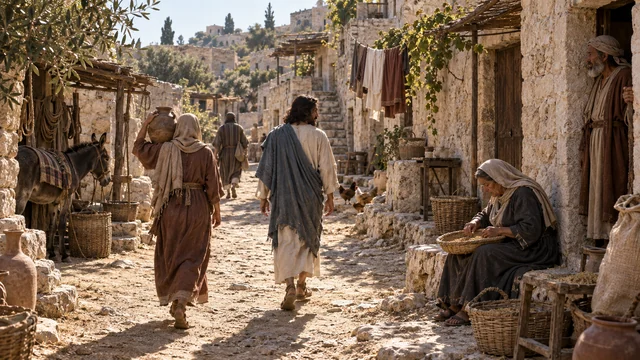
A cosmic opening suddenly narrows to an afternoon. Two disciples hear John identify Jesus and simply begin following him. John does not call them back, because their departure proves that his witness is doing exactly what it was meant to do. Jesus’ first recorded question in the Gospel is not a lecture but “What seek ye?” Their answer leads to an invitation, “Come and see,” and the Book of John even remembers the hour. The scale is striking: the Word who was before creation can also be encountered in the time and place of an ordinary visit. Andrew quickly finds Simon and announces the Messiah, but the account does not pretend that one title means complete understanding. Simon is then given a new name before any explanation of his future is supplied. The encounter opens lives rather than finishing them, and recognition begins through invitation, time spent, and one person bringing another.
Deep dive
John repeats his identification, and two of his disciples leave to follow Jesus. There is no attempt to reclaim them. His witness works precisely because it produces movement away from himself. Jesus' first recorded words in this Gospel ask what they seek. Their answer concerns where he is staying, and his invitation gives them time with him rather than an immediate lecture. The exact hour anchors the scene in a remembered encounter. The Gospel that began before creation is quite capable of attending to the hour of an afternoon.
Andrew's response is to find Simon. Recognition becomes witness almost at once, but John does not pretend that Andrew now understands everything implied by the title Messiah. The title is translated, as is the new name Jesus gives Simon. These explanations make the account accessible beyond readers already familiar with the terms. Simon arrives through his brother's initiative, yet Jesus addresses him with knowledge and a name that point beyond the introduction. His future is not developed here; it is opened. The unnamed second disciple remains unnamed, and the passage does not require a confident identification to make its point.
Words to trace: Jesus, Simon, brother, disciples, followed, interpreted
Verse-by-verse path
- John 1:35
“Stood” is a pluperfect, “had been standing”, as if John were waiting there. That he had disciples of his own the Book mentions again at 3:25 and 4:1. Two of them are about to become the first disciples of Jesus.
- John 1:36
“Looking upon” is emblepo, to fix one’s eyes, the verb used of Jesus looking at Simon in verse 42. The title is repeated in a shorter form, without “which taketh away the sin of the world”, and this time it sends two men walking.
- John 1:37
“Followed” is akoloutheo, which means both to walk behind someone and to become his disciple, and both are happening. There is no call from Jesus in this first scene of discipleship; they follow on the strength of John’s word.
- John 1:38
Jesus’ first words in the Book of John are a question, and it comes back: “Whom seek ye?” to the arresting party (18:4) and “Whom seekest thou?” to Mary Magdalene at the tomb (20:15). “Dwellest” is meno, abide, the verb used of the Spirit remaining on him (verses 32–33).
- John 1:39
Counting from sunrise, the tenth hour is about four in the afternoon, late enough that they stayed the night. Some have argued that John counts from midnight, making it ten in the morning, but that is a minority view. The precise hour is the kind of detail a man remembers from the day his life changed.
- John 1:40
Andrew is a Greek name, meaning manly, as is Philip’s. Each time Andrew appears in this Book he is bringing someone to Jesus: his brother here, the boy with the loaves (6:8–9), and the Greeks who wanted to see Jesus (12:22).
- John 1:41
“Messias” is a Greek spelling of the Aramaic meshiha, anointed; in the New Testament it appears only in John, here and at 4:25, both times translated for the reader. Some manuscripts read “in the morning” or “he was the first to find” for “he first findeth”.
- John 1:42
The best manuscripts read “son of John”, not “Jona”. Cephas is Aramaic kepha, rock, the name Paul generally uses for him (1 Corinthians 1:12; Galatians 2:9). In Matthew the naming comes at Caesarea Philippi (16:18); in John it happens at the first meeting, as a promise, “thou shalt be called”.
John 1:35-42
King James Version35Again the next day after John stood, and two of his disciples;
36And looking upon Jesus as he walked, he saith, Behold the Lamb of God!
37And the two disciples heard him speak, and they followed Jesus.
38Then Jesus turned, and saw them following, and saith unto them, What seek ye? They said unto him, Rabbi, (which is to say, being interpreted, Master,) where dwellest thou?
39He saith unto them, Come and see. They came and saw where he dwelt, and abode with him that day: for it was about the tenth hour.
40One of the two which heard John speak, and followed him, was Andrew, Simon Peter’s brother.
41He first findeth his own brother Simon, and saith unto him, We have found the Messias, which is, being interpreted, the Christ.
42And he brought him to Jesus. And when Jesus beheld him, he said, Thou art Simon the son of Jona: thou shalt be called Cephas, which is by interpretation, A stone.
John 1:43-51
Nazareth Is Not the Final Explanation
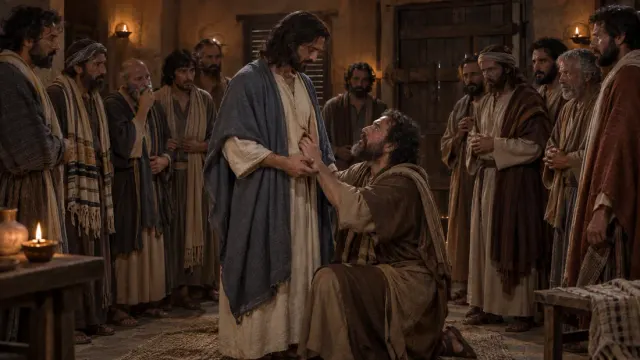
Nathanael thinks Nazareth settles the question before he meets the man. Philip does not defend the town with an argument. He repeats the same practical invitation already heard in the chapter: “Come and see.” What changes Nathanael is not a repaired opinion of Nazareth but Jesus’ knowledge of him, including the unexplained reference to the fig tree. The Book of John never tells the reader what happened there, which keeps the focus on the fact that Jesus knows what Nathanael knows should not be publicly available. Nathanael answers with major titles, Son of God and King of Israel, yet Jesus immediately says the disclosure will become larger. The image of angels ascending and descending recalls Jacob’s dream, but the meeting point between heaven and earth is now centered on the Son of man. Nazareth may be the location people know, but it is not the final explanation of who stands before them.
Deep dive
Nathanael initially treats Nazareth as an argument sufficient to settle the matter. Philip does not produce a lengthy defense of the town's reputation. He invites an encounter. The exchange has a dry economy: a place has been dismissed before its resident has been met. Jesus then identifies Nathanael's lack of deceit and refers to seeing him under the fig tree. John supplies neither the activity beneath that tree nor an account of Nathanael's thoughts there. His astonishment is clear; the private detail that made the statement decisive is not supplied.
The confession of God's Son and Israel's King is substantial, but Jesus immediately points beyond the circumstances that elicited it. The angels ascending and descending recall Jacob's dream in Genesis 28:12. Here their movement centers on the Son of man rather than a ladder set between earth and heaven. The promise enlarges both Nathanael's field of vision and the chapter's gathering titles. Jesus is not simply a remarkable man whose knowledge has overcome an objection about his hometown. The encounter between heaven and earth is being located in him.
Words to trace: Jesus, Nathanael, Philip, findeth, Nazareth, tree
Verse-by-verse path
- John 1:43
Jesus himself calls someone for the first time in the Book of John. “Follow me” are also nearly his last words in it, spoken to Peter on the shore of the lake: “Follow thou me” (21:19–22).
- John 1:44
Bethsaida, “house of fishing”, lay near where the Jordan enters the Sea of Galilee; Philip the tetrarch rebuilt it as Julias (Josephus, Antiquities 18.28). Mark places Simon and Andrew’s house in Capernaum (Mark 1:29), so they may have moved there, or the family belonged to both.
- John 1:45
Nathanael, “God has given”, never appears in Matthew, Mark or Luke. He is often identified with Bartholomew, who follows Philip in their lists of the Twelve, and 21:2 says he came from Cana. “The son of Joseph” was the ordinary way to name a man, set beside the prologue’s “only begotten of the Father”.
- John 1:46
Nazareth is never mentioned in the Old Testament, in Josephus or in the early rabbinic writings; it was a village of perhaps a few hundred people. Nathanael came from Cana, a few miles to the north, which may add a neighbour’s scorn to the question.
- John 1:47
Jacob, renamed Israel, was the Bible’s man of guile: Isaac said “Thy brother came with subtilty” (Genesis 27:35), and the Greek there is dolos, the word for guile here. Psalm 32:2 blesses the man “in whose spirit there is no guile.” Verse 51 will return to Jacob.
- John 1:48
The fig tree offered shade, and later rabbinic tales picture teachers studying the law beneath one. Sitting under one’s own fig tree was also the prophets’ picture of peace (Micah 4:4; Zechariah 3:10). Nathanael’s question, “Whence knowest thou me?”, is his first admission.
- John 1:49
Psalm 2 joins his two titles: “Yet have I set my king upon my holy hill of Zion… Thou art my Son” (Psalm 2:6–7). The crowd at the entry into Jerusalem will cry “the King of Israel” (12:13), and the title over the cross will say “King of the Jews”.
- John 1:50
Greek has no question marks, so this may be a question or a statement: “because I said… thou believest.” “Greater things” anticipates Jesus’ words at 5:20, that the Father “will shew him greater works than these, that ye may marvel.”
- John 1:51
“Verily, verily” is amen doubled, a form found only in John, about twenty-five times and always from Jesus. “Ye” is plural. In Genesis 28:12 the Hebrew “on it” can also be read “on him”, and a rabbinic midrash took the angels to be ascending and descending on Jacob himself (Genesis Rabbah 68:12).
John 1:43-51
King James Version43The day following Jesus would go forth into Galilee, and findeth Philip, and saith unto him, Follow me.
44Now Philip was of Bethsaida, the city of Andrew and Peter.
45Philip findeth Nathanael, and saith unto him, We have found him, of whom Moses in the law, and the prophets, did write, Jesus of Nazareth, the son of Joseph.
46And Nathanael said unto him, Can there any good thing come out of Nazareth? Philip saith unto him, Come and see.
47Jesus saw Nathanael coming to him, and saith of him, Behold an Israelite indeed, in whom is no guile!
48Nathanael saith unto him, Whence knowest thou me? Jesus answered and said unto him, Before that Philip called thee, when thou wast under the fig tree, I saw thee.
49Nathanael answered and saith unto him, Rabbi, thou art the Son of God; thou art the King of Israel.
50Jesus answered and said unto him, Because I said unto thee, I saw thee under the fig tree, believest thou? thou shalt see greater things than these.
51And he saith unto him, Verily, verily, I say unto you, Hereafter ye shall see heaven open, and the angels of God ascending and descending upon the Son of man.
Questions to keep in mind while reading
- Watch what Jesus says and does, and how people respond.
- Trace kingdom, discipleship, opposition, cross, and resurrection in the evangelist’s own sequence.
- Let later doctrine clarify the scene without erasing its immediate setting.
Text first
Where readers differ
The chapter summary begins with what the passage says and how its parts fit together. It does not assume one denomination has already settled every question. Where a conclusion depends on a tradition, literary theory, or historical reconstruction, that dependence is named openly.
The KJV text is presented first. Interpretive conclusions are labeled, and differences are introduced only when they help a reader understand why serious communities do not always reach the same answer.
Comparative interpretive notes for this chapter are in preparation. Until reviewed notes are ready, this page separates the KJV text from summary and application without claiming that serious readers agree on every question.
Questions beneath the surface
- What account of God, human freedom, responsibility, and the good life emerges from John 1?
- Which tension does the chapter refuse to resolve quickly?
- What changes when the chapter is read as part of the whole canon rather than as an isolated moral lesson?
- Where might a sincere reader confuse a familiar tradition with something the text states directly?
Questions for serious personal contemplation
These open-ended questions make room for tension, honest response, prayer, and conclusions that remain accountable to the chapter.
Observe without rushing
What part of John 1 makes you stop, feel unsettled, or feel surprised, and why?
Which detail in the passage would be easiest to overlook? How does that detail change your understanding?
Where do you see tension between what happens and this focus: Light shining in darkness and the Word dwelling among ordinary people; John identifying Jesus, the first disciples following, Andrew bringing Peter, and Nathanael called?
What important question does the passage leave open instead of resolving quickly?
Examine your inner life honestly
Which person, response, fear, or desire in the passage feels most like your own life right now?
What assumption about God, other people, or yourself does this text challenge?
Which part would you rather soften, avoid, or explain away too quickly? What might that reaction reveal?
If this Scripture could ask you one direct question, what do you think it would ask?
Respond with wisdom and courage
What do you need to remember, confess, grieve, thank God for, or trust after reading this passage?
How might another faithful person read this situation differently without ignoring the text?
What obedient response would be costly, uncomfortable, or slow, yet still faithful to Scripture?
What question will you carry into prayer this week, and which verses will you keep in front of you?
Music and video connected to the passage
Related media appears when its Scripture reference overlaps this study. Music and video can illuminate a theme while the biblical text remains the foundation.