The big picture
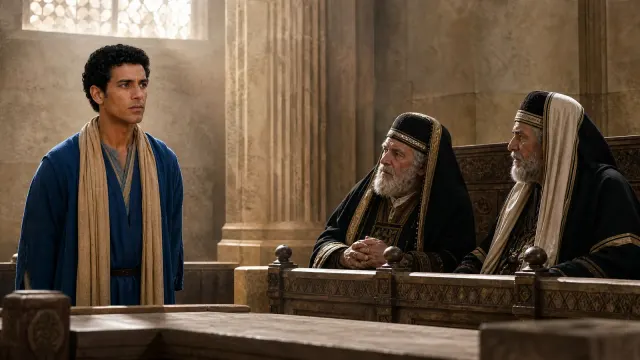
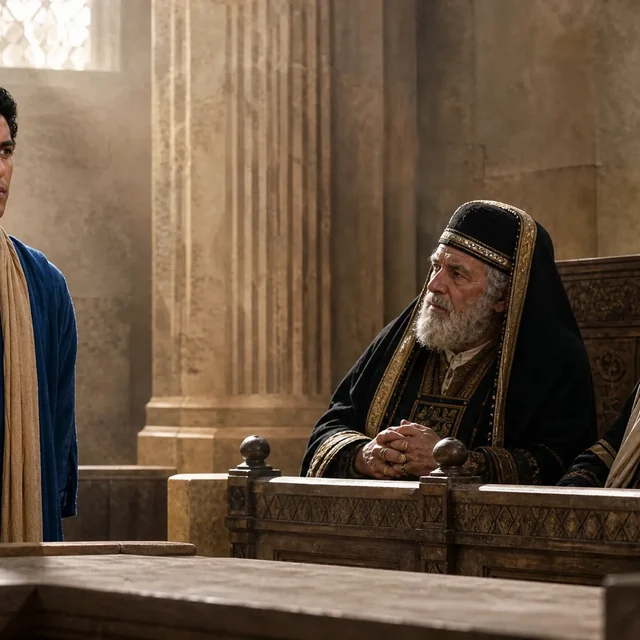
Stephen answers the charges against him by taking the council through Israel's own history, but the route he chooses keeps unsettling the assumptions behind the accusations. God appears to Abraham before Abraham possesses the land. God is with Joseph in Egypt after his brothers reject him. Moses is refused before God sends “this Moses” as ruler and deliverer, and holy ground appears in the wilderness long before a temple stands in Jerusalem. The tabernacle and temple are acknowledged as real gifts without being allowed to contain the God who made heaven and earth. By the time Stephen turns directly on his hearers, the pattern is clear: sacred privileges have repeatedly existed beside resistance to God's messengers. The accused becomes the accuser, charging the council with receiving the law and not keeping it. The hearing ends not in acquittal but in stones, while Stephen sees Jesus at God's right hand and dies praying for the people killing him.
In this chapter
- Glory Before Possession Acts 7:1-8
Charged in connection with the holy place, Stephen begins far from Jerusalem.
- The Rejected Brother Becomes the Provider Acts 7:9-16
The patriarchs enter Stephen's speech through envy, which prevents ancestry from becoming a flattering shield.
- A Deliverer His Own People Do Not Recognize Acts 7:17-29
The promised time draws near under conditions that look nothing like progress.
- Holy Ground in the Wilderness Acts 7:30-43
Stephen places holy ground in the wilderness, where no Jerusalem temple stands and Moses himself is a long-displaced shepherd.
- A House That Cannot Contain Its Maker Acts 7:44-50
Stephen does not win his argument by dismissing the tabernacle or temple as mistakes.
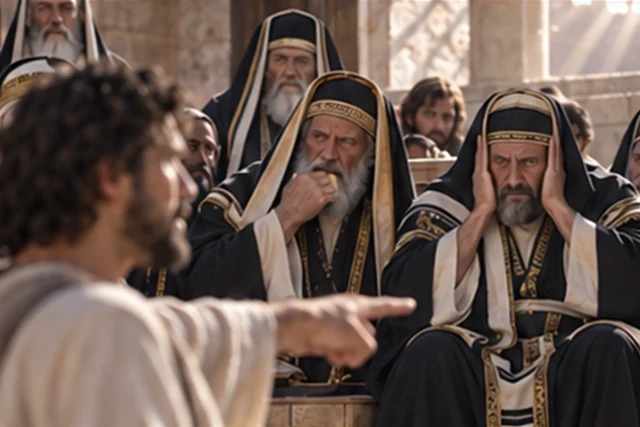
- The Accused Becomes the Accuser Acts 7:51-53
The defense turns into an indictment with almost no transition.
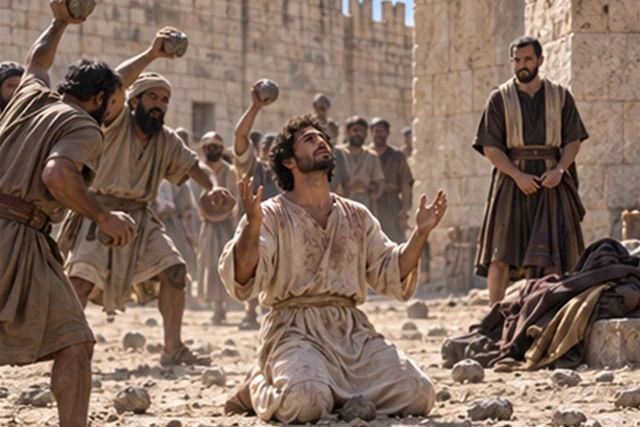
- A Prayer Survives the Stones Acts 7:54-60
The council's rage and Stephen's vision happen in the same room at the same time, producing two completely different verdicts on Jesus.

Scripture beside the summary
Acts · King James Version · 60Acts 7:1-8
Glory Before Possession
Charged in connection with the holy place, Stephen begins far from Jerusalem. The God of glory appears to Abraham in Mesopotamia, before Abraham lives in Charran and before he possesses any part of the promised land. That geography is already an argument. God's presence and initiative do not wait for a sanctuary, a national border, or even for Abraham to own enough ground to set his foot on. Promise comes before possession and before descendants: land is pledged to a childless man, and the future includes bondage as well as deliverance. Circumcision enters within that promise-shaped history rather than creating the history from nothing. The Book of Acts does not pause to settle every chronological question raised by comparing Stephen's compressed account with Genesis, including the timing of Terah's death. The speech does not need a full family chronology to make its first point. God was acting, speaking, and directing before the institutions Stephen is accused of dishonoring had come into existence.
Deep dive
Charged concerning the holy place, Stephen begins in Mesopotamia. The "God of glory" appears to Abraham before he lives in Charran and before he enters the land now occupied by Stephen's hearers. The location is part of the argument. God's initiative is not dependent on the temple or even on Abraham already being in the promised territory.
Promise and possession are deliberately separated. Abraham receives no inheritance large enough to set his foot on, yet the land is promised to him and his seed while he has no child. Stephen then includes the prediction of bondage and later deliverance. The history begins with God making a future rather than with Israel holding an institution. Circumcision follows within that promise-shaped sequence.
The speech is compressed, and its placement of Abraham's departure after his father's death raises chronological questions when compared with Genesis 11:26–12:4. Proposed explanations include Abraham not being Terah's eldest son, despite being named first. Acts does not stop to supply a family chronology. Its present emphasis is clear without resolving every date: God appears, promises, and directs before Abraham possesses the things promised.
Words to trace: land, begat, Abraham, bondage, Charran, dwelt
Verse-by-verse path
- Acts 7:1
The question is the formal opening of a hearing: do you admit the charges? The high priest is probably still Caiaphas, in office until AD 36. What follows is the longest speech in the Book of Acts, and it takes the question far more broadly than it was asked.
- Acts 7:2
“Men, brethren, and fathers” is the opening Paul will use to a Jerusalem crowd in 22:1. “The God of glory” is a phrase from Psalm 29:3. Genesis tells of the call at Haran, but Genesis 15:7 and Nehemiah 9:7 say God brought Abram out of Ur, and Philo and Josephus also place a first call there.
- Acts 7:3
The words are Genesis 12:1, quoted nearly exactly, but without “and from thy father’s house”. The omission suits the account Stephen gives, in which Abraham leaves his country first and parts from his father only later, at Haran.
- Acts 7:4
Haran lay on the upper Euphrates, in what is now south-eastern Turkey, a centre of the moon god’s worship. The Samaritan Pentateuch gives Terah’s age at death as 145 rather than 205, which would put his death before Abram left, and some think Stephen follows a reading of that kind. “Wherein ye now dwell” addresses the council directly.
- Acts 7:5
“Not so much as to set his foot on” borrows the phrase of Deuteronomy 2:5, where Israel is told not to take the land of Edom, “no, not so much as a foot breadth”. The only ground Abraham ever owned in Canaan was a burial cave, bought from the sons of Heth (Genesis 23).
- Acts 7:6
Genesis 15:13 gives four hundred years; Exodus 12:40 says the stay in Egypt was 430, and Paul counts 430 from the promise to the Law (Galatians 3:17). Stephen uses the round figure. “Sojourn” is the adjective paroikos, a resident alien, living in a land without citizen’s rights.
- Acts 7:7
Genesis 15:14 ends “they shall come out with great substance”. Stephen closes instead with words from Exodus 3:12, “ye shall serve God upon this mountain”, and makes the mountain “this place”, the very word the witnesses used of the temple in 6:13-14.
- Acts 7:8
“And so” means in this way, within the covenant: Isaac is born and circumcised under the promise, not before it. “Patriarchs” is used here of Jacob’s twelve sons, as in the Jewish work called the Testaments of the Twelve Patriarchs; in 2:29 Peter gave the same title to David.
Acts 7:1-8
King James Version1Then said the high priest, Are these things so?
2And he said, Men, brethren, and fathers, hearken; The God of glory appeared unto our father Abraham, when he was in Mesopotamia, before he dwelt in Charran,
3And said unto him, Get thee out of thy country, and from thy kindred, and come into the land which I shall shew thee.
4Then came he out of the land of the Chaldæans, and dwelt in Charran: and from thence, when his father was dead, he removed him into this land, wherein ye now dwell.
5And he gave him none inheritance in it, no, not so much as to set his foot on: yet he promised that he would give it to him for a possession, and to his seed after him, when as yet he had no child.
6And God spake on this wise, That his seed should sojourn in a strange land; and that they should bring them into bondage, and entreat them evil four hundred years.
7And the nation to whom they shall be in bondage will I judge, said God: and after that shall they come forth, and serve me in this place.
8And he gave him the covenant of circumcision: and so Abraham begat Isaac, and circumcised him the eighth day; and Isaac begat Jacob; and Jacob begat the twelve patriarchs.
Acts 7:9-16
The Rejected Brother Becomes the Provider
The patriarchs enter Stephen's speech through envy, which prevents ancestry from becoming a flattering shield. They sell Joseph into Egypt, “but God was with him.” That small contrast does enormous work. The rejected brother receives wisdom and authority in a foreign land, and when famine reaches the family, the place of exile becomes the place where provision is found. Recognition does not even come on the first visit. Joseph is made known to his brothers on the second, reinforcing Stephen's growing pattern of a deliverer who is not understood at once by his own people. The Book of Acts also preserves difficult textual details rather than smoothing them away. Stephen counts seventy-five persons, while the KJV text of Genesis gives seventy, and his compressed burial statement draws together traditions connected with Machpelah and Shechem. The precise harmonization is disputed. Those questions matter, but they do not erase the main movement of the paragraph: human rejection sends Joseph away, and God's presence makes the rejected man the means of preservation.
Deep dive
The patriarchs enter this section through envy, not through a flattering celebration of their status. They sell Joseph, "but God was with him". Stephen places divine presence precisely beside human rejection. Egypt, outside the promised land, becomes the location where Joseph receives wisdom and authority and where the hungry family eventually finds food. The rejected brother is not incidental to their preservation; he is the means of it.
Recognition comes on the second visit. Stephen's selection of that detail strengthens the recurring pattern of a deliverer initially misunderstood or refused. The family is preserved before its members fully recognize the one through whom provision has come. This prepares the much longer treatment of Moses without yet naming Jesus as the final point of the comparison.
Two textual difficulties deserve notice. Acts counts seventy-five relatives, corresponding to an expanded reckoning found in the ancient Greek tradition, while Genesis 46:27 in the KJV gives seventy. Verse 16 also compresses burial traditions: Genesis describes Abraham's purchase at Machpelah, while Genesis 33:19 and Joshua 24:32 connect Jacob and Joseph with Shechem. Some readings treat Acts as telescoping these traditions; others propose an additional purchase. The precise reconciliation is disputed, and Acts supplies no separate explanation.
Words to trace: Egypt, fathers, Jacob, Joseph, father, kindred
Verse-by-verse path
- Acts 7:9
“Moved with envy” is zeloo, from the same root as the “indignation”, zelos, that moved the high priest against the apostles in 5:17. Stephen’s selection lets the council hear its own motive in the patriarchs. “God was with him” is the refrain of Genesis 39:2 and 39:21.
- Acts 7:10
“Favour and wisdom”, charis and sophia, are the two qualities the Book of Acts has just given Stephen himself: “full of grace”, in the oldest manuscripts, and a wisdom his opponents could not resist (6:8, 10). The accused man describes Joseph in the terms used of himself.
- Acts 7:11
“Sustenance” is chortasmata, fodder or provisions, the word the Greek of Genesis uses for the provender carried for animals (Genesis 24:25; 42:27). A pastoral family needed food for its flocks as well as its people. “Chanaan” is the Greek spelling of Canaan.
- Acts 7:12
“Corn” in 1611 English meant grain of any kind, not maize; the Greek is sitia, grain or wheat. The first journey is told in Genesis 42, when ten brothers go down and Benjamin stays at home.
- Acts 7:13
“Was made known” is anagnorizomai, the verb the Greek of Genesis 45:1 uses when Joseph “made himself known unto his brethren”. In Greek drama the same word family named the moment of recognition that turns a plot.
- Acts 7:14
A Hebrew manuscript of Exodus from Qumran also reads seventy-five for the family of Jacob at Exodus 1:5, so the larger number was not only a Greek variant but existed in Hebrew texts of Stephen’s day.
- Acts 7:15
Egypt lies below the hill country of Canaan, so going there is always “going down” in the Hebrew Bible. Jacob made Joseph swear not to bury him in Egypt (Genesis 47:29-30), and that oath is why the next verse carries the bodies back.
- Acts 7:16
Sychem is Shechem, near the “parcel of ground that Jacob gave to his son Joseph” (John 4:5). By Stephen’s day it was Samaritan country. That the patriarchs lie buried in land now held by Samaritans is a point a Jerusalem audience would not have enjoyed; whether Stephen meant it so is an inference.
Acts 7:9-16
King James Version9And the patriarchs, moved with envy, sold Joseph into Egypt: but God was with him,
10And delivered him out of all his afflictions, and gave him favour and wisdom in the sight of Pharaoh king of Egypt; and he made him governor over Egypt and all his house.
11Now there came a dearth over all the land of Egypt and Chanaan, and great affliction: and our fathers found no sustenance.
12But when Jacob heard that there was corn in Egypt, he sent out our fathers first.
13And at the second time Joseph was made known to his brethren; and Joseph’s kindred was made known unto Pharaoh.
14Then sent Joseph, and called his father Jacob to him, and all his kindred, threescore and fifteen souls.
15So Jacob went down into Egypt, and died, he, and our fathers,
16And were carried over into Sychem, and laid in the sepulchre that Abraham bought for a sum of money of the sons of Emmor the father of Sychem.
Acts 7:17-29
A Deliverer His Own People Do Not Recognize
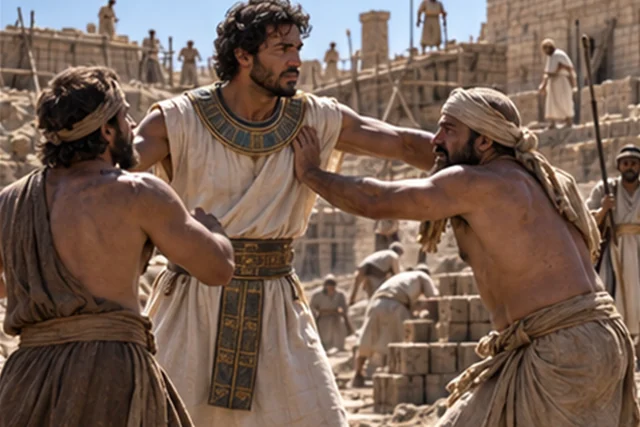
The promised time draws near under conditions that look nothing like progress. Israel multiplies, a king arises who does not know Joseph, and children are exposed to death. Moses is preserved inside that crisis and educated within the Egyptian world that dominates his people. At forty he intervenes for an oppressed Israelite, believing his brethren will understand that God is giving deliverance through him. They do not. The next day, when he tries to reconcile two Israelites, the question comes back at him: “Who made thee a ruler and a judge over us?” Stephen is storing that sentence for later. The Book of Acts does not turn Moses' first attempt into a smooth early chapter of inevitable leadership. Rejection sends him into Midian as a stranger, where years pass before God's commission arrives. The distance between what Moses supposes his people will recognize and what they actually recognize is central to Stephen's case. A deliverer can be refused before the very people refusing him understand whom God has chosen.
Deep dive
The approach of the promised time coincides with oppression, not an obvious improvement in Israel's circumstances. The people multiply, a different king arises, and children are exposed to death. Moses is preserved within this threat and then raised in the household associated with the power threatening his people. Stephen emphasizes his Egyptian learning and strength in word and deed, details that make his later rejection more pointed.
At forty, Moses intervenes for an oppressed Israelite. Stephen explicitly supplies Moses' supposition: he thinks his brethren will understand that God is giving deliverance through him. They do not. That statement belongs to the speech and is not a license to invent every other feeling Moses may have had. The next day's attempt to reconcile two Israelites meets a direct challenge to his authority.
The question about who made Moses ruler and judge will return almost word for word in verse 35. Stephen is laying down the language he intends to overturn. Moses leaves as a rejected man and lives as a stranger in Midian. The interruption is not a minor detour in a smooth ascent to leadership. It exposes the distance between the people's immediate verdict and the commission God will give.
Words to trace: brethren, Moses, wrong, children, Egyptian, nourished
Verse-by-verse path
- Acts 7:17
The oldest manuscripts read “the promise which God had declared”, homologeo, rather than “sworn”. “Grew and multiplied” is the language of Exodus 1:7, where the fulfilment of the promise to Abraham is already under way in a foreign land.
- Acts 7:18
Exodus 1:8 is quoted exactly, and the oldest manuscripts add “over Egypt”. “Another” is heteros, a king of a different kind, perhaps a new dynasty. With Joseph forgotten, the family’s protection in Egypt ends.
- Acts 7:19
“Dealt subtilly” is katasophizomai, to outwit by cunning, the verb Pharaoh uses in the Greek of Exodus 1:10: “let us deal wisely with them”. “Cast out” suggests exposure, the Greco-Roman practice of abandoning unwanted infants, though Pharaoh’s order was to throw the boys into the Nile (Exodus 1:22).
- Acts 7:20
“Exceeding fair” is literally “fair to God”, a Hebrew way of forming a superlative, or else “beautiful in God’s sight”. Exodus 2:2 calls him “a goodly child” and Hebrews 11:23 “a proper child”, fine in appearance. Three months is as long as his mother could hide him.
- Acts 7:21
“Took him up” is anaireo, which in Greek papyri can mean lifting up an exposed child and adopting it. Exodus says “he became her son” (Exodus 2:10). Josephus gives the princess a name, Thermuthis; the Book of Jubilees calls her Tharmuth.
- Acts 7:22
Exodus says nothing of Moses’ education. Philo describes Egyptian tutors teaching him arithmetic, geometry, music and the hieroglyphs. “Mighty in words” sits oddly beside Moses’ own protest that he was “slow of speech, and of a slow tongue” (Exodus 4:10); Stephen may mean his writings.
- Acts 7:23
Exodus gives no age here. Dividing Moses’ 120 years (Deuteronomy 34:7) into three forties, in Egypt, in Midian and in the wilderness, is found in later Jewish tradition too. “Visit” is episkeptomai, the verb of God visiting his people (Luke 1:68; 7:16).
- Acts 7:24
“Avenged” is literally “did justice for”. Exodus 2:12 adds that Moses “looked this way and that way” and hid the body in the sand. Stephen leaves out the furtiveness and tells only the defence of the oppressed.
- Acts 7:25
Nothing in Exodus says what Moses supposed; this sentence is Stephen’s own reading of the event. “By his hand” is a Hebrew way of speaking of agency, and it returns in verse 35, where God sends Moses “by the hand of the angel”.
- Acts 7:26
“Set them at one again” is how the King James renders synallasso, to reconcile. The English phrase “at one” is the root of the word “atonement”, at-one-ment. Stephen also gives Moses words not in Exodus 2:13: “Sirs, ye are brethren.”
- Acts 7:27
“Thrust him away” is aposato, and the same verb returns in verse 39 for the whole people: “our fathers... thrust him from them”. The one man who shoved Moses aside in a quarrel becomes a picture of the nation.
- Acts 7:28
The question is quoted word for word from the Greek of Exodus 2:14. It tells Moses that what he did in secret is known, and Exodus adds the consequence: “Moses feared, and said, Surely this thing is known.” “Diddest” is an old form of “didst”.
- Acts 7:29
“Stranger” is paroikos, the resident alien, the word of verse 6 for Abraham’s seed in a foreign land. Moses named his first son Gershom, saying “I have been a stranger in a strange land” (Exodus 2:22). The two sons are Gershom and Eliezer (Exodus 18:3-4).
Acts 7:17-29
King James Version17But when the time of the promise drew nigh, which God had sworn to Abraham, the people grew and multiplied in Egypt,
18Till another king arose, which knew not Joseph.
19The same dealt subtilly with our kindred, and evil entreated our fathers, so that they cast out their young children, to the end they might not live.
20In which time Moses was born, and was exceeding fair, and nourished up in his father’s house three months:
21And when he was cast out, Pharaoh’s daughter took him up, and nourished him for her own son.
22And Moses was learned in all the wisdom of the Egyptians, and was mighty in words and in deeds.
23And when he was full forty years old, it came into his heart to visit his brethren the children of Israel.
24And seeing one of them suffer wrong, he defended him, and avenged him that was oppressed, and smote the Egyptian:
25For he supposed his brethren would have understood how that God by his hand would deliver them: but they understood not.
26And the next day he shewed himself unto them as they strove, and would have set them at one again, saying, Sirs, ye are brethren; why do ye wrong one to another?
27But he that did his neighbour wrong thrust him away, saying, Who made thee a ruler and a judge over us?
28Wilt thou kill me, as thou diddest the Egyptian yesterday?
29Then fled Moses at this saying, and was a stranger in the land of Madian, where he begat two sons.
Acts 7:30-43
Holy Ground in the Wilderness
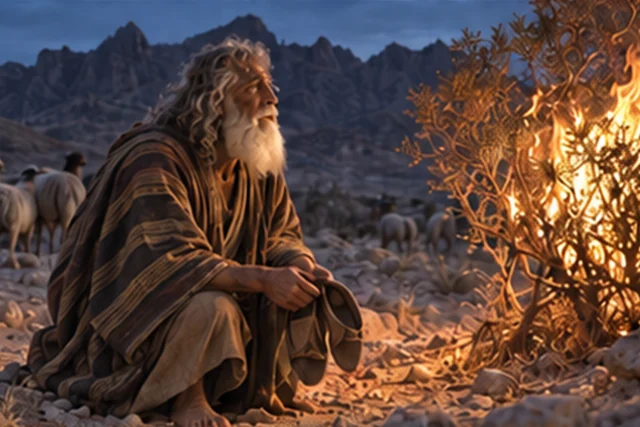
Stephen places holy ground in the wilderness, where no Jerusalem temple stands and Moses himself is a long-displaced shepherd. The holiness comes from God's presence, not from an impressive building. There God names himself as the God of Abraham, Isaac, and Jacob, declares that he has seen Israel's suffering, and sends the very Moses once rejected as ruler and judge. “This Moses” becomes ruler and deliverer, performs wonders, receives living oracles, and speaks of the prophet to come. The speech honors Moses rather than belittling him. That makes Israel's later refusal more serious, not less. Their hearts turn back toward Egypt, they make the calf, and they rejoice in what their own hands have made. Amos then gives Stephen language for a deeper history of idolatry ending in exile. The Book of Acts uses the wilderness to join two themes: God is free to make ground holy wherever he reveals himself, and possession of divine words does not guarantee that the people entrusted with them will obey.
Deep dive
Another forty years pass before the burning bush. Stephen now locates "holy ground" in a wilderness, not in the Jerusalem sanctuary. The ground is holy because God makes himself known there. The God named is the God of Abraham, Isaac, and Jacob, and his declared purpose is to deliver the people whose affliction he has seen. Stephen's geographical argument and his argument about rejected deliverers meet in the same scene.
"This Moses" and "the same" drive the reversal. The man refused as ruler is the man God sends as ruler and deliverer. He also receives living oracles and speaks of the prophet to come. The KJV's "church in the wilderness" refers here to Israel's gathered congregation, not to a claim that every later church arrangement already existed at Sinai. Stephen honors Moses' commission and the divine words entrusted to him.
The refusal nevertheless continues. The people's hearts turn back toward Egypt, and they rejoice in what their own hands have made. Amos 5:25–27 then supplies a prophetic judgment on idolatry, quoted here in a form ending with exile beyond Babylon. The speech is not saying that possession of worship practices guarantees fidelity. It is tracing how people entrusted with God's words can replace obedience with objects they control.
Words to trace: Egypt, Moses, Lord, wilderness, angel, fathers
Verse-by-verse path
- Acts 7:30
Exodus 3:1 calls the mountain Horeb; Stephen uses Sinai, the name of the mountain of the Law, as Exodus itself does later. “An angel of the Lord in a flame of fire in a bush” follows the Greek of Exodus 3:2 closely.
- Acts 7:31
“Sight” is horama, the word the Book of Acts later uses for the visions of Peter and Paul (10:17; 16:9). “Drew near to behold” is katanoeo, to look closely and study, the look of a man inspecting something strange. Only then does the voice come.
- Acts 7:32
“Trembled” is entromos, the word used later of the jailer at Philippi who came in “trembling” (16:29). In Exodus the command to take off his shoes comes before God names himself (Exodus 3:5-6); Stephen reverses the order, putting the name of the fathers’ God first.
- Acts 7:33
Joshua receives the same command from the captain of the LORD’s host outside Jericho (Joshua 5:15). Jewish tradition held that the priests ministered barefoot in the temple. Stephen, accused of speaking against the holy place, uses the word “holy” first of a patch of desert.
- Acts 7:34
“I have seen, I have seen” imitates a Hebrew idiom, the verb doubled for emphasis, “seeing I have seen” (Exodus 3:7). “Am come down” is the language of God coming down at Babel (Genesis 11:5) and at Sinai (Exodus 19:20).
- Acts 7:35
“Deliverer” is lytrotes, redeemer, one who pays a ransom, a word used nowhere else in the New Testament. The Greek Psalter uses it of God, “my strength, and my redeemer” (Psalm 19:14). On the Emmaus road the disciples had said “we trusted that it had been he which should have redeemed Israel” (Luke 24:21).
- Acts 7:36
The “Red sea” is the Greek name; the Hebrew is yam suph, sea of reeds. The wonders and signs of Moses answer the “miracles and wonders and signs” Peter ascribed to Jesus (2:22) and the wonders Stephen himself was doing (6:8).
- Acts 7:37
The oldest manuscripts end the quotation at “like unto me” and lack “him shall ye hear”. The Greek repeats houtos, “this one”, at the head of verses 35, 36, 37 and 38, a hammering rhetorical pattern: this Moses, this man, this is he.
- Acts 7:38
“Lively” in 1611 meant living, as in the “lively stones” of 1 Peter 2:5; the Greek is logia zonta, living oracles. Paul says the Jews were entrusted with “the oracles of God” (Romans 3:2). Stephen speaks of the Law with high honour, answering the charge that he blasphemed it.
- Acts 7:39
At Kadesh the people said “let us make a captain, and let us return into Egypt” (Numbers 14:4). Stephen places the turn in their hearts, before any journey; Egypt stands for a return to what they knew. “Would not obey” is literally “would not become obedient”.
- Acts 7:40
The words are Exodus 32:1. Aaron made one calf, yet the people ask for “gods”, plural; the Hebrew elohim can be either, and the Greek chooses the plural. When Nehemiah retells the moment the people say “This is thy God” (Nehemiah 9:18). “This Moses” is contemptuous.
- Acts 7:41
“Made a calf” is a single Greek verb, moschopoieo, calf-making, a word not found in any earlier Greek writing, perhaps coined for this sentence. The idol and the festivity are one action in Exodus 32:6: “they sat down to eat and to drink, and rose up to play.”
- Acts 7:42
“Gave them up” is paradidomi, the verb of Paul’s refrain in Romans 1:24-28, “God gave them up”. Worship of “the host of heaven”, the stars, was forbidden in Deuteronomy 4:19 and practised under Manasseh (2 Kings 21:3). “The book of the prophets” is the scroll of the Twelve minor prophets, counted as one book.
- Acts 7:43
In Amos 5:26 the Hebrew names are Sikkuth and Kiyyun, the second probably Kaiwan, an Assyrian name for the planet Saturn. The Greek translation turned them into “Moloch” and “Rephan”, and Stephen quotes the Greek. Amos says “beyond Damascus”; the speech has “beyond Babylon”, looking to the later exile.
Acts 7:30-43
King James Version30And when forty years were expired, there appeared to him in the wilderness of mount Sina an angel of the Lord in a flame of fire in a bush.
31When Moses saw it, he wondered at the sight: and as he drew near to behold it, the voice of the Lord came unto him,
32Saying, I am the God of thy fathers, the God of Abraham, and the God of Isaac, and the God of Jacob. Then Moses trembled, and durst not behold.
33Then said the Lord to him, Put off thy shoes from thy feet: for the place where thou standest is holy ground.
34I have seen, I have seen the affliction of my people which is in Egypt, and I have heard their groaning, and am come down to deliver them. And now come, I will send thee into Egypt.
35This Moses whom they refused, saying, Who made thee a ruler and a judge? the same did God send to be a ruler and a deliverer by the hand of the angel which appeared to him in the bush.
36He brought them out, after that he had shewed wonders and signs in the land of Egypt, and in the Red sea, and in the wilderness forty years.
37This is that Moses, which said unto the children of Israel, A prophet shall the Lord your God raise up unto you of your brethren, like unto me; him shall ye hear.
38This is he, that was in the church in the wilderness with the angel which spake to him in the mount Sina, and with our fathers: who received the lively oracles to give unto us:
39To whom our fathers would not obey, but thrust him from them, and in their hearts turned back again into Egypt,
40Saying unto Aaron, Make us gods to go before us: for as for this Moses, which brought us out of the land of Egypt, we wot not what is become of him.
41And they made a calf in those days, and offered sacrifice unto the idol, and rejoiced in the works of their own hands.
42Then God turned, and gave them up to worship the host of heaven; as it is written in the book of the prophets, O ye house of Israel, have ye offered to me slain beasts and sacrifices by the space of forty years in the wilderness?
43Yea, ye took up the tabernacle of Moloch, and the star of your god Remphan, figures which ye made to worship them: and I will carry you away beyond Babylon.
Acts 7:44-50
A House That Cannot Contain Its Maker
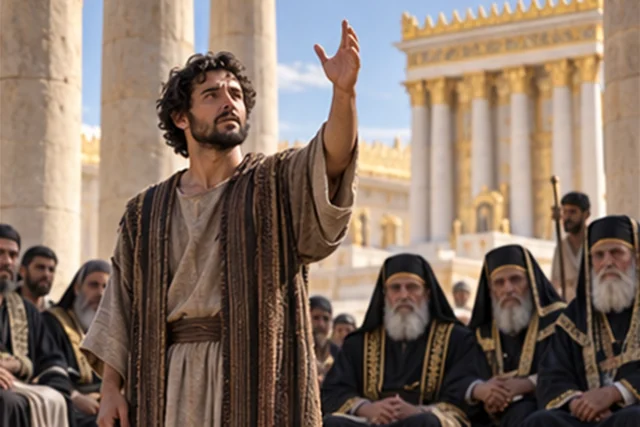
Stephen does not win his argument by dismissing the tabernacle or temple as mistakes. The tabernacle has a God-given pattern, Israel carries it through the wilderness and into the land, David desires a dwelling place, and Solomon builds the house. The distinction comes after all of that: “the most High dwelleth not in temples made with hands.” A place can be appointed for worship without becoming a container that limits the God who appointed it. Isaiah supplies the scale, with heaven as God's throne, earth as his footstool, and everything as the work of his hand. That language also lands sharply after Stephen has described idolatry as delighting in works made by human hands. The Book of Acts will not let the temple be reduced to an idol, but it will not let reverence for the temple become a claim that God can be possessed by architecture. Even the KJV's “Jesus” in this paragraph refers to Joshua, keeping the historical sequence clear rather than importing Jesus of Nazareth into Joshua's human role.
Deep dive
The defense does not describe the tabernacle as an unauthorized mistake. God commands its pattern, it accompanies the people, and David finds favor before Solomon builds the house. Stephen's distinction is between a place appointed for worship and a place imagined to confine God. The first is acknowledged; the second is denied.
The KJV's "Jesus" in verse 45 refers to Joshua, who brought the fathers into the land. The shared Greek form of the names accounts for the wording. It does not move Jesus of Nazareth into the conquest account as its human commander. This small clarification prevents an unnecessary confusion at the very point where Stephen is tracing successive stages of Israel's history.
Isaiah 66:1–2 supplies the decisive scale: heaven as throne, earth as footstool, and everything made by God's hand. Stephen has just described idolatry as rejoicing in the work of human hands. The language now prevents the temple itself from being treated as an object that secures possession of God. The God who gave the pattern is not reduced to the building constructed from it.
Words to trace: fathers, house, tabernacle, appointed, build, built
Verse-by-verse path
- Acts 7:44
“Tabernacle of witness” is skene tou martyriou, the Greek Old Testament’s name for the tent of meeting, and it puts “witness” at the centre of Israel’s worship in a book about witnesses (1:8). “Fashion” is typos, the pattern shown on the mountain (Exodus 25:40), which Hebrews 8:5 also quotes.
- Acts 7:45
“That came after” is diadexamenoi, having received it in succession, the tent handed down from the wilderness generation to the next like an heirloom. “The Gentiles” are the nations of Canaan. The tabernacle travelled for centuries; it was never a fixed address for God.
- Acts 7:46
The wording comes from Psalm 132:5, David’s vow “until I find out a place for the LORD, an habitation for the mighty God of Jacob”. The oldest manuscripts read “a dwelling for the house of Jacob”, a harder reading that scribes seem to have smoothed into “the God of Jacob”.
- Acts 7:47
The shortest line of the speech, six words. At the dedication of this same house Solomon himself prayed: “the heaven and heaven of heavens cannot contain thee; how much less this house that I have builded?” (1 Kings 8:27). Stephen’s point had been made first by the builder.
- Acts 7:48
“Made with hands”, cheiropoietos, is almost a technical word for idols in the Greek Old Testament (Leviticus 26:1; Isaiah 46:6). At Jesus’ trial false witnesses accused him of threatening “this temple that is made with hands” (Mark 14:58). Paul will say the same to the Athenians in 17:24.
- Acts 7:49
Isaiah 66:1 comes from the last chapter of Isaiah, spoken to people rebuilding after the exile. “The place of my rest” pushes against Psalm 132:14, which says of Zion, “This is my rest for ever.” The prophet and the psalm stand in tension, and Stephen quotes the prophet.
- Acts 7:50
Isaiah 66:2 states it: “all those things hath mine hand made.” Stephen turns it into a question, “Hath not my hand made all these things?” The speech has now set God’s one hand, which made everything, against human hands, which made the calf (verse 41) and the house (verse 48).
Acts 7:44-50
King James Version44Our fathers had the tabernacle of witness in the wilderness, as he had appointed, speaking unto Moses, that he should make it according to the fashion that he had seen.
45Which also our fathers that came after brought in with Jesus into the possession of the Gentiles, whom God drave out before the face of our fathers, unto the days of David;
46Who found favour before God, and desired to find a tabernacle for the God of Jacob.
47But Solomon built him an house.
48Howbeit the most High dwelleth not in temples made with hands; as saith the prophet,
49Heaven is my throne, and earth is my footstool: what house will ye build me? saith the Lord: or what is the place of my rest?
50Hath not my hand made all these things?
Acts 7:51-53
The Accused Becomes the Accuser
The defense turns into an indictment with almost no transition. Stephen moves from “our fathers” to “your fathers” and accuses his hearers of continuing the same resistance traced through the speech. “Uncircumcised in heart and ears” takes covenant vocabulary and aims it at people who possess the outward mark but refuse to hear. The charge is not a rejection of Israel's Scriptures or ancestry. Stephen has just spent the entire defense arguing from them. That shared ground is what makes the accusation bite. Prophets were persecuted, those who announced the Just One were killed, and now Stephen charges this council with betraying and murdering the one they announced. The final sentence answers the original accusation about the law by reversing it: his hearers received the law and did not keep it. The Book of Acts directs these words at the people confronting Stephen in this hearing. It gives no warrant for detaching the indictment from that setting and applying it indiscriminately to Jewish people as a whole.
Deep dive
The address turns from "our fathers" to "your fathers" as Stephen presses the connection between earlier persecution and the present hearing. "Uncircumcised in heart and ears" uses the language of covenant identity to expose resistance within those who possess its outward mark. The accusation concerns refusal to hear and obey, not a new biological definition of belonging.
Stephen calls Jesus the Just One and places the council's betrayal and killing of him at the culmination of resistance to the prophets who announced his coming. His final charge answers the original allegation concerning the law: the hearers received it but did not keep it. These are accusations directed at the people confronting Stephen in this hearing. They should not be detached from that setting and converted into a claim about every Jewish person. Stephen himself speaks from within Israel's Scriptures and ancestry. The force of his indictment depends on that shared ground.
Words to trace: fathers, always, angels, betrayers, coming, disposition
Verse-by-verse path
- Acts 7:51
“Stiffnecked” is the word God used of Israel at the golden calf: “thou art a stiffnecked people” (Exodus 33:5), so it follows the calf of verse 41 exactly. “Uncircumcised... ears” comes from Jeremiah 6:10: “their ear is uncircumcised, and they cannot hearken.”
- Acts 7:52
Jewish tradition held that Isaiah was sawn in two under Manasseh (compare Hebrews 11:37), and 2 Chronicles 24:21 tells of Zechariah son of Jehoiada stoned in the court of the temple, a precedent pointed enough here. “Betrayers” is prodotai, the word Luke 6:16 uses of Judas, “which also was the traitor”.
- Acts 7:53
The belief that angels mediated the Law at Sinai rests on texts like Deuteronomy 33:2, where the Greek has angels at God’s right hand, and it appears in Galatians 3:19 and Hebrews 2:2. “Disposition” means arrangement or ordinance, the Law as delivered through intermediaries.
Acts 7:51-53
King James Version51Ye stiffnecked and uncircumcised in heart and ears, ye do always resist the Holy Ghost: as your fathers did, so do ye.
52Which of the prophets have not your fathers persecuted? and they have slain them which shewed before of the coming of the Just One; of whom ye have been now the betrayers and murderers:
53Who have received the law by the disposition of angels, and have not kept it.
Acts 7:54-60
A Prayer Survives the Stones
The council's rage and Stephen's vision happen in the same room at the same time, producing two completely different verdicts on Jesus. Below, Stephen is being rejected and rushed toward death. Above, he sees the glory of God and Jesus standing at God's right hand. The Book of Acts does not tell the reader exactly why Jesus is standing, despite later suggestions of welcome, witness, or readiness to act. It leaves the posture vivid without inventing an explanation. Stephen then says what he sees, and the men who have just been accused of being uncircumcised in ears physically stop their ears before rushing him. Saul appears for the first time beside the garments of the witnesses, introduced within the killing he will later remember. Stephen's final agency is prayer. He entrusts his spirit to the Lord Jesus and asks that the sin not be laid to his killers' charge. The stones remain brutal; “fell asleep” does not make them gentle. His last words outlast the violence inflicted on him.
Deep dive
The council's rage and Stephen's vision occupy the same moment. He looks into heaven and sees God's glory and Jesus standing at God's right hand. Explanations for the standing posture include welcome, witness, and readiness to act, but Acts does not specify one. The contrast it does make plain is between the earthly condemnation unfolding below and the heavenly position of the one Stephen confesses.
Those attacking him stop their ears after his charge that they are uncircumcised in ears. The physical action gives the accusation a dreadful immediate form. Their witnesses place garments at Saul's feet, introducing him within Stephen's death rather than in a separate biographical notice. No formal verdict is quoted. The movement from hearing to collective violence is the event Acts chooses to show.
Stephen's final prayers echo Jesus' death in Luke 23:34, 46: entrusting the spirit and seeking forgiveness for those responsible. Stephen addresses the Lord Jesus, and Acts closes with the language of falling asleep after plainly describing a killing. That language does not soften the stones into something harmless. It leaves his final agency in the prayers he speaks rather than in the violence others inflict.
Words to trace: cried, hand, Jesus, Lord, loud, right
Verse-by-verse path
- Acts 7:54
Gnashing teeth is the posture of the wicked against the righteous in the Psalms: “they gnashed upon me with their teeth” (Psalm 35:16; compare 37:12 and Job 16:9). The Greek imperfect pictures a continued grinding, rage that has lost the power of speech.
- Acts 7:55
The speech opened with “the God of glory” appearing to Abraham (verse 2), and it ends with Stephen seeing “the glory of God”. The first and last things in his account are God’s glory showing itself outside the temple, first in Mesopotamia and now in a council chamber.
- Acts 7:56
Outside the Gospels, this is the only place in the New Testament where Jesus is called “the Son of man” with the definite article, and the only time anyone but Jesus himself uses the full title of him. Before this same council Jesus had said, “Hereafter shall the Son of man sit on the right hand of the power of God” (Luke 22:69). The heavens also opened at Jesus’ baptism (Luke 3:21).
- Acts 7:57
“With one accord” is homothymadon, the word the Book of Acts has used for the believers’ unity in prayer (1:14; 2:46; 4:24). Here the same unanimity drives a mob. Both sides cry “with a loud voice”: the council here, Stephen in verse 60.
- Acts 7:58
The Law required the condemned to be taken outside the camp (Leviticus 24:14), and the witnesses’ hands were to be the first against him (Deuteronomy 17:7); they strip off their outer cloaks to throw. “Young man” is neanias, used of men up to about forty, so Saul could be anywhere from his twenties upward.
- Acts 7:59
In the King James “God” is printed in italics: the Greek says only that Stephen was “calling upon and saying”, and the one he calls on is “Lord Jesus”. Peter quoted Joel at Pentecost, “whosoever shall call on the name of the Lord shall be saved” (2:21), and Stephen dies doing exactly that.
- Acts 7:60
Jewish prayer was normally made standing; Luke notes kneeling at moments of great urgency (Luke 22:41; Acts 9:40; 20:36). “Lay not this sin to their charge” is literally “do not make this sin stand against them”, the verb histemi, as a debt entered in a ledger.
Acts 7:54-60
King James Version54When they heard these things, they were cut to the heart, and they gnashed on him with their teeth.
55But he, being full of the Holy Ghost, looked up stedfastly into heaven, and saw the glory of God, and Jesus standing on the right hand of God,
56And said, Behold, I see the heavens opened, and the Son of man standing on the right hand of God.
57Then they cried out with a loud voice, and stopped their ears, and ran upon him with one accord,
58And cast him out of the city, and stoned him: and the witnesses laid down their clothes at a young man’s feet, whose name was Saul.
59And they stoned Stephen, calling upon God, and saying, Lord Jesus, receive my spirit.
60And he kneeled down, and cried with a loud voice, Lord, lay not this sin to their charge. And when he had said this, he fell asleep.
Questions to keep in mind while reading
- Track who acts, who speaks, who is affected, and what changes.
- Notice repeated promises, failures, rescues, and consequences.
- Do not assume the account approves every action that is reported.
Text first
Where readers differ
The chapter summary begins with what the passage says and how its parts fit together. It does not assume one denomination has already settled every question. Where a conclusion depends on a tradition, literary theory, or historical reconstruction, that dependence is named openly.
The KJV text is presented first. Interpretive conclusions are labeled, and differences are introduced only when they help a reader understand why serious communities do not always reach the same answer.
Comparative interpretive notes for this chapter are in preparation. Until reviewed notes are ready, this page separates the KJV text from summary and application without claiming that serious readers agree on every question.
Questions beneath the surface
- What account of God, human freedom, responsibility, and the good life emerges from Acts 7?
- Which tension does the chapter refuse to resolve quickly?
- What changes when the chapter is read as part of the whole canon rather than as an isolated moral lesson?
- Where might a sincere reader confuse a familiar tradition with something the text states directly?
Questions for serious personal contemplation
These open-ended questions make room for tension, honest response, prayer, and conclusions that remain accountable to the chapter.
Observe without rushing
What part of Acts 7 makes you stop, feel unsettled, or feel surprised, and why?
Which detail in the passage would be easiest to overlook? How does that detail change your understanding?
Where do you see tension between what happens and this focus: Acts 7 develops its own movement around fathers, Egypt, Moses, land, Jacob?
What important question does the passage leave open instead of resolving quickly?
Examine your inner life honestly
Which person, response, fear, or desire in the passage feels most like your own life right now?
What assumption about God, other people, or yourself does this text challenge?
Which part would you rather soften, avoid, or explain away too quickly? What might that reaction reveal?
If this Scripture could ask you one direct question, what do you think it would ask?
Respond with wisdom and courage
What do you need to remember, confess, grieve, thank God for, or trust after reading this passage?
How might another faithful person read this situation differently without ignoring the text?
What obedient response would be costly, uncomfortable, or slow, yet still faithful to Scripture?
What question will you carry into prayer this week, and which verses will you keep in front of you?
Music and video connected to the passage
Related media appears when its Scripture reference overlaps this study. Music and video can illuminate a theme while the biblical text remains the foundation.